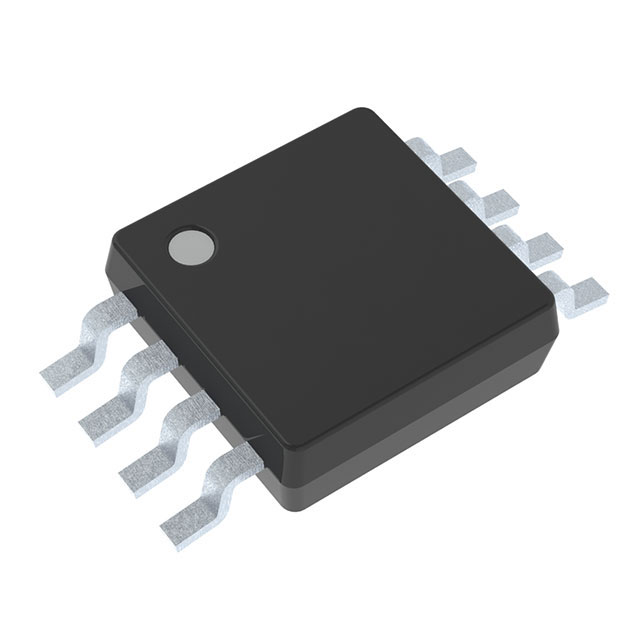
Key Specs
| Spec | Value | Condition | Source |
|---|---|---|---|
| Clock Sync | No | Digi-Key | |
| Control Features | Frequency Control | Digi-Key | |
| Duty Cycle (Max) | 96% | Digi-Key | |
| Function | Step-Up, Step-Down, Step-Up/Step-Down | Digi-Key | |
| Mounting Type | Surface Mount | Digi-Key | |
| Number Of Outputs | 1 | Digi-Key | |
| Operating Temperature Range | -40°C ~ 85°C (TA) | Digi-Key | |
| Output Configuration | Positive, Isolation Capable | Digi-Key | |
| Output Phases | 1 | Digi-Key | |
| Output Type | Transistor Driver | Digi-Key | |
| Package Case | 8-TSSOP, 8-MSOP (0.118”, 3.00mm Width) | Digi-Key | |
| Serial Interfaces | - | Digi-Key | |
| Supplier Device Package | 8-MSOP | Digi-Key | |
| Supply Voltage (Typ) | 7.6V ~ 20V | Digi-Key | |
| Switching Frequency (Typ) | 500kHz | Digi-Key | |
| Synchronous Rectifier | Yes | Digi-Key | |
| Topology | Boost, Buck, Flyback, Forward Converter | Digi-Key |
When To Use
Use the MIC38C43BMM TR in applications requiring a single-output DC-DC converter with flexible topology support (Boost, Buck, Flyback, Forward) and synchronous rectification for improved efficiency. Ideal scenarios include battery-powered systems or industrial power supplies operating within the supply voltage range of 7.6 V to 20 V, and where a high duty cycle of up to 96% is beneficial for wide output voltage range. Its surface-mount 8-TSSOP or 8-MSOP package suits compact designs needing positive output configuration with isolation capability.
Do not use this device in multi-output power supply designs or where clock synchronization is mandatory, as it lacks clock synchronization capability. For applications requiring multi-phase outputs or digital serial interfaces, consider alternative devices with those features.
When Not To Use
-
>10A output current from 12V bus: The MIC38C43BMM TR is limited to single-phase, moderate current output and cannot handle heavy loads without overheating or instability. Use a high-current synchronous buck with external FETs for scalable current capacity and efficiency.
-
Battery-powered sensor needing μA standby current: Quiescent current is not specified at μA-level, and switching losses at 500kHz are non-negligible. Use a low-IQ PFM buck to avoid battery drain during sleep.
-
Very low input-to-output voltage differential, e.g. 3.3V in to 3V out: The minimum dropout at high load and switching losses make it inefficient and noisy in this range. Use an LDO regulator to meet low noise and low differential voltage requirements.
Application Notes
The switching node connected to the internal transistor driver switches at the typical frequency of 500 kHz and requires the smallest possible loop area to minimize EMI and switching losses. Careful PCB layout is critical around this node.
The feedback pin is noise-sensitive and must be routed away from noisy switching signals and high-current loops to ensure accurate voltage regulation.
Due to the device’s integrated synchronous rectifier and efficient topology support, a heatsink is generally not required under typical operating conditions within the supply voltage range of 7.6 V to 20 V and ambient temperature range of -40°C to 85°C. However, thermal considerations should be evaluated based on load current and PCB thermal management.
Gotchas
-
Mistake: Operating the converter beyond the maximum duty cycle of 96%.
Failure Mode: The device may enter into saturation or erratic switching behavior, leading to output voltage instability or damage to the internal transistor driver.
Fix: Ensure the design maintains the duty cycle below 96% under all load and line conditions by proper component selection and feedback loop design. -
Mistake: Using inductors or capacitors that cannot handle the 500 kHz switching frequency or the supply voltage range of 7.6 V to 20 V.
Failure Mode: Excessive losses, overheating, or premature component failure, resulting in reduced efficiency and reliability.
Fix: Select inductors and capacitors rated for the specified switching frequency and voltage range, with low ESR and appropriate ripple current ratings. -
Mistake: Neglecting to minimize the switching node loop area.
Failure Mode: Increased electromagnetic interference (EMI) and noise coupling into sensitive nodes, degrading performance and potentially causing malfunction.
Fix: Layout the PCB to keep the loop area of the switching node as small as possible and separate noise-sensitive pins from high-current paths.