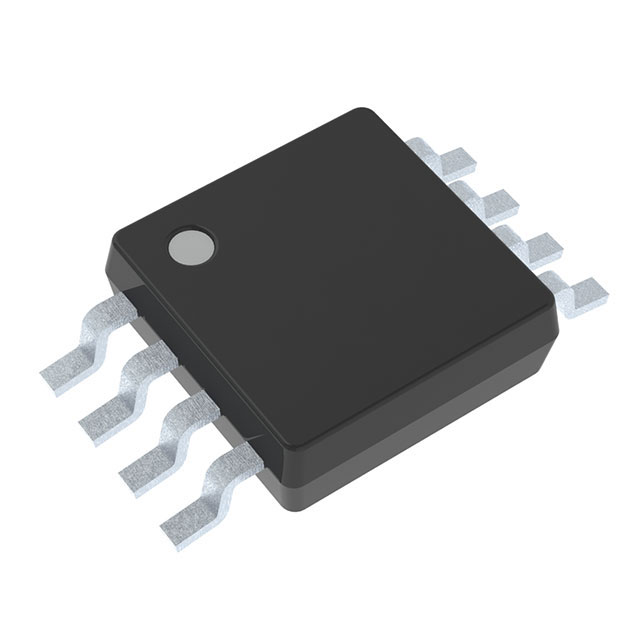
MIC38C43BMM TR vs CSD95377Q4M: Component Comparison for Power Electronics Engineers
1. Quick verdict
For integrated DC-DC controller IC applications requiring flexible topologies (boost, buck, flyback, forward) and isolated outputs, the MIC38C43BMM TR is the better choice due to its built-in control features and synchronous rectification capability. Conversely, for high-current, synchronous buck converter half-bridge MOSFET driver applications with tight switching frequency requirements up to 2 MHz and demanding thermal environments, the CSD95377Q4M excels as a discrete power MOSFET half-bridge solution.
2. Spec comparison table
| Spec | MIC38C43BMM TR | CSD95377Q4M | Notes |
|---|---|---|---|
| Function | Step-Up, Step-Down, Step-Up/Step-Down | Half Bridge Driver for synchronous buck | MIC38C43BMM TR is a controller IC; CSD95377Q4M is a power MOSFET device; fundamentally different roles. |
| Topology | Boost, Buck, Flyback, Forward | Synchronous Buck Converters | MIC38C43BMM TR supports multiple topologies; CSD95377Q4M optimized for synchronous buck only. |
| Output configuration | Positive, Isolation Capable | Half Bridge | MIC38C43BMM TR supports isolated outputs; CSD95377Q4M is half-bridge MOSFET pair. |
| Number of outputs | 1 | N/A (MOSFET half-bridge) | MIC38C43BMM TR has a single transistor driver output; CSD95377Q4M is a dual MOSFET device. |
| Control features | Frequency Control | PWM interface | MIC38C43BMM TR controls switching frequency internally; CSD95377Q4M expects external PWM. |
| Switching frequency (typical) | 500 kHz | 2 MHz | CSD95377Q4M supports much higher switching frequencies, suitable for high-frequency designs. |
| Maximum duty cycle | 96% | N/A | MIC38C43BMM TR supports very high duty cycle; CSD95377Q4M is a MOSFET, duty cycle depends on controller. |
| Synchronous rectifier | Yes | N/A | MIC38C43BMM TR includes synchronous rectification; CSD95377Q4M is the MOSFET stage for synchronous operation. |
| Supply voltage range | 7.6 V to 20 V | 4.5 V to 5.5 V | MIC38C43BMM TR supports wider supply voltage; CSD95377Q4M limited to low-voltage gate drive. |
| Maximum load voltage | N/A | 16 V (max) | CSD95377Q4M power MOSFET max voltage rating important for buck converter input. |
| Rated continuous current | N/A | 30 A (min), 35 A (typ, max) | CSD95377Q4M can handle high current loads; MIC38C43BMM TR is a controller, not rated for current. |
| Peak output current | N/A | 70 A (min) | CSD95377Q4M supports high transient currents. |
| Operating temperature range | -40°C to 85°C (TA) | -40°C to 150°C (TJ) | CSD95377Q4M supports higher junction temperature, suitable for harsher thermal environments. |
| Package | 8-MSOP / 8-TSSOP | 8-VSON (3.5x4.5 mm) | MIC38C43BMM TR smaller footprint; CSD95377Q4M uses power-optimized VSON package. |
| Mounting type | Surface Mount | Surface Mount | Both surface mount, but different package types and sizes. |
| Quiescent/standby current | N/A | 1 µA / 130 µA (typical) | CSD95377Q4M has low quiescent and standby current; MIC38C43BMM TR datasheet does not specify. |
| Power dissipation max | N/A | 8 W | CSD95377Q4M rated for high power dissipation; MIC38C43BMM TR power dissipation depends on application. |
| Features | Isolation capable, synchronous rectification | Bootstrap circuit, diode emulation, half-bridge MOSFET | MIC38C43BMM TR supports isolated outputs and synchronous rectification; CSD95377Q4M integrates bootstrap and diode emulation for efficient half-bridge switching. |
| Logic interface | No serial interface | PWM input | MIC38C43BMM TR no digital interface; CSD95377Q4M expects PWM logic input signals. |
| Thermal resistance (junction-to-board) | N/A | 2.5 °C/W (min) | CSD95377Q4M package optimized for thermal conduction. |
| PCB footprint area (typical) | 3.00 mm width (8-MSOP) | 3.5 mm x 4.5 mm (VSON) | CSD95377Q4M larger but optimized for power handling. |
| Load type | N/A | Inductive | CSD95377Q4M designed specifically for inductive loads in synchronous buck converters. |
| Switching node distance advice | N/A | Minimize node length between MOSFETs | CSD95377Q4M requires careful layout to reduce switching losses and EMI. |
| Voltage to pin max | N/A | 20 V | CSD95377Q4M pin voltage rating important for robust design. |
| Bootstrap capacitor value | N/A | 100 nF (typical) | CSD95377Q4M requires external bootstrap capacitor for high-side MOSFET gate drive. |
3. Design trade-offs
The MIC38C43BMM TR is a multifunction DC-DC controller IC designed to support a wide range of topologies (boost, buck, flyback, forward) with integrated synchronous rectification and isolation capability. Its ability to internally manage frequency control and provide a transistor driver output simplifies the power stage and reduces external component count, especially beneficial in isolated power supply designs. However, its typical switching frequency is limited to 500 kHz, which may restrict size reduction of passive components compared to higher-frequency designs.
In contrast, the CSD95377Q4M is a discrete half-bridge power MOSFET device optimized for synchronous buck converters operating up to 2 MHz switching frequency. Its very low R_DS(on) and ability to handle continuous currents of up to 35 A (with 70 A peak) make it well-suited for high-current, high-efficiency power stages where thermal management is a key concern. The integrated bootstrap circuit and diode emulation features improve switching efficiency and reduce losses during dead-time, but this part requires an external PWM controller and careful gate drive design.
From a thermal perspective, the CSD95377Q4M’s 8 W maximum power dissipation rating and low junction-to-board thermal resistance (2.5 °C/W) enable it to perform reliably in demanding environments up to 150°C junction temperature. The MIC38C43BMM TR, with a more limited ambient temperature range (-40°C to 85°C), is less suitable for high-temperature applications where power MOSFET junction heating is critical. This difference also reflects the fundamental roles: MIC38C43BMM TR is a controller IC, while CSD95377Q4M is a power MOSFET device designed for robust power delivery.
Layout considerations differ significantly. The MIC38C43BMM TR’s 8-MSOP/8-TSSOP package offers a compact footprint with moderate power handling, whereas the CSD95377Q4M’s 8-VSON package, while larger, is optimized for low parasitic inductances and thermal conduction. The CSD95377Q4M requires careful minimization of switching node lengths and placement of a bootstrap capacitor for reliable high-side gate drive, increasing PCB complexity. MIC38C43BMM TR’s integrated controller reduces such layout constraints but sacrifices the high switching frequency and current handling capacity.
Cost at volume also diverges. The MIC38C43BMM TR integrates control and drive functions, reducing the bill of materials and assembly complexity for multi-topology controllers, potentially lowering system cost in low- to medium-power isolated power supplies. The CSD95377Q4M, as a discrete MOSFET half-bridge, will typically be less expensive per unit but requires complementary controller ICs and additional components, increasing overall system cost, especially in low-volume or less complex designs.
4. Use-case fit
Choose MIC38C43BMM TR when…
- Designing isolated flyback or forward converters where integrated frequency control and synchronous rectification reduce component count.
- Building step-up, step-down, or buck-boost power supplies requiring a single output transistor driver with a supply voltage range from 7.6 V to 20 V.
- Operating in applications with moderate switching frequencies (~500 kHz) and ambient temperatures up to 85°C.
- Needing a compact 8-MSOP or 8-TSSOP footprint for space-constrained designs.
- Avoiding the complexity of discrete MOSF