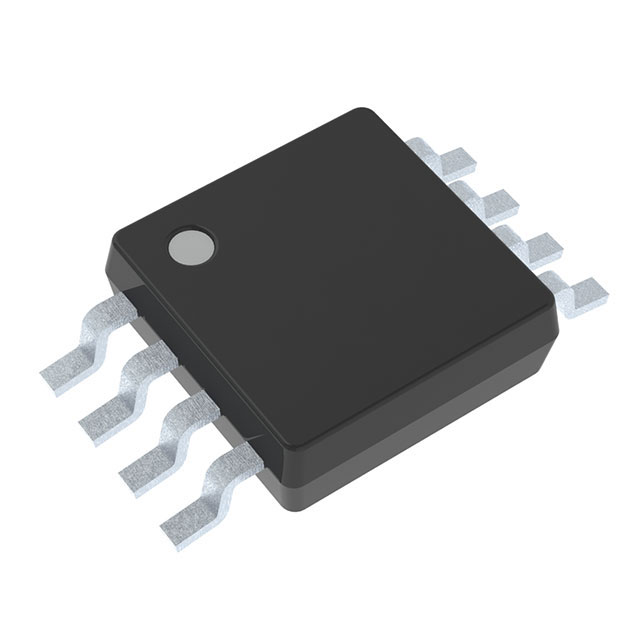
MIC38C43BMM TR vs AOZ5311NQI_2: Component Comparison for Power Electronics Engineers
Note: These parts are in the same general category of DC-DC conversion support ICs but are not direct substitutes. The MIC38C43BMM TR is a versatile DC-DC controller IC supporting multiple topologies (boost, buck, flyback, forward), while the AOZ5311NQI_2 is a half-bridge DrMOS power stage optimized specifically for synchronous buck converters. Their functional roles and application domains differ significantly.
1. Quick verdict
For flexible DC-DC converter designs requiring isolated or non-isolated boost, buck, flyback, or forward topologies with a wide input voltage range (7.6–20 V), the MIC38C43BMM TR is the better choice due to its topology versatility and control features. For high-current synchronous buck applications demanding integrated half-bridge power stages with high peak current capability (up to 120 A pulse) and compact QFN packaging, the AOZ5311NQI_2 outperforms due to its integrated DrMOS design and thermal handling suited to dense power delivery.
2. Spec comparison table
| Spec | MIC38C43BMM TR | AOZ5311NQI_2 | Notes |
|---|---|---|---|
| Function | Step-Up, Step-Down, Step-Up/Step-Down | Half Bridge Driver Synchronous Buck | MIC38C43BMM TR supports more topologies; AOZ5311NQI_2 is specialized for synchronous buck. |
| Topology | Boost, Buck, Flyback, Forward | Synchronous Buck | AOZ5311NQI_2 limited to synchronous buck; MIC38C43BMM TR supports isolated topologies. |
| Output Configuration | Positive, Isolation Capable | Half Bridge | MIC38C43BMM TR supports isolation; AOZ5311NQI_2 is half-bridge power stage only. |
| Number of Outputs | 1 | 1 | Equivalent. |
| Output Type | Transistor Driver | DrMOS half bridge | AOZ5311NQI_2 integrates MOSFETs; MIC38C43BMM TR drives external transistors. |
| Mounting Type | Surface Mount | Surface Mount | Equivalent. |
| Package | 8-MSOP, 8-TSSOP | 31-QFN (5x5 mm) | AOZ5311NQI_2 package larger but includes power MOSFETs; MIC38C43BMM TR is controller only. |
| Supply Voltage Range | 7.6 V – 20 V | 4.5 V – 5.5 V | MIC38C43BMM TR supports higher input voltages; AOZ5311NQI_2 limited to logic-level 5 V. |
| Operating Temperature Range | -40°C to 85°C | -40°C to 125°C | AOZ5311NQI_2 supports higher ambient temperature for harsher environments. |
| Max Junction Temperature | Not specified | 150°C | AOZ5311NQI_2 rated for higher junction temperature, beneficial for thermal margin. |
| Switching Frequency Typical | 500 kHz | 2 MHz | AOZ5311NQI_2 supports much higher switching frequency, enabling smaller passives. |
| Switching Frequency Range | Not specified | 2 MHz (typ) / 200 kHz (min) | AOZ5311NQI_2 frequency range specified; MIC38C43BMM TR frequency range not fully specified. |
| Duty Cycle Max | 96% | Not specified | MIC38C43BMM TR allows very high duty cycle, useful for high step-up ratios. |
| Synchronous Rectifier | Yes | Yes | Both support synchronous rectification. |
| Current Output Channel (typ) | Not specified | 55 A | AOZ5311NQI_2 includes integrated MOSFETs rated for large currents. |
| Current Peak Output (pulse) | Not specified | 120 A (10 µs pulse) | AOZ5311NQI_2 supports very high transient currents, important for dynamic loads. |
| Drain-Source Voltage Max | Not specified | 150 V | AOZ5311NQI_2 MOSFETs can handle high voltage spikes; MIC38C43BMM TR drives external FETs. |
| Driver Supply Voltage Range | 7.6 V – 20 V | 4.5 V – 5.5 V | MIC38C43BMM TR supports higher driver supply voltage. |
| PWM Interface | No clock sync, frequency control | PWM input (2.7 V) | AOZ5311NQI_2 requires PWM input; MIC38C43BMM TR features frequency control without sync. |
| Control Circuit Bias Current | Not specified | 430 µA (typ) | Low bias current in AOZ5311NQI_2 reduces control losses; MIC38C43BMM TR data unavailable. |
| Fault Protection | Not specified | Over Temperature, Shoot-Through, UVLO | AOZ5311NQI_2 integrates fault protection; MIC38C43BMM TR does not specify protection features. |
| ESD Rating | Not specified | 2 kV | AOZ5311NQI_2 includes specified ESD rating. |
| Bootstrap Capacitor Requirements | Not specified | 100 nF min, X7R or X5R ceramics | AOZ5311NQI_2 requires bootstrap capacitor; MIC38C43BMM TR not applicable. |
| Thermal Management | Not specified | Requires inner power plane, thermal relief pads | AOZ5311NQI_2 requires careful PCB thermal design due to high current MOSFETs. |
| Storage Temperature Range | Not specified | -65°C to 150°C | AOZ5311NQI_2 supports wider storage temperature. |
| Package Dimensions | 8-MSOP (~3 mm width) | 5x5 mm QFN | AOZ5311NQI_2 larger footprint but includes power MOSFETs. |
| Logic Thresholds | Not specified | Logic high 2.5–4.0 V, Logic low 0–1.2 V | AOZ5311NQI_2 logic levels specified for interface design. |
| Pull-down Resistance | Not specified | 120 Ω | AOZ5311NQI_2 includes internal pull-down for gate drive control. |
| Zero Cross Detect | Not specified | 0.5 mV threshold, 350 ns blanking | AOZ5311NQI_2 supports diode emulation mode for improved efficiency at light load. |
3. Design trade-offs
The MIC38C43BMM TR and AOZ5311NQI_2 differ fundamentally in their roles and integration level. The MIC38C43BMM TR is a flexible DC-DC controller IC capable of managing multiple topologies, including isolated flyback and forward converters, which are essential in isolated power supplies. This versatility comes at the cost of requiring external MOSFETs or switches, meaning the overall solution size and efficiency depend heavily on the MOSFET selection and PCB layout. Its maximum duty cycle of 96% enables designs requiring high step-up or step-down ratios, but the switching frequency is fixed at 500 kHz, limiting the minimum passive component size compared to higher-frequency solutions.
In contrast, the AOZ5311NQI_2 is a DrMOS half-bridge power stage optimized for synchronous buck converters, integrating both high- and low-side MOSFETs with gate drivers and protection features in a compact 5x5 mm QFN. This integration reduces component count and simplifies layout but restricts the topology to synchronous buck only. Its high switching frequency of 2 MHz allows for smaller inductors and capacitors, critical in space-constrained applications such as VRMs or point-of-load converters. The AOZ5311NQI_2 supports very high peak currents (up to 120 A pulses), which makes it suitable for delivering transient load currents efficiently.
Thermally, the AOZ5311NQI_2 demands careful PCB design with dedicated inner power planes and thermal relief pads to dissipate heat from the integrated MOSFETs. Its maximum junction temperature rating of 150°C and higher ambient temperature range (-40°C to 125°C) allow it to withstand harsher environments than the MIC38C43BMM TR, which is rated only to 85°C ambient and does not specify junction temperature limits. The MIC38C43BMM TR, as a controller, will dissipate far less power but leaves the thermal management challenge to the external MOSFETs.
Gate drive and interface considerations differ greatly. The MIC38C43BMM TR provides a transistor driver output compatible with external FETs and uses frequency control without clock synchronization, which can complicate noise-sensitive multi-phase designs. The AOZ5311NQI_2 requires a PWM input signal at