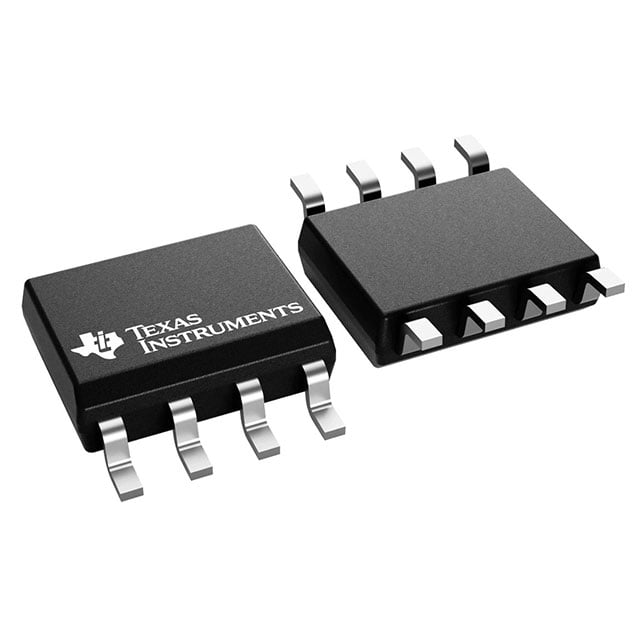
Key Specs
| Spec | Value | Condition | Source |
|---|---|---|---|
| Control Features | - | Digi-Key | |
| Input Voltage (Max) | 20V | Digi-Key | |
| Mounting Type | Surface Mount | Digi-Key | |
| Number Of Regulators | 1 | Digi-Key | |
| Operating Temperature Range | 0°C ~ 125°C | Digi-Key | |
| Output Configuration | Positive | Digi-Key | |
| Output Current (Max) | 100mA | Digi-Key | |
| Output Type | Fixed | Digi-Key | |
| Output Voltage (Max) | - | Digi-Key | |
| Output Voltage (Min) | 5V | Digi-Key | |
| Package Case | 8-SOIC (0.154”, 3.90mm Width) | Digi-Key | |
| Protection Features | Over Current, Over Temperature, Reverse Polarity, Short Circuit | Digi-Key | |
| Psrr | 49dB (120Hz) | Digi-Key | |
| Supplier Device Package | 8-SOIC | Digi-Key | |
| Voltage Dropout (Max) | 1.7V @ 40mA | Digi-Key |
When To Use
Use the UA78L05ACDR in applications requiring a fixed 5V output voltage with a maximum output current of 100mA, such as low-power embedded systems or sensor modules operating within an input voltage up to 20V. Its surface-mount 8-SOIC package and protection features (Over Current, Over Temperature, Reverse Polarity, Short Circuit) make it suitable for compact designs with moderate thermal and electrical stress.
Do not use this regulator in high-current applications exceeding 100mA or where dropout voltage must be lower than 1.7V at 40mA; in such cases, consider a low-dropout (LDO) regulator or a switching regulator better suited for higher currents and lower dropout voltages.
When Not To Use
-
5V output at 500mA for embedded processor: The 100mA max output current is insufficient for high current loads. Use a high-current synchronous buck with external FETs to handle higher currents efficiently and avoid thermal shutdown.
-
Input voltage only 6V, output 5V with minimal dropout: The maximum dropout voltage of 1.7V at 40mA means the device cannot reliably regulate at low input-output differentials. Use an LDO regulator designed for low dropout voltage to maintain regulated output under these conditions.
-
Battery-powered sensor with μA sleep current: The quiescent current is not optimized for ultra-low power standby, which would drain batteries rapidly. Use a low-IQ PFM buck regulator to minimize standby current and extend battery life.
Application Notes
-
the Ground pin and the Output pin require a low-ESR ceramic capacitor close to the package to maintain stability; output capacitor ESR affects loop stability and ripple.
-
Input bypass capacitor must be placed within 5mm of the device’s input pin (pin 1) to minimize input voltage spikes and improve transient response.
-
Avoid routing sensitive analog signals near the package’s ground and output pins (pins 4 and 5) to reduce coupling of output voltage ripple.
-
The package is SOIC-8 with a 3.90mm width; ensure solder pad footprint matches to avoid mechanical stress and thermal resistance increase.
-
No switching node (SW) exists—this is a linear regulator; noise-sensitive pins are primarily the output pin and the ground pin, which should have clean PCB return paths to prevent ground bounce and output noise.
Pin numbers are package-specific. Verify against the datasheet pinout diagram before routing.
Gotchas
-
[Hidden thermal derating]: The maximum output current of 100mA assumes proper thermal conditions; at elevated ambient temperatures near 125°C, the effective maximum current drops due to internal junction-to-ambient thermal resistance. Without a proper thermal relief or PCB copper area, the device may enter thermal shutdown unexpectedly. Fix: Measure junction temperature with a thermocouple during worst-case load and provide adequate PCB copper for heat dissipation.
-
[Minimum load requirement misconception]: Some linear regulators require a minimum load to maintain regulation; although not explicitly stated, the UA78L05ACDR can exhibit output voltage drift or oscillations at very light loads (<1mA). Fix: Add a small bleed resistor (e.g., 10kΩ) on the output to provide minimum load and stabilize regulation.
-
[Output capacitor ESR and stability]: Using a high-ESR electrolytic capacitor on the output can cause oscillations or increased output ripple due to loop instability. Fix: Use a low-ESR ceramic capacitor of at least 1µF close to the output pin.
-
[Reverse polarity protection caveat]: While the device includes reverse polarity protection, applying reverse voltage beyond transient conditions (e.g., sustained reverse input) can cause permanent damage due to internal diode conduction and heating. Fix: Verify polarity correctness in assembly and consider an external diode for sustained reverse polarity scenarios.