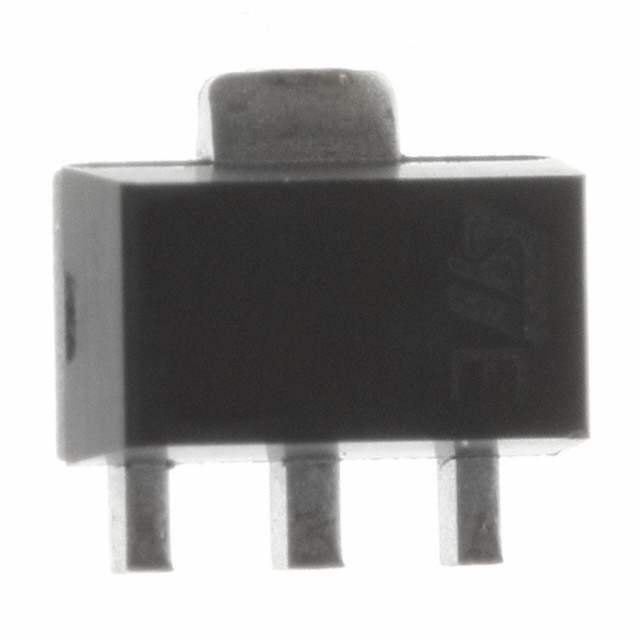
L78L33ABUTR vs UA78L05ACDR: Linear Regulator Component Comparison
Quick verdict
For low-voltage, low-current 3.3V rails with limited board space, the L78L33ABUTR is the better choice due to its smaller SOT-89 package, wider input voltage range, and extended operating temperature. For 5V applications where reverse polarity protection is critical and thermal conditions are moderate, the UA78L05ACDR offers stronger protection and a familiar SOIC footprint, making it preferable despite its higher dropout voltage and narrower input voltage limit.
Spec comparison table
| Spec | L78L33ABUTR | UA78L05ACDR | Notes |
|---|---|---|---|
| Output voltage (fixed) | 3.3 V | 5 V | Output voltage selection drives application compatibility; 3.3V vs 5V rails. |
| Output current max | 100 mA | 100 mA | Equivalent maximum output current capability. |
| Input voltage max | 30 V | 20 V | L78L33ABUTR supports higher input voltages, enabling larger input voltage headroom. |
| Voltage dropout max | Not specified | 1.7 V @ 40 mA | UA78L05ACDR dropout voltage is specified and relatively high, impacting efficiency. |
| Quiescent current (Iq) | 5.5 mA | Not specified | L78L33ABUTR quiescent current known; UA78L05ACDR datasheet does not specify this value. |
| Supply current max | 6 mA | Not specified | L78L33ABUTR has low supply current, beneficial for low-power applications. |
| Operating temperature range | -40°C to 125°C | 0°C to 125°C | L78L33ABUTR supports wider ambient temperature range, better for industrial use. |
| Protection features | Over Current, Over Temperature, Short Circuit | Over Current, Over Temperature, Reverse Polarity, Short Circuit | UA78L05ACDR adds reverse polarity protection, improving robustness in harsh conditions. |
| Package / Case | TO-243AA (SOT-89-3) | 8-SOIC (3.90 mm width) | L78L33ABUTR’s smaller package saves PCB space; UA78L05ACDR’s SOIC is easier for hand soldering. |
| Mounting type | Surface Mount | Surface Mount | Both support standard surface mount assembly. |
| Number of regulators | 1 | 1 | Single output linear regulators. |
| Output configuration | Positive | Positive | Both regulators provide positive fixed voltage output. |
| PSRR (120Hz) | 49 dB | 49 dB | Equal power supply rejection ratio at 120 Hz. |
Design trade-offs
The L78L33ABUTR’s 3.3V fixed output and 30V maximum input voltage make it well-suited for designs where the input supply can be significantly higher than the output, such as battery-powered or noisy industrial inputs. The higher maximum input voltage provides better margin for voltage spikes or unregulated supply variations. Its lower quiescent current (~5.5 mA) helps reduce power loss in standby modes, which is important for battery-powered or energy-sensitive designs.
The UA78L05ACDR’s 5V fixed output voltage is the standard for many legacy and logic-level circuits, making it a natural fit for those needing a regulated 5V supply. However, it has a lower maximum input voltage rating (20V), which restricts input supply choices. Its dropout voltage (1.7V at 40 mA) is modest but must be accounted for in efficiency and thermal calculations, especially at higher currents. The dropout spec for the L78L33ABUTR is not specified, but typically the L78Lxx series regulators have dropout voltages around 2V at full load; this makes the UA78L05ACDR slightly better in low dropout scenarios at moderate currents.
Thermally, both regulators dissipate power proportional to (Vin - Vout) × Iout. The L78L33ABUTR’s wider temperature rating (-40°C to 125°C) allows it to be used in harsher environments without additional thermal management, whereas the UA78L05ACDR is limited to 0°C minimum, potentially requiring added thermal or environmental protection in cold climates.
Protection features differ meaningfully: the UA78L05ACDR provides reverse polarity protection, which can prevent damage if the input is connected backward, a useful feature in user-serviceable or error-prone installations. The L78L33ABUTR lacks this, so additional external protection might be required.
From a PCB layout standpoint, the L78L33ABUTR’s SOT-89-3 package is smaller and requires fewer PCB resources than the UA78L05ACDR’s 8-SOIC package, which can be advantageous for compact designs. However, the SOIC package is generally easier to hand solder or rework, which could influence prototyping or low-volume production decisions.
Cost at volume is not provided here but typically STMicroelectronics parts in SOT-89 packages are cost-competitive, and Texas Instruments SOIC devices are widely available and well-supported. The choice may be influenced by supply chain preferences or existing vendor relationships.
Use-case fit
Choose L78L33ABUTR when…
- Designing a 3.3V rail with up to 100 mA load in industrial or automotive environments requiring a wide input voltage range (up to 30V) and extended temperature range (-40°C minimum).
- Board space is limited, and a compact SOT-89 package is necessary.
- Low quiescent current is important to minimize standby power consumption.
- The application can tolerate the lack of integrated reverse polarity protection or external protection is already designed in.
- Higher input voltage margin is needed to handle noisy or unregulated supplies.
Choose UA78L05ACDR when…
- A 5V fixed output is required to power legacy logic or microcontroller systems.
- Reverse polarity protection is critical to prevent damage from incorrect power connections.
- The input voltage is reliably below 20V and the operating environment is controlled above 0°C.
- The SOIC package is preferred for easier manual soldering or prototyping.
- Dropout voltage of approximately 1.7V at 40 mA is acceptable within the thermal budget and efficiency constraints.
Drop-in compatibility
These two devices are not pin-compatible or footprint-compatible. The L78L33ABUTR comes in a 3-lead SOT-89 package, whereas the UA78L05ACDR is in an 8-lead SOIC package with a different pinout and physical size. Substituting one for the other requires PCB redesign as well as consideration of the output voltage difference (3.3V vs 5V). There is no direct drop-in substitution possible without electrical and mechanical changes.
Alternatives to consider
- LM1117-3.3: Low dropout linear regulator with 800 mA output current capability, ideal for higher current 3.3V rails with improved dropout voltage.
- MIC5205-3.3YM5: Ultra-low quiescent current (down to 85 µA) 3.3V regulator in SOT-23 package, suitable for battery-powered applications requiring minimal idle current.
- TLV70233: Low dropout regulator from Texas Instruments with 3.3V output and low dropout voltage, good for low voltage headroom applications.