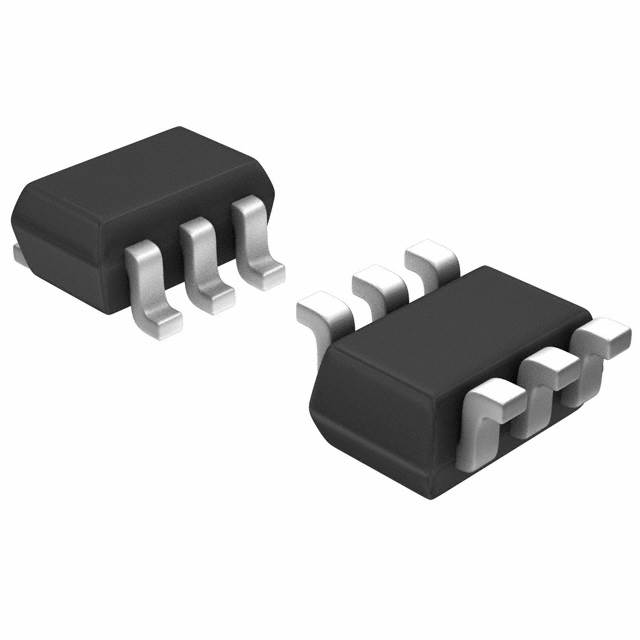
Key Specs
| Spec | Value | Condition | Source |
|---|---|---|---|
| Configuration | 2 N-Channel (Dual) | Digi-Key | |
| Current Continuous Drain ID 25 C | 350mA | Digi-Key | |
| Drain-source Voltage (Max) | 30V | Digi-Key | |
| FET Feature | Logic Level Gate | Digi-Key | |
| Gate Charge Qg Max VGS | 0.68nC @ 4.5V | Digi-Key | |
| Grade | Automotive | Digi-Key | |
| Input Capacitance Ciss Max VDS | 50pF @ 15V | Digi-Key | |
| Mounting Type | Surface Mount | Digi-Key | |
| Operating Temperature Range | -55°C ~ 150°C (TJ) | Digi-Key | |
| Package Case | 6-TSSOP, SC-88, SOT-363 | Digi-Key | |
| Power (Max) | 445mW | Digi-Key | |
| Qualification | AEC-Q101 | Digi-Key | |
| RDS On Max ID VGS | 1.4Ohm @ 350mA, 4.5V | Digi-Key | |
| Supplier Device Package | 6-TSSOP | Digi-Key | |
| Technology | MOSFET (Metal Oxide) | Digi-Key | |
| VGS Th Max ID | 1.1V @ 250µA | Digi-Key |
When To Use
Use the NX3008NBKS,115 MOSFET in applications requiring low current switching up to 350 mA continuous drain current with a maximum drain-source voltage of 30 V, such as automotive signal switching, low-power load drivers, or logic-level switching circuits. Its logic-level gate and low gate charge (typical 0.52 to 0.68 nC) make it suitable for battery-powered or low-voltage control systems where minimal gate drive power is critical.
Do not use this device for high current power stages exceeding 350 mA continuous drain current or applications requiring voltages above 30 V. For higher current or voltage ratings, select MOSFETs with correspondingly higher drain current and voltage specifications, as this device’s maximum continuous drain current is limited to 350 mA and maximum voltage is 30 V.
When Not To Use
-
Load current > 350mA continuous: The 350mA max continuous current rating disqualifies this MOSFET for higher current loads. Use a multi-phase buck controller or a high-current synchronous buck with external FETs for better current sharing and thermal performance.
-
Switching frequency > 500kHz required: The relatively modest gate charge (0.68nC @ 4.5V) and switching times (turn-on delay 15–30ns, fall time 19ns) limit high-frequency efficiency and switching losses. Use a high-frequency buck controller for stable operation and reduced switching losses.
-
Input-output voltage differential < 1V with noise-sensitive loads: With a minimum gate threshold around 0.5V and typical Rds(on) of 1.5Ω, this device is not optimized for very low dropout or low noise. Use an LDO regulator when noise and voltage dropout are critical.
Application Notes
- The drain node switches and must be routed with the smallest possible loop area to minimize switching noise and electromagnetic interference (EMI).
- The gate pin is noise-sensitive; use a short, low-inductance gate drive trace and include a gate resistor to prevent oscillations.
- Thermal management is critical: at a typical power dissipation of 445 mW max and thermal resistance junction-to-ambient of up to 300 K/W per device, ensure adequate PCB copper area or heatsinking to keep junction temperature below +150 °C.
- The device’s fast switching times (turn-on delay 15–30 ns, turn-off delay 69–138 ns) require careful layout to avoid voltage spikes or ringing.
- Ensure gate-source voltage does not exceed ±8 V to prevent gate oxide damage.
- Use proper ESD protection on the gate and drain pins, considering the device’s maximum ESD rating of 2000 V.
Gotchas
-
[Assuming typical Rds(on) at 25°C applies at 150°C]: Designers often size thermal dissipation using the 1.5Ω Rds(on) typical at 25°C, ignoring the increase to up to 2.5Ω at 150°C. This causes unexpected heating and possible thermal runaway under high load. Fix: Use derated Rds(on) values at max operating temperature for power loss calculations.
-
[Gate drive noise coupling from SW node]: If the gate drive trace runs close to the switching node or high-current paths, gate voltage ringing can induce partial or spurious switching, leading to shoot-through or increased EMI. Fix: Route gate drive traces with a ground guard and keep them short and separated from SW.
-
[Failure to account for transient peak drain current (1.4A)]: The device tolerates short spikes up to 1.4A, but continuous currents near this level cause immediate damage. Designers sometimes assume the spike rating is continuous, leading to MOSFET failure during load transients. Fix: Design load and protection circuits so spikes remain brief and infrequent, validating with transient scope captures.
-
[Minimal load or no load startup instability]: At very low or no load, the MOSFET’s gate leakage currents (~1µA typ) and low gate charge can cause slow or erratic switching transitions in some topologies, resulting in output voltage ripple or startup glitches. Fix: Include a minimum load resistor or soft-start circuitry to stabilize gate voltage during startup.