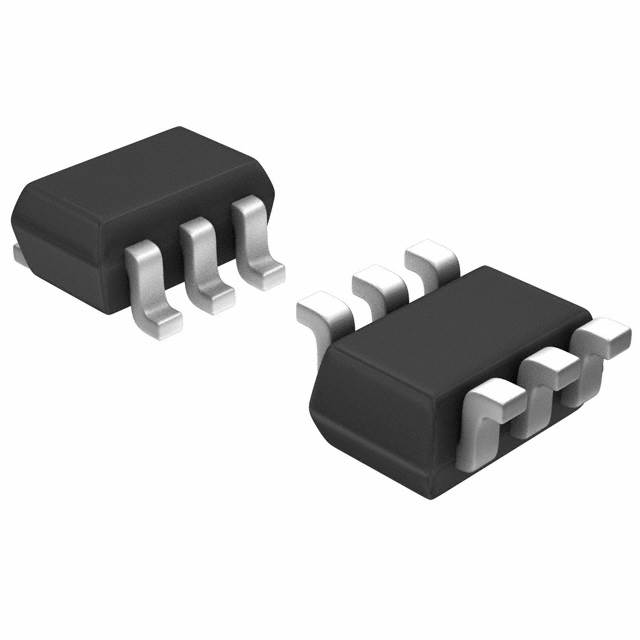
NX3008NBKS,115 vs 2N7002DW-7-F MOSFET Arrays: A Detailed Component Comparison
Quick verdict
For low-voltage switching applications demanding higher current capacity and better on-resistance, especially in automotive-grade environments, the NX3008NBKS,115 is the clear choice due to its 350mA continuous current rating and lower R_DS(on). For designs requiring a higher voltage rating (up to 60 V) with moderate current (230mA) and a smaller footprint, the 2N7002DW-7-F fits better, particularly where voltage headroom or ruggedness to higher V_DS is critical.
Spec comparison table
| Spec | NX3008NBKS,115 | 2N7002DW-7-F | Notes |
|---|---|---|---|
| Configuration | 2 N-Channel (Dual) | 2 N-Channel (Dual) | Equivalent |
| Drain-Source Voltage, max (V_DS) | 30 V | 60 V | 2N7002DW-7-F doubles voltage rating — better for higher voltage margins |
| Continuous Drain Current, max (I_D) | 350 mA | 230 mA | NX3008NBKS,115 supports ~50% higher continuous current |
| Pulsed Drain Current, max | 1.4 A | 0.8 A | NX3008NBKS,115 supports higher pulsed current spikes |
| R_DS(on) @ 25°C, max | 1.4 Ω @ 350mA, 4.5 V | 7.5 Ω @ 50mA, 5 V | NX3008NBKS,115 has significantly lower R_DS(on), reducing conduction losses |
| Gate Threshold Voltage, typical (V_GS(th)) | 0.6 – 1.1 V | 1.0 – 2.0 V | NX3008NBKS,115 has lower threshold voltage, easier to drive from logic-level signals |
| Gate Source Voltage, max | ±8 V | ±20 V | 2N7002DW-7-F supports higher gate drive voltages without damage |
| Input capacitance (C_iss), typical | 34 – 50 pF @ 25°C, 15V | 50 pF @ 25 V | Comparable; NX3008NBKS,115 slightly lower typical input capacitance |
| Output capacitance (C_oss), typical | 6.5 pF | 25 pF | NX3008NBKS,115 output capacitance is significantly lower — better switching performance |
| Reverse transfer capacitance (C_rss), typical | 2.2 pF | Not specified | NX3008NBKS,115 has low C_rss, reducing Miller effect |
| Gate Charge (Q_g) typical @ 4.5 V | 0.52 – 0.68 nC | Not specified | NX3008NBKS,115 has very low gate charge, enabling faster switching and lower gate drive losses |
| Drain Leakage Current @ 25°C | 1 µA | 1 mA | NX3008NBKS,115 leakage is three orders of magnitude lower — better for low leakage designs |
| Power Dissipation, max | 445 mW | 310 mW | NX3008NBKS,115 supports ~40% higher power dissipation |
| Operating Temperature Range | -55°C to +150°C | -55°C to +150°C | Equivalent |
| Package | 6-TSSOP (SOT-363) | 6-TSSOP (SOT-363) | Equivalent |
| Thermal Resistance Junction-to-Ambient (R_θJA) | 300 K/W (typ) | 318 K/W (max) | Comparable, NX3008NBKS,115 slightly better thermal conductivity |
| ESD Rating | 2000 V | Not specified | NX3008NBKS,115 has known ESD protection rating |
| Grade | Automotive (AEC-Q101 qualified) | Not specified | NX3008NBKS,115 is automotive qualified |
| Forward Transconductance (g_fs) | 310 mS (typ) | Not specified | NX3008NBKS,115 has specified g_fs, useful for gain and switching speed considerations |
| Forward Diode Voltage (typ) | Not specified | 0.78 V | 2N7002DW-7-F specifies diode forward voltage, relevant for body diode conduction |
| Gate Leakage Current typical | 0.2 – 1 µA | ±10 nA | 2N7002DW-7-F has lower gate leakage current, beneficial for very low power gate drive |
| Storage Temperature Range | -65°C to +150°C | -55°C to +150°C | NX3008NBKS,115 has wider storage range |
Design trade-offs
The NX3008NBKS,115 offers a significantly higher continuous drain current rating (350mA vs 230mA) and lower R_DS(on) (1.4 Ω max at 350mA vs 7.5 Ω at 50mA), translating directly into lower conduction losses and higher efficiency in low-voltage, low-current switching applications. Its logic-level gate threshold (~0.6 to 1.1 V typical) enables direct drive from 1.8–3.3 V logic with minimal margin, beneficial for microcontroller-driven designs without a dedicated MOSFET driver. The very low gate charge (0.52–0.68 nC) and output capacitance (6.5 pF) reduce switching losses and gate drive power, which is important in fast switching or PWM applications.
In contrast, the 2N7002DW-7-F doubles the voltage rating to 60 V, providing a much higher margin for applications with higher supply voltages or transient spikes. However, it sacrifices on-current capability and has a much higher on-resistance (7.5 Ω max at 50mA), limiting efficiency and thermal performance in continuous conduction. Its gate threshold voltage is higher (1.0 to 2.0 V typical), requiring more robust gate drive voltages for full enhancement, and its gate voltage rating is ±20 V steady-state, enabling it to survive higher gate drive voltages or transient spikes without damage.
Thermally, both parts have similar packages and comparable junction-to-ambient thermal resistances, but the NX3008NBKS,115 supports almost 40% higher power dissipation (445 mW vs 310 mW), which means it can handle higher dissipation in constrained board areas without additional heatsinking. The 2N7002DW-7-F’s higher leakage current (up to 1 mA at 25°C) can be a concern for battery-powered or ultra-low leakage designs, whereas the NX3008NBKS,115’s leakage is much lower.
From a layout perspective, both parts share the same 6-TSSOP (SOT-363) footprint, so PCB space is comparable. However, the NX3008NBKS,115’s lower capacitances and gate charge reduce EMI and switching noise coupling, easing sensitive mixed-signal layouts.
Cost-wise, the NX3008NBKS,115 is automotive grade (AEC-Q101 qualified), which typically comes at a premium but guarantees tighter process controls and reliability for harsh environments. The 2N7002DW-7-F is a general-purpose MOSFET array, likely less expensive for consumer or industrial applications where automotive qualification is not required.
Use-case fit
Choose NX3008NBKS,115 when…
- You need to switch loads up to 350mA continuously at voltages up to 30 V with minimal conduction loss.
- Your design requires direct logic-level drive at 1.8–3.3 V with low gate charge for minimal gate drive power.
- Operating environment demands automotive qualification or extended temperature and reliability guarantees.
- You require low leakage current for battery-powered or low-standby current applications.
- Your switching frequency is high enough that low gate charge and capacitances reduce overall switching losses and EMI.
Choose 2N7002DW-7-F when…
- Your application voltage can reach up to 60 V and requires robust voltage margin or transient voltage tolerance.
- Load currents are modest (up to 230mA), and efficiency is less critical than voltage headroom.
- Gate drive voltage may exceed 8 V but stay within ±20 V, or you need tolerance to higher gate voltage transients.
- You operate in consumer or industrial environments where automotive qualification is not mandatory.
- Space constraints favor the very common and widely available 2N7002DW-7-F, and cost sensitivity is a priority.
Drop-in compatibility
Both devices are dual N-channel MOSFET arrays in a 6-TSSOP (SOT-363) package, suggesting footprint compatibility. However, pin-to-pin compatibility is not explicitly confirmed in the datasheets provided. Given the same package and configuration, they may be electrically substitutable in simple switching applications, but the differences in gate threshold voltage, maximum voltage ratings, and R_DS(on) mean performance and reliability margins will differ.
Without explicit cross-reference or application notes confirming pin compatibility, substituting one for the other should be verified by checking the pinout in detail and testing the circuit under expected operating conditions. Gate drive voltage requirements and