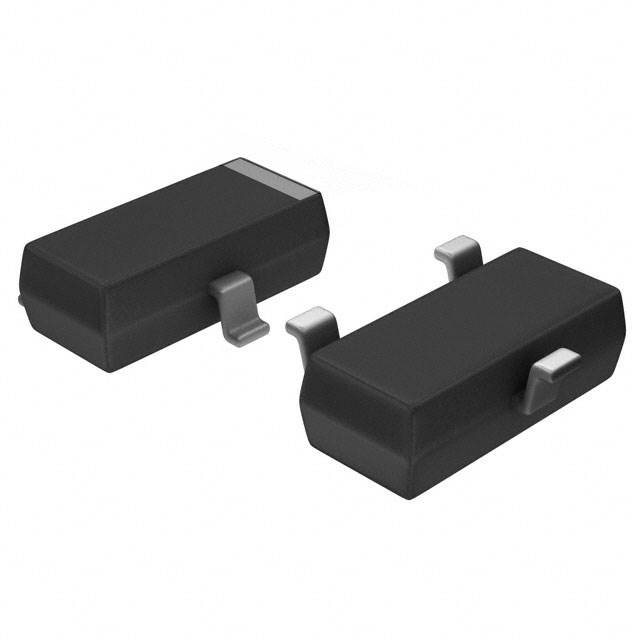
MMBF5485 vs NX3008NBKS,115: Component Comparison for Power Electronics Design
Quick verdict
For RF and low-current analog front-end applications requiring low noise and high-frequency operation, the MMBF5485 is the preferred choice due to its JFET technology and 400 MHz frequency rating. For general-purpose switching or load-driving in automotive or industrial contexts with currents up to 350 mA, the NX3008NBKS,115 offers better robustness, higher voltage rating, and integrated dual MOSFETs, making it more suitable for digital control and power switching.
Spec comparison table
| Spec | MMBF5485 | NX3008NBKS,115 | Notes |
|---|---|---|---|
| Configuration | N-Channel JFET | 2 x N-Channel MOSFET (Dual) | Dual MOSFETs allow dual switch functionality; JFET is single device |
| Current rating (continuous) | 10 mA | 350 mA | NX3008NBKS supports 35x higher continuous current |
| Frequency rating | 400 MHz | Not specified (MOSFET, low MHz range) | MMBF5485 is RF-capable; NX3008NBKS not intended for high-frequency analog |
| Gain | Not specified | Not specified | Not directly comparable |
| Noise figure | 4 dB | Not specified | MMBF5485 optimized for low noise, suitable for sensitive analog front ends |
| Output power max | Not specified | 445 mW | NX3008NBKS can dissipate significantly more power |
| Package case | TO-236-3 (SOT-23-3) | 6-TSSOP (SOT-363) | NX3008NBKS larger, dual transistor package |
| Supplier device package | SOT-23-3 | 6-TSSOP | See above |
| Technology | JFET | MOSFET (Metal Oxide) | Different device physics; JFET better for analog/RF, MOSFET better for power switching |
| Voltage rated (V) | 25 V | 30 V | NX3008NBKS has 20% higher voltage rating |
| Voltage test (V) | 15 V | Not specified | Not directly comparable |
| Absolute maximum rating | Not specified | See datasheet (30 V max, 350 mA max) | NX3008NBKS explicitly rated for higher power and voltage |
| Ambient temperature range | Not specified | -55 °C to +150 °C | NX3008NBKS supports automotive-grade temperature range |
| Input capacitance (typ, 25°C) | Not specified | 34 - 50 pF | NX3008NBKS input capacitance given; relevant for switching speed and EMI |
| Output capacitance (typ, 25°C) | Not specified | 6.5 pF | NX3008NBKS output capacitance low, aiding switching performance |
| Reverse transfer capacitance (typ) | Not specified | 2.2 pF | NX3008NBKS low reverse transfer capacitance reduces Miller effect |
| Drain current max | 10 mA | 350 mA (typ), 1.4 A (peak) | NX3008NBKS supports significantly higher currents |
| Drain-source on-state resistance (typ) | Not specified | 1.5 Ω (typ) | Rds(on) relevant for conduction losses — NX3008NBKS moderate for 350 mA range |
| Gate charge (typ) | Not specified | 0.52 - 0.68 nC @ 4.5 V | NX3008NBKS low gate charge suits low gate drive power |
| Gate threshold voltage (Vgs_th) | Not specified | 0.5 - 1.75 V (typ/min/max) | NX3008NBKS logic-level gate drive compatible |
| Gate-source voltage max/min | Not specified | ±8 V | NX3008NBKS rated for ±8 V gate drive voltages |
| Forward transconductance (gfs) (typ) | Not specified | 310 mS | NX3008NBKS transconductance indicates switching responsiveness |
| Drain leakage current (typ) | Not specified | 1 µA @ 25 °C, 10 µA @ 150 °C | NX3008NBKS low leakage current beneficial for low standby power |
| Gate leakage current (typ) | Not specified | 0.2 - 1 µA | NX3008NBKS low gate leakage minimizes control losses |
| Power dissipation max | Not specified | 445 mW | NX3008NBKS can handle higher power dissipation |
| Thermal resistance junction-to-ambient (typ) | Not specified | 300 K/W per device | Thermal handling info available only for NX3008NBKS |
| Thermal resistance junction-to-solder point (typ) | Not specified | 130 K/W | NX3008NBKS thermal path details aid thermal design |
| Switching times (typ) | Not specified | t_on: 15-30 ns, t_off: 69-138 ns | NX3008NBKS switching speed suitable for moderate frequency switching |
| ESD rating | Not specified | 2000 V | NX3008NBKS rated for ESD robustness |
| Operating temperature range | Not specified | -55 °C to +150 °C | NX3008NBKS suitable for automotive/industrial environments |
| Grade | Not specified | Automotive (AEC-Q101 qualified) | NX3008NBKS suited for automotive reliability requirements |
Design trade-offs
The MMBF5485 and NX3008NBKS,115 target fundamentally different application niches, which drives their design trade-offs. The MMBF5485 is a single N-Channel JFET optimized for RF and low-noise analog applications up to 400 MHz. Its extremely low current capability (10 mA max) and modest voltage rating (25 V) indicate it is not designed for power switching but rather for sensitive front-end amplification or buffering where noise figure (4 dB) and high-frequency response are critical. Its SOT-23-3 package is compact but suitable for low power dissipation.
In contrast, the NX3008NBKS,115 is a dual N-Channel MOSFET array designed for general-purpose switching and load-driving applications up to 350 mA continuous current and 30 V. The MOSFET construction allows for logic-level gate drive (threshold around 0.5–1.75 V), enabling direct interfacing with digital controllers without additional gate drive circuitry. The device’s Rds(on) of approximately 1–1.5 Ω at 350 mA is moderate; this is acceptable for low-current switching but not for high-efficiency power conversion. Its low gate charge (~0.6 nC) and fast switching times (t_on ~15-30 ns, t_off ~69-138 ns) make it suitable for moderate frequency switching, but not RF power amplification.
Thermally, the NX3008NBKS,115 can dissipate up to 445 mW and is automotive-grade AEC-Q101 qualified, with operating temperatures from -55 °C to +150 °C. This means it can survive harsh environments and higher power dissipation, while the MMBF5485’s thermal data is not specified but implied to be lower due to low current and power limits. The NX3008NBKS’s dual 6-TSSOP package is larger and may require more PCB real estate but allows integration of two switches, reducing component count and assembly cost.
From a layout perspective, the MMBF5485’s SOT-23-3 package is easier to route in dense analog front ends, but sensitive RF layout techniques are needed due to its high-frequency operation and JFET characteristics. The NX3008NBKS’s larger package and MOSFET structure require careful consideration of switching noise, gate drive impedance, and thermal reliefs but are more forgiving in digital switching applications.
Cost-wise, the MMBF5485 is likely less expensive per unit but serves a niche purpose. The NX3008NBKS,115’s automotive qualification and dual package may command a higher price but reduce BOM count and improve reliability in automotive/industrial designs.
Use-case fit
Choose MMBF5485 when…
- Designing low-noise RF front ends or impedance buffer stages requiring operation up to 400 MHz.
- Implementing sensitive analog signal conditioning where a low 4 dB noise figure improves system SNR.
- Current draw is minimal (≤10 mA), and the device functions primarily as a voltage-controlled resistor or low-noise amplifier element.
- Space is constrained and a small SOT-23-3 package is preferred.
- Your application requires JFET characteristics such as high input impedance and low distortion in analog circuits.
Choose NX3008NBKS,115 when…
- Driving loads up to 350 mA at voltages up to 30 V in automotive or industrial environments.
- Needing a logic-level MOSFET switch compatible with microcontroller outputs without external gate drivers.
- Space allows for a 6-TSSOP package and you want two N