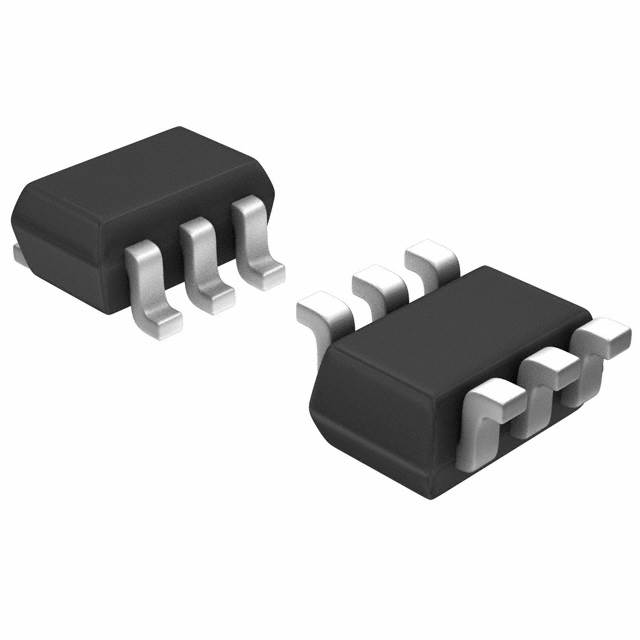
Component Comparison: NX3008NBKS,115 vs 2N7002BKS,115
1. Quick verdict
For low-voltage, low-current switching applications where minimal gate charge and low R_DS(on) at 30 V are critical, the NX3008NBKS,115 is the better choice due to lower on-resistance and gate charge. For applications requiring higher voltage margin up to 60 V and moderate current, where switching speed and ruggedness at higher voltages matter more, the 2N7002BKS,115 is preferable despite its higher R_DS(on) and gate charge.
2. Spec comparison table
| Spec | NX3008NBKS,115 | 2N7002BKS,115 | Notes |
|---|---|---|---|
| Manufacturer | Nexperia USA Inc. | Nexperia USA Inc. | Same supplier |
| Configuration | 2 N-Channel (Dual) | 2 N-Channel (Dual) | Equivalent |
| Maximum Drain-Source Voltage (V_DS max) | 30 V | 60 V | 2N7002BKS doubles voltage rating; better for higher voltage applications |
| Continuous Drain Current (I_D max @ 25°C) | 350 mA | 300 mA | NX3008NBKS offers 17% higher continuous current capability |
| Pulsed Drain Current (I_D peak) | 1.4 A | 1.2 A | NX3008NBKS supports slightly higher peak current |
| Power Dissipation (P_D max) | 445 mW | 295 mW | NX3008NBKS can dissipate ~50% more power |
| R_DS(on) typ @ 25°C | 1.0–1.4 Ω (typ) @ 350 mA, 4.5 V | 3.0 Ω (typ) @ 300 mA | NX3008NBKS on-resistance ~2–3x lower, significantly better conduction losses |
| R_DS(on) max | 1.4 Ω @ 350 mA, 4.5 V | 3.0 Ω @ 300 mA | NX3008NBKS offers tighter max spec and lower loss |
| Gate Threshold Voltage (V_GS(th) typ) | 0.9 V | 3.0 V | NX3008NBKS switches on at much lower V_GS—better for logic-level drive |
| Gate Charge Qg typ @ 4.5 V | 0.68 nC | 0.6 nC | Roughly comparable gate charge; NX3008NBKS slightly higher per datasheet, but gate charge min data conflicts (see notes) |
| Input Capacitance (C_iss) typ | 34–50 pF | 33 pF @ 10 V | Comparable input capacitance |
| Output Capacitance (C_oss) typ | 6.5 pF | 7 pF | Similar |
| Reverse Transfer Capacitance (C_rss) typ | 2.2 pF | 4 pF | NX3008NBKS has lower C_rss; better for switching speed control |
| Gate Leakage Current (typ @ 25°C) | 0.2–1 µA | 10 µA max | NX3008NBKS has significantly lower gate leakage current |
| ESD Rating | 2 kV | 2 kV | Equal |
| Operating Temperature Range (T_J) | -55°C to +150°C | -55°C to +150°C | Equal |
| Package | 6-TSSOP (SC-88, SOT-363) | 6-TSSOP (SC-88, SOT-363) | Pin and package type identical |
| Thermal Resistance Junction-to-Ambient (R_thJA) typ per transistor | 390–445 K/W | 370 K/W | Comparable, slightly better for 2N7002BKS |
| Turn-On Delay Time (t_d(on)) typ | 15–30 ns | 5–10 ns | 2N7002BKS is faster to turn on |
| Fall Time (t_fall) typ | 19 ns | 7 ns | 2N7002BKS switches off faster |
| Rise Time (t_rise) typ | 11 ns | Not specified | NX3008NBKS rise time known, 2N7002BKS no data |
| Power Dissipation Typical (P_D typ) | 280 mW | 295 mW | Similar typical power dissipation |
| Gate-Source Voltage Max | ±8 V | ±20 V | 2N7002BKS has higher gate voltage rating, more rugged gate drive tolerance |
| Drain Leakage Current (I_DSS) @ 25°C typ | 1 µA | 1 µA max | Similar |
| Drain Leakage Current (I_DSS) @ 150°C typ | 10 µA | 10 µA max | Similar |
| Gate Current Typ @ 25°C | 0.2–1 µA | 10 µA max | NX3008NBKS has lower typical gate current |
| Supplier Device Package | 6-TSSOP | 6-TSSOP | Same |
| Date of Release | Not specified | October 17, 2024 | 2N7002BKS is newer product |
3. Design trade-offs
The NX3008NBKS,115 and 2N7002BKS,115 are both dual N-channel MOSFET arrays in the same 6-TSSOP package, but they serve different niches primarily because of their voltage rating and R_DS(on) characteristics. NX3008NBKS is optimized for 30 V systems with low on-resistance (typical 1.0–1.4 Ω at 350 mA, 4.5 V gate drive), which translates into lower conduction losses and better efficiency in low-voltage switching or load switching applications such as power rails or signal multiplexing at 12 V or below. The 2N7002BKS,115 doubles the voltage rating to 60 V but at the cost of roughly double the R_DS(on), which increases conduction losses proportionally.
Gate drive voltage and threshold differences are significant: NX3008NBKS has a low gate threshold around 0.9 V typ, making it easier to drive directly from logic-level signals (3.3 V or 5 V) with a lower risk of partial conduction. The 2N7002BKS,115 has a much higher typical threshold of 3.0 V, which demands a stronger gate drive voltage to ensure full enhancement; this can complicate driver design or affect switching speed if the gate drive voltage is limited.
Switching speeds favor the 2N7002BKS,115, with turn-on and fall times roughly half those of the NX3008NBKS,115. This makes the 2N7002BKS more suitable for higher-frequency switching applications up to 1 MHz, as noted in its datasheet, where switching losses and timing are critical. However, the NX3008NBKS’s lower reverse transfer capacitance (C_rss) reduces the Miller effect, which can help maintain switching performance despite slower intrinsic switching times.
Thermal dissipation capability is marginally better for the NX3008NBKS in terms of maximum power dissipation (445 mW vs. 295 mW), which means it can handle higher continuous power without overheating. However, the thermal resistance per transistor is slightly better on the 2N7002BKS, which may offset some power dissipation differences depending on the PCB layout and cooling.
From a layout perspective, both parts share the same 6-TSSOP package footprint and pinout, making board-level substitution straightforward if electrical parameters are accommodated. However, the different R_DS(on) and threshold voltages mean that electrical behavior will differ, so substitution is not purely plug-and-play without revalidating performance.
Cost at volume is not specified here, but typically the 2N7002 family is widely produced and may offer cost advantages. The newer 2N7002BKS,115 is also AEC-Q101 qualified, targeting automotive applications, but so is the NX3008NBKS,115.
4. Use-case fit
Choose NX3008NBKS,115 when…
- You need a MOSFET array for low-voltage (≤30 V) load switching with currents up to 350 mA and want to minimize conduction losses.
- Your system logic voltage is limited (e.g., 3.3 V or 5 V) and you require a low gate threshold MOSFET for reliable on/off switching.
- Thermal dissipation margin is critical, and you need a device with higher continuous power dissipation capability (445 mW max).
- Your switching frequency is moderate, and gate charge and input capacitance should be minimized to reduce driver power.
- You require an automotive-grade device with AEC-Q101 qualification at a small 6-TSSOP footprint.
Choose 2N7002BKS,115 when…
- Your application requires a 60 V drain-source voltage rating for higher voltage