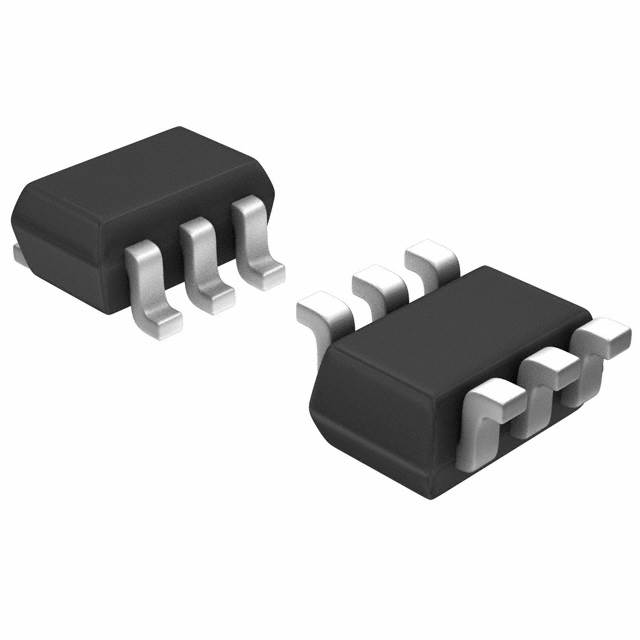
Key Specs
| Spec | Value | Condition | Source |
|---|---|---|---|
| Configuration | N and P-Channel | Digi-Key | |
| Current Continuous Drain ID 25 C | 350mA, 200mA | Digi-Key | |
| Drain-source Voltage (Max) | 30V | Digi-Key | |
| FET Feature | Logic Level Gate | Digi-Key | |
| Gate Charge Qg Max VGS | 0.68nC @ 4.5V | Digi-Key | |
| Grade | Automotive | Digi-Key | |
| Input Capacitance Ciss Max VDS | 50pF @ 15V | Digi-Key | |
| Mounting Type | Surface Mount | Digi-Key | |
| Operating Temperature Range | -55°C ~ 150°C (TJ) | Digi-Key | |
| Package Case | 6-TSSOP, SC-88, SOT-363 | Digi-Key | |
| Power (Max) | 445mW | Digi-Key | |
| Qualification | AEC-Q101 | Digi-Key | |
| RDS On Max ID VGS | 1.4Ohm @ 350mA, 4.5V | Digi-Key | |
| Supplier Device Package | 6-TSSOP | Digi-Key | |
| Technology | MOSFET (Metal Oxide) | Digi-Key | |
| VGS Th Max ID | 1.1V @ 250µA | Digi-Key |
When To Use
Use the NX3008CBKS,115 in low-voltage automotive and industrial logic-level switching applications where a maximum drain-source voltage of 30 V and continuous drain current up to 350 mA are required. It is ideal for circuits needing a compact surface-mount MOSFET with a low gate charge of 0.68 nC at 4.5 V, such as battery management systems, load switches, and signal-level switching, benefiting from its logic-level gate drive and AEC-Q101 automotive qualification.
When Not To Use
Do not use the NX3008CBKS,115 in high-current power switching applications exceeding 350 mA continuous drain current or where a drain-source voltage above 30 V is required. For such cases, select a MOSFET with a higher current rating and voltage capability, such as a power MOSFET designed for automotive powertrain or high-power DC-DC converter applications.
Application Notes
The NX3008CBKS,115’s drain pin switches the load current and must be wired with the smallest possible loop area to minimize EMI and switching losses. The gate pin is noise-sensitive due to the low gate charge and threshold voltage (1.1 V max @ 250 µA); therefore, gate drive traces should be kept short and shielded from high-current paths. Given the maximum power dissipation of 445 mW and operating temperature range up to 150°C (TJ), a heatsink is generally not required for typical switching loads under 350 mA, but proper PCB thermal design with adequate copper area is recommended to maintain junction temperature within limits.
Gotchas
-
[Underestimating RDS(on) increase at low gate drive voltages]: Designers sometimes assume the 1.4Ω RDS(on) at 4.5V gate drive applies down to the threshold voltage. In reality, driving the gate near threshold (~1.1V) causes partial conduction, resulting in significant heating and voltage drop. The device may appear functional but will run hot and fail prematurely. Fix: always design gate drive circuits to reach at least 4.5V VGS.
-
[Ignoring capacitance variation with VDS]: The input capacitance (Ciss) of 50pF is specified at 15V; at lower VDS voltages, capacitance can increase, slowing switching speeds and increasing losses. This causes unexpected switching delays and ringing in high-frequency applications. Fix: characterize Ciss across operating voltage or verify switching node waveforms experimentally.
-
[Gate drive noise coupling causing false turn-on]: The combined N and P-channel MOSFET package and compact pinout can couple switching noise into gate drive pins if layout is poor. This can cause unintended partial turn-on or shoot-through pulses visible as jitter or overshoot on scope. Fix: use short gate traces, add small gate resistors (~10Ω), and separate noisy SW nodes from gate lines.
-
[Startup with no minimum load]: At very light or no load, the device can fail to switch properly due to insufficient current flow, causing output voltage instability or failure to start switching. This is often missed in bench testing with ideal loads. Fix: add a small minimum load resistor or ensure the controller driving this MOSFET can handle zero-load conditions.