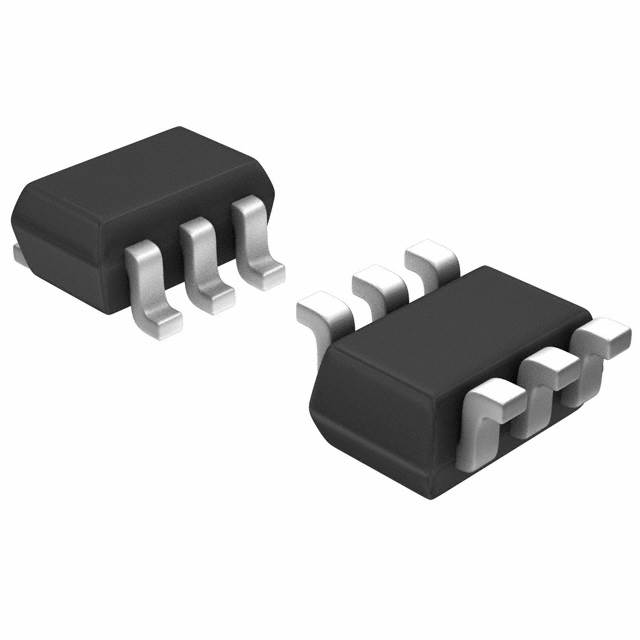
NX3008CBKS,115 vs 2N7002BKS,115 MOSFET Arrays: A Detailed Comparison
Quick verdict
For low-voltage, mixed-signal applications requiring complementary MOSFET pairs and very low gate charge, the NX3008CBKS,115 is the better choice due to its integrated N- and P-channel devices, lower gate threshold, and balanced current ratings. For higher voltage switching (up to 60 V) with simple N-channel requirements and moderate current (~300 mA), the 2N7002BKS,115 offers better voltage margin and power dissipation capability despite higher gate threshold and on-resistance.
Spec comparison table
| Spec | NX3008CBKS,115 | 2N7002BKS,115 | Notes |
|---|---|---|---|
| Configuration | N- and P-Channel | 2 × N-Channel | NX3008CBKS offers complementary pair; 2N7002BKS is dual N-channel only |
| Drain-Source Voltage Max (V) | 30 V | 60 V | 2N7002BKS doubles voltage rating, suitable for higher voltage rails |
| Continuous Drain Current (Id) | 350 mA (N), 200 mA (P) @ 25°C | 300 mA (Ta) | NX3008CBKS N-channel can handle slightly higher current; P-channel lower |
| Power Dissipation Max | 445 mW | 295 mW | NX3008CBKS has higher max power dissipation despite lower voltage rating |
| On-Resistance Rds(on) Max | 1.4 Ω @ 350 mA, 4.5 V | 1.6 Ω @ 500 mA, 10 V | NX3008CBKS has lower Rds(on) at lower gate voltage; 2N7002BKS rated at higher V and I |
| Gate Threshold Voltage (Vgs_th) | 1.1 V @ 250µA (max) | 2.1 V @ 250µA (max) | NX3008CBKS has significantly lower gate threshold voltage, easier to drive from logic |
| Gate Charge Qg Max @ 4.5V | 0.68 nC | 0.6 nC | Comparable gate charge; marginally lower for 2N7002BKS but similar in practice |
| Input Capacitance Ciss Max | 50 pF @ 15 V | 50 pF @ 10 V | Similar input capacitance; no major difference |
| Package | 6-TSSOP (SOT-363) | 6-TSSOP (SOT-363) | Same package type and pin count |
| Operating Temperature Range (TJ) | -55°C to 150°C | -55°C to 150°C | Equivalent thermal range |
| Qualification | AEC-Q101 (Automotive) | AEC-Q101 (Automotive) | Both meet automotive qualification |
| Drain Current Peak | Not specified | 1.2 A | 2N7002BKS can handle short pulses at higher current |
| Power Dissipation Typical | Not specified | 295 mW | NX3008CBKS max rating higher, 2N7002BKS typical power dissipation given |
| Gate Drive Voltage Max | Not explicitly specified | 20 V max | 2N7002BKS max gate voltage rating higher, but likely similar operating range |
| Leakage Current Max @ 25°C | Not specified | 1 µA (Id leakage) | 2N7002BKS leakage current data available; low leakage |
| Switching Times (td_on/off, tfall) | Not specified | td_on typ 10 ns, td_off typ 24 ns, tfall typ 7 ns | 2N7002BKS switching times available; useful for high-speed switching applications |
Design trade-offs
The NX3008CBKS,115 integrates complementary N- and P-channel MOSFETs in a single 6-TSSOP package, making it well-suited for half-bridge configurations, level shifting, or low-side/high-side switching in low-voltage systems (max 30 V). The lower gate threshold voltage (1.1 V max) means it can be driven directly from low-voltage logic signals with minimal margin, reducing the need for additional gate drivers. The P-channel device’s continuous current rating is limited to 200 mA, so it’s not for high-current high-side switching, but sufficient for signal-level switching and load control.
In contrast, the 2N7002BKS,115 offers dual N-channel devices rated to 60 V, doubling the voltage headroom for applications with higher supply voltages or transient spikes. It has a slightly higher continuous current rating at 300 mA and a peak pulse rating up to 1.2 A, useful for pulsed loads or inductive switching where current spikes occur. However, it has a significantly higher gate threshold voltage (2.1 V max) and higher Rds(on) at typical gate voltages (1.6 Ω @ 10 V, 500 mA), meaning it requires a stronger drive signal and will dissipate more conduction loss at equal load current.
Thermally, the NX3008CBKS’s power dissipation rating (445 mW max) is higher than the 2N7002BKS’s 295 mW max, but at half the voltage rating. In practice, the 2N7002BKS’s lower thermal resistance per device (typical 370 K/W) and higher voltage rating make it better for higher voltage but lower power dissipation applications. The NX3008CBKS’s balanced complementary architecture can reduce board area and component count for low-voltage complementary switching, which may offset its slightly lower voltage and current ratings.
Gate charge is similar between the two, with the NX3008CBKS at 0.68 nC and the 2N7002BKS at 0.6 nC at 4.5 V, so switching losses will be comparable at low gate voltages. The 2N7002BKS’s documented switching speed (on the order of 10 ns on and 24 ns off) suggests it is optimized for faster switching than the NX3008CBKS, which does not publish switching times. This can matter in high-frequency switching applications or where switching losses dominate.
Cost-wise, the 2N7002BKS’s simpler dual N-channel configuration and higher voltage rating typically make it a lower-cost option for high-voltage low-current switching, while the NX3008CBKS’s complementary pair and higher power dissipation rating tend to increase cost but reduce system complexity.
Use-case fit
Choose NX3008CBKS,115 when…
- You need a complementary MOSFET pair in a single package for low-voltage (≤30 V) half-bridge or push-pull driver circuits.
- Your logic-level gate drive voltage is limited to around 3.3–4.5 V and you require a low gate threshold (≤1.1 V max) for reliable switching.
- Your load currents are modest: up to 350 mA on the N-channel and 200 mA on the P-channel device.
- You want to minimize component count and PCB area with integrated complementary devices.
- The application demands automotive qualification (AEC-Q101) for harsh environment reliability.
Choose 2N7002BKS,115 when…
- Your system voltage can reach up to 60 V, requiring robust voltage margin and transient tolerance.
- You only need N-channel devices, for example, low-side switching or simple level shifting.
- Your load current is around 300 mA continuous, with possible short pulses up to 1.2 A.
- You require faster switching times (ns range) for higher frequency signals or PWM control.
- The gate drive voltage is at least 5 V to overcome the higher gate threshold voltage (2.1 V max).
Drop-in compatibility
Both devices share the same package outline and pin count (6-TSSOP / SOT-363), but they are not pin-to-pin compatible due to the NX3008CBKS having complementary N- and P-channel devices internally, while the 2N7002BKS contains two N-channel devices only. Pin functions and internal connections differ; substituting one for the other without schematic and PCB redesign is not feasible.
The footprint is compatible, so a PCB designed for either package could physically accommodate the other, but electrical and functional compatibility is not guaranteed. No explicit pinout cross-reference is provided in the datasheets, so direct drop-in replacement is not recommended without detailed verification.
Alternatives to consider
- BSS138 (Nexperia): Single N-channel MOSFET, 50 V, low gate charge, widely used for low-power switching and level shifting.
- Si2302 (Vishay): Complementary N- and P-channel MOSFET pair in a single package, with similar voltage and current ratings, useful for half-bridge drivers.
- FDN337N (ON Semiconductor): N-channel MOSFET with a lower Rds(on) and gate threshold voltage suitable for low-voltage logic-level drive applications.
This comparison should help you select the appropriate MOSFET array based on voltage, current, switching speed, and configuration requirements for your automotive or industrial design.