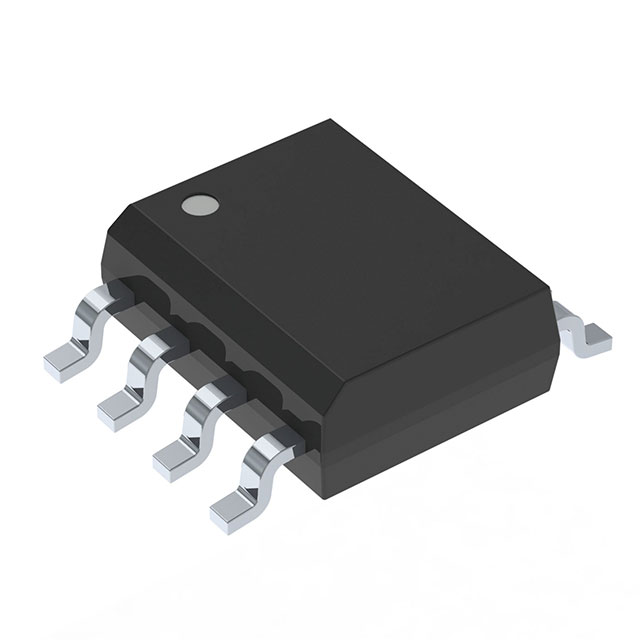
Key Specs
| Spec | Value | Condition | Source |
|---|---|---|---|
| Channel Type | Independent | Digi-Key | |
| Current Peak Output Source Sink | 5A, 5A | Digi-Key | |
| Digikey Programmable | Not Verified | Digi-Key | |
| Driven Configuration | Low-Side | Digi-Key | |
| Gate Type | MOSFET (N-Channel) | Digi-Key | |
| Input Type | Non-Inverting | Digi-Key | |
| Logic Voltage Vil Vih | - | Digi-Key | |
| Mounting Type | Surface Mount | Digi-Key | |
| Number Of Drivers | 2 | Digi-Key | |
| Operating Temperature Range | -40°C ~ 150°C (TJ) | Digi-Key | |
| Package Case | 8-SOIC (0.154”, 3.90mm Width) | Digi-Key | |
| Rise Fall Time (Typ) | 5.3ns, 4.5ns | Digi-Key | |
| Supplier Device Package | PG-DSO-8-60 | Digi-Key | |
| Voltage Supply | 4.5V ~ 20V | Digi-Key |
When To Use
-
4.5V to 12V step-down @ 3A: The 4.5V minimum supply voltage allows operation from common 5V rails with margin, while the 5A peak current source/sink rating covers transient load surges up to 3A steady-state comfortably. Using a synchronous buck controller without integrated gate drivers here risks shoot-through if gate timing is not precisely tuned.
-
High-frequency PWM gate drive in motor control: The typical rise/fall times of 5.3ns/4.5ns enable fast switching of N-channel MOSFETs, minimizing switching losses and improving efficiency at frequencies approaching a few hundred kHz. A low-IQ PFM buck or linear regulator would suffer from excessive switching delays or power dissipation, respectively.
-
Low-side MOSFET gate drive in automotive ECU (-40°C to 150°C): The wide junction temperature range supports harsh automotive environments, preventing thermal runaway or latch-up seen in parts rated for lower TJ. Controllers designed for narrower temperature ranges risk premature failure or derating under engine bay conditions.
When Not To Use
-
Output current above 5A continuous: The 5A peak current rating limits sustained load capability. For loads exceeding this, use a multi-phase buck controller to distribute current and reduce thermal stress.
-
Input/output differential under 1V with noise-sensitive analog loads: The part’s non-inverting input and MOSFET gate drive require a minimum voltage headroom; it is not optimized for low dropout operation. An LDO regulator is better suited when dropout voltage and noise are critical.
-
Switching frequency above 500kHz for compact magnetics: The rise/fall time and internal gate drive strength of this part do not guarantee stable operation above 500kHz. A high-frequency buck controller designed for >500kHz switching should be selected instead.
Application Notes
-
The switching node (SW) must have a compact, low-inductance layout to minimize voltage overshoot and ringing caused by the fast 5.3ns rise time; long traces or large loop areas will degrade switching performance.
-
Pins 2 and the gate drive outputs pin are noise-sensitive and should be routed away from analog or low-level signals to prevent coupling interference, especially in mixed-signal environments.
-
Ground returns for the driver and power MOSFET source must be star-connected near the package to avoid ground bounce that can cause false switching or erratic gate drive behavior.
-
Use a low-ESR bootstrap or supply decoupling capacitor close to the IC to ensure stable gate voltage during high di/dt transitions and prevent undervoltage lockout.
-
Guard routing for the gate drive lines is recommended to shield them from high dV/dt switching nodes, preventing unintended turn-on or cross-conduction.
Gotchas
-
[Bootstrap capacitor undervoltage]: Designers sometimes assume the internal gate driver can start switching immediately after power-up without verifying bootstrap capacitor voltage. If the bootstrap voltage is insufficient, the gate drive amplitude will be reduced, leading to incomplete MOSFET turn-on, elevated conduction losses, and thermal hotspots visible on the MOSFET package. Fix: Measure the bootstrap voltage during startup and ensure correct capacitor sizing and placement per datasheet guidelines.
-
[Ground bounce causing false triggering]: The fast 5.3ns rise time combined with high transient current can cause local ground potential shifts if the PCB return path is not low inductance. This manifests as random switching glitches or oscillations on the gate drive waveform observed on the scope. Fix: Implement a solid, low impedance ground plane with short return paths and separate analog/digital grounds tied at a single point.
-
[Undetected cross-conduction in low-side only configuration]: Because this part drives only low-side N-MOSFETs, engineers may neglect dead-time insertion or rely on external timing, assuming no risk of shoot-through. In reality, insufficient dead-time can cause shoot-through current spikes and device heating. Fix: Design gate drive timing carefully with external dead-time control or use dedicated gate driver protections.
-
[ESR of output capacitor affecting switching stability]: It is tempting to select low-ESR ceramic capacitors for output filtering, but too low ESR can interact with the driver’s fast switching edges and cause LC ringing or instability. This appears as high-frequency oscillations on the output voltage waveform and occasional gate driver current spikes. Fix: Verify capacitor ESR per datasheet recommendations and consider adding a small ESR or damping resistor if instability is observed.