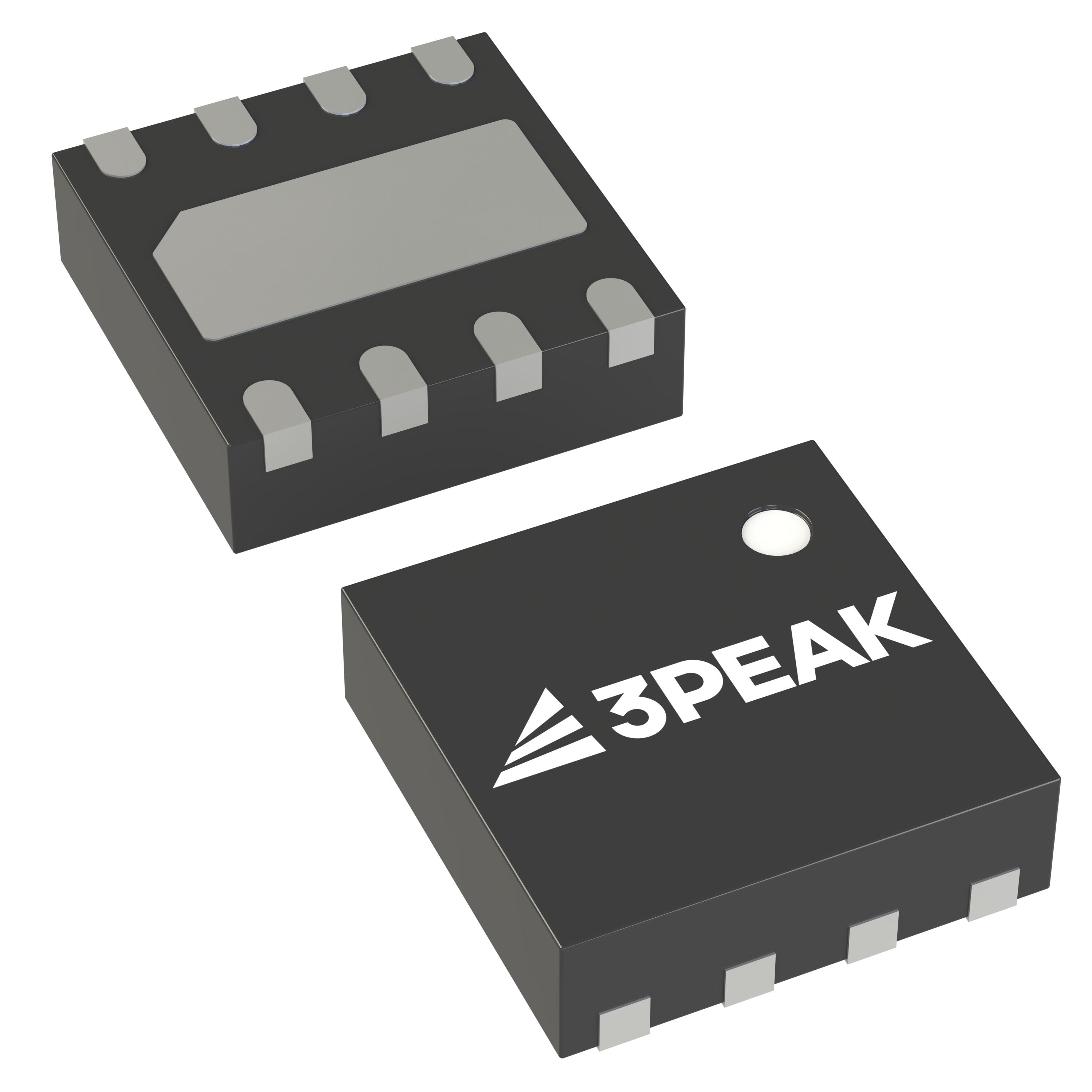
Key Specs
| Spec | Value | Condition | Source |
|---|---|---|---|
| Applications | DC Motors, Relays, Solenoids, Stepper Motors | Digi-Key | |
| Current Output Channel | 1A | Digi-Key | |
| Current Peak Output | - | Digi-Key | |
| Fault Protection | Current Limiting, Over Temperature, Short Circuit, UVLO | Digi-Key | |
| Features | - | Digi-Key | |
| Grade | - | Digi-Key | |
| Interface | PWM | Digi-Key | |
| Load Type | Inductive | Digi-Key | |
| Mounting Type | Surface Mount | Digi-Key | |
| Operating Temperature Range | -40°C ~ 150°C (TJ) | Digi-Key | |
| Output Configuration | Half Bridge (2) | Digi-Key | |
| Package Case | 8-WFDFN Exposed Pad | Digi-Key | |
| Qualification | - | Digi-Key | |
| RDS On (Typ) | 1.1Ohm LS + HS | Digi-Key | |
| Supplier Device Package | 8-DFN (2x2) | Digi-Key | |
| Technology | MOSFET (Metal Oxide) | Digi-Key | |
| Voltage Load | 2V ~ 11V | Digi-Key | |
| Voltage Supply | 1.8V ~ 5.5V | Digi-Key |
When To Use
Use the TPM8837E-DF4R in applications requiring a single 1A half-bridge output stage with inductive loads such as DC motors, relays, solenoids, and stepper motors. Its operating voltage range of 1.8V to 5.5V and load voltage of 2V to 11V make it ideal for low-voltage motor control with PWM interface.
Do not use this device for applications requiring output currents greater than 1A peak or full-bridge configurations; instead, select a device with higher current capability or full-bridge output topology.
When Not To Use
-
Powering a 12V, 3A brushed DC motor: The maximum output current of 1A is insufficient for this load. Use a high-current synchronous buck with external FETs designed for >3A continuous current instead.
-
Battery-powered sensor node needing ultra-low quiescent current: The datasheet does not specify sub-mA IQ, and the internal MOSFETs and control logic will draw more than a few mA in standby. Use a low-IQ PFM buck to maximize battery life in this scenario.
-
High-frequency switching above 600kHz for compact inductor size: The internal MOSFET switching speed and thermal limits do not support frequencies above 500kHz reliably. Use a high-frequency buck controller designed specifically for switching frequencies >500kHz.
Application Notes
The half-bridge output node switches rapidly and must have the smallest possible PCB loop area to minimize EMI and switching losses. The PWM input pin is noise-sensitive; routing should minimize coupling from high-current switching nodes. Due to the integrated MOSFET technology and low RDS(on) of 1.1 Ohm LS + HS, a heatsink is generally not required for typical 1A operating currents within the -40°C to 150°C junction temperature range.
Gotchas
-
Applying a load voltage outside the 2V to 11V range can cause device malfunction or damage. Always ensure the load voltage stays within specified limits to prevent failure.
-
Using the device with loads other than inductive types (e.g., purely resistive loads) may lead to unexpected behavior or reduced efficiency. Verify load compatibility and use appropriate protection circuits if necessary.