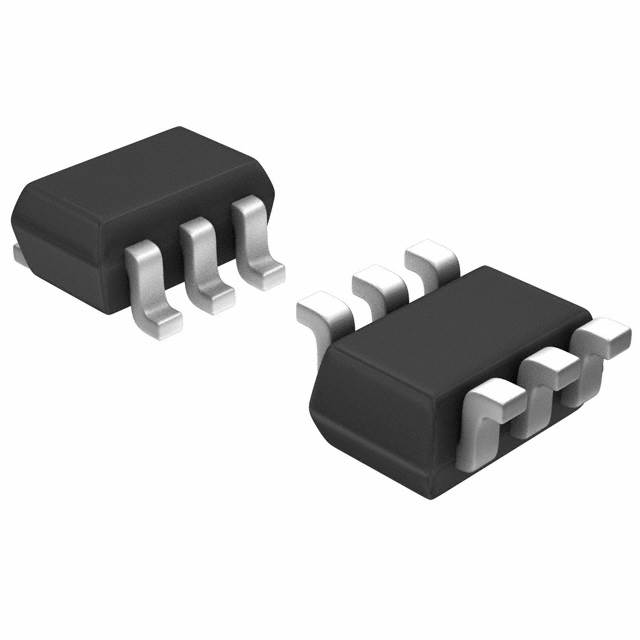
Component Comparison: NX3008NBKS,115 vs TPM8837E-DF4R
Quick verdict
For low-voltage, low-current switching applications requiring discrete MOSFETs or simple dual MOSFET arrays, the NX3008NBKS,115 is preferable due to its automotive qualification, lower gate charge, and higher voltage rating (30 V). For integrated half-bridge driver applications such as driving small DC motors or solenoids with built-in protections and PWM control, the TPM8837E-DF4R is the better choice, offering 1 A output current capability and fault protections not available in the NX3008NBKS.
Spec comparison table
| Spec | NX3008NBKS,115 | TPM8837E-DF4R | Notes |
|---|---|---|---|
| Device type | Dual N-Channel MOSFET array | Half Bridge MOSFET driver | TPM8837E integrates driver and MOSFETs, NX3008NBKS is discrete MOSFET array |
| Voltage rating (Drain-Source) | 30 V (max) | 2 V ~ 11 V | NX3008NBKS supports higher voltage, suitable for 30 V rails vs TPM8837E limited to 11 V |
| Continuous drain current | 350 mA (typ & min) | 1 A (output channel) | TPM8837E supports nearly 3x higher current, better for higher load currents |
| Peak drain current | 1.4 A | Not specified | NX3008NBKS data available; TPM8837E peak not specified |
| R_DS(on) typical @ 25°C | 1 Ω to 1.4 Ω (350 mA, 4.5 V gate) | 1.1 Ω (LS + HS) | Comparable on-resistance; TPM8837E includes both low and high side MOSFETs |
| Gate charge (Q_g) typical @ 25°C | 0.52 - 0.68 nC @ 4.5 V | Not specified | NX3008NBKS has very low gate charge, beneficial for switching losses |
| Gate threshold voltage (V_GS(th)) typical | 0.6 - 0.9 - 1.1 V | Not specified | NX3008NBKS is logic-level gate, suitable for 3.3 V and 5 V logic |
| Gate voltage max/min | ±8 V | Not specified | NX3008NBKS data available; TPM8837E gate drive specifics not provided |
| Input capacitance (C_iss) typical @ 25°C | 34 - 50 pF | Not specified | NX3008NBKS low input capacitance reduces gate drive losses |
| Output capacitance (C_oss) typical | 6.5 pF | Not specified | NX3008NBKS data only |
| Reverse transfer capacitance (C_rss) typical | 2.2 pF | Not specified | NX3008NBKS data only |
| Power dissipation max | 445 mW | Not specified | NX3008NBKS data only; TPM8837E thermal limits undocumented |
| Operating temperature range | -55°C to +150°C | -40°C to +150°C | NX3008NBKS wider low-temp rating, beneficial for automotive/industrial |
| Package | 6-TSSOP (2.2 x 1.35 mm) | 8-DFN (2 x 2 mm) | TPM8837E package smaller footprint but different pinout |
| Mounting type | Surface mount | Surface mount | Both surface mount |
| Electrostatic discharge rating | 2000 V (max) | Not specified | NX3008NBKS ESD rating known |
| Fault protection | None | Current limiting, over-temp, short circuit, UVLO | TPM8837E has integrated protections, reduces external circuitry |
| Output configuration | 2 N-Channel MOSFET (Discrete) | Half bridge (2 MOSFETs + driver) | TPM8837E integrates driver and MOSFETs, simplifying design |
| Interface | Discrete MOSFET | PWM | TPM8837E designed for PWM control |
| Load type | Generic MOSFET switch | Inductive (motors, relays, solenoids) | TPM8837E targeted for inductive load switching |
| Supplier device package | 6-TSSOP | 8-DFN (2x2) | Different package types |
Design trade-offs
The NX3008NBKS,115 is a dual discrete MOSFET array optimized for low-voltage switching up to 30 V with a continuous drain current of 350 mA. Its low gate charge (~0.6 nC) and relatively low input capacitance (34–50 pF) make it suitable for applications requiring efficient switching at moderate frequencies and low gate drive current. The device’s AEC-Q101 qualification and wide temperature range down to -55 °C make it a solid choice for automotive and industrial environments where robustness and reliability are critical. However, the relatively high on-resistance (1 to 1.4 Ω at 350 mA) limits its efficiency and power dissipation, especially when larger currents are involved.
By contrast, the TPM8837E-DF4R integrates a half-bridge driver with MOSFETs capable of delivering up to 1 A continuous current. This integration simplifies system design by incorporating fault protections like current limiting, over-temperature shutdown, short-circuit protection, and undervoltage lockout (UVLO). These features reduce the need for external protection components and firmware complexity for fault handling. Its operating voltage range is limited to 11 V maximum, making it unsuitable for 30 V rails, but well targeted for low-voltage inductive loads such as small motors and solenoids.
Thermally, the NX3008NBKS is limited to 445 mW power dissipation max, which is quite low and requires careful thermal design for continuous operation near max current. Its high thermal resistance (up to 445 K/W per transistor junction-to-ambient) means it dissipates heat inefficiently, necessitating PCB copper area or heatsinking to maintain junction temperature. The TPM8837E’s thermal characteristics are unspecified in the source data, but integration of driver and MOSFETs and its higher current capability suggest it is internally optimized for thermal management in typical motor driver use cases.
From a gate drive perspective, NX3008NBKS requires discrete gate drive signals and careful drive strength to switch the MOSFETs efficiently, especially given its gate charge and threshold voltage. TPM8837E’s PWM interface and integrated driver remove this burden, providing cleaner and more reliable switching control with minimal external components. This also reduces layout sensitivity, as the internal driver handles gate drive timing and dead-time management inherent to half-bridge operation.
Cost-wise, the NX3008NBKS is likely less expensive per unit due to its simpler discrete MOSFET architecture and older package technology. The TPM8837E, with integrated driver and protections, will command a higher price but reduce BoM and design complexity, potentially lowering overall system cost in motor control or inductive load applications.
Use-case fit
Choose NX3008NBKS,115 when…
- You need a dual discrete logic-level MOSFET array for low-current switching up to 30 V rails, such as signal switching or level shifting.
- Automotive or industrial environments requiring AEC-Q101 qualification and extended temperature range (-55 °C to +150 °C).
- Designing efficient low-frequency switching circuits where low gate charge reduces driver losses.
- Applications where external driver ICs are already present or gate drive control is custom and discrete.
- Space-constrained designs where 6-TSSOP package footprint is preferable over larger driver ICs.
Choose TPM8837E-DF4R when…
- Driving small DC motors, relays, solenoids, or stepper motors with up to 1 A current at voltages up to 11 V.
- You require integrated fault protections (current limiting, short-circuit, over-temperature, UVLO) to simplify system design.
- PWM control interface is needed for efficient speed or torque control.
- You want to offload gate drive and half-bridge management to a single IC, reducing PCB complexity and component count.
- Applications where component count and firmware complexity must be minimized, such as compact motor drivers or embedded actuator controllers.
Drop-in compatibility
These two parts are not pin-compatible nor footprint-compatible. The NX3008NBKS,115 comes in a 6-TSSOP package with discrete dual MOSFETs, while the TPM8837E-DF4R is an integrated half-bridge driver in an 8-DFN (2x2 mm) package with a completely different pinout and internal architecture. Substituting one for the other requires redesigning the PCB footprint, modifying gate drive and control circuitry, and adjusting power and thermal management. There is no direct drop-in replacement path between these devices.
Alternatives to consider
- BSS138 (N-channel MOSFET): Widely available, very low gate charge, suitable for low-voltage switching; popular for logic-level applications.
- IRLML2502 (Discrete logic-level MOSFET): Low R_DS(on) at logic voltages