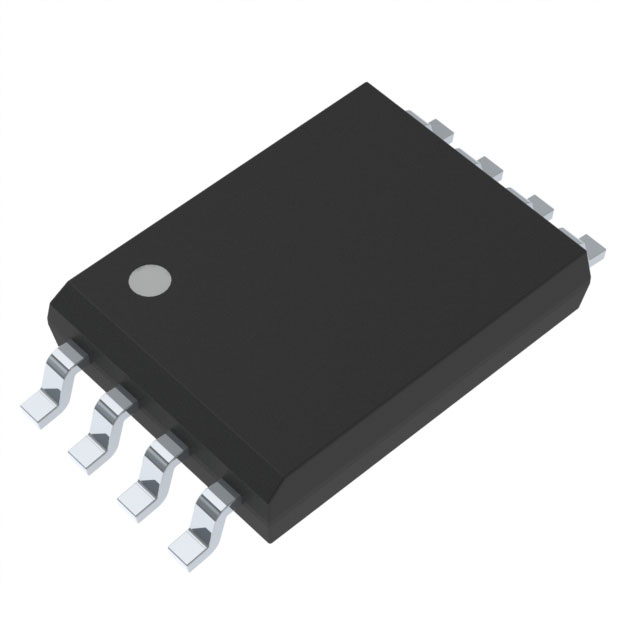
Key Specs
| Spec | Value | Condition | Source |
|---|---|---|---|
| Approval Agency | UL | Digi-Key | |
| Common Mode Transient Immunity (Min) | 100V/ns | Digi-Key | |
| Current Output High Low | 4A, 4A | Digi-Key | |
| Current Peak Output | 4A | Digi-Key | |
| Mounting Type | Surface Mount | Digi-Key | |
| Number Of Channels | 1 | Digi-Key | |
| Operating Temperature Range | -40°C ~ 125°C | Digi-Key | |
| Package Case | 8-SOIC (0.295”, 7.50mm Width) | Digi-Key | |
| Propagation Delay Tplh Tphl (Max) | 90ns, 90ns | Digi-Key | |
| Pulse Width Distortion (Max) | 20ns | Digi-Key | |
| Rise Fall Time (Typ) | 30ns, 30ns | Digi-Key | |
| Supplier Device Package | 8-SO | Digi-Key | |
| Technology | Capacitive Coupling | Digi-Key | |
| Voltage Forward Vf (Typ) | - | Digi-Key | |
| Voltage Isolation | 5000Vrms | Digi-Key | |
| Voltage Output Supply | 3V ~ 5.5V | Digi-Key |
When To Use
-
Isolated 3.3V gate drive @ 4A peak: The 4A peak output current and 26V gate driving voltage max support driving power MOSFET gates in isolated half-bridge or bridge stages, with immunity to 100 V/ns common mode transients ensuring clean switching edges. Using a non-isolated synchronous buck controller here would risk latch-up or shoot-through due to insufficient isolation and transient immunity.
-
Industrial automation sensor interface with 3.3V logic: The STGAP2SICSC’s 3.3–5.5 V logic supply range and input thresholds matched to TTL/CMOS inputs allow direct interface with standard industrial sensors and controllers, while the 3.5 kVRMS isolation voltage and UL approval guarantee safety and noise robustness. A simple LDO regulator or non-isolated driver might fail due to transient overvoltages causing device latch-up or damage.
-
Short-circuit protected gate driver for power modules: The clamp threshold at 2 V typ and max short-circuit clamp current of 5 A provide active protection against shoot-through or gate overvoltage conditions, preventing thermal runaway of the driven transistor. A generic driver without clamp function risks destructive gate oxide breakdown or uncontrolled current spikes under fault conditions.
When Not To Use
-
Output current above 4 A continuous: The max output current rating of 4 A disqualifies this device for high-current applications. Use a high-current synchronous buck with external FETs designed to handle currents beyond this limit.
-
Switching frequency above 1 MHz: With a typical maximum switching frequency of 1 MHz and a max pulse width distortion of 20 ns, this part is unsuitable for very high-frequency designs. Use a high-frequency buck controller for switching frequencies significantly exceeding 1 MHz.
-
Battery-powered device requiring ultra-low quiescent current: The standby supply current minimum of 400 µA and max of 65 µA is too high for µA sleep-mode or coin cell powered designs. Use a low-IQ PFM buck controller optimized for sub-µA quiescent current.
Application Notes
-
The switching node (SW) should be routed with minimal loop area and away from noise-sensitive input pins (such as pin 3, the logic input) to maintain the 100 V/ns common-mode transient immunity.
-
Place SMT ceramic capacitors within 8 mm of the supply rail pins to minimize parasitic inductance and ensure stable operation, as recommended by the PCB layout guideline.
-
Avoid routing any traces or copper planes beneath the driver IC to prevent coupling noise that can cause erratic switching or false triggering.
-
Power transistors must be placed close to the driver to minimize gate drive loop inductance, ensuring the 75 ns max propagation delay is not degraded by layout parasitics.
-
Ensure the clamp pin (CLAMPth) has a capacitor within the specified 1 µF to 10 µF range and placed close to the IC to guarantee correct clamp threshold operation and short-circuit protection timing.
Pin numbers are package-specific. Verify against the datasheet pinout diagram before routing.
Gotchas
-
[Clamp capacitor value below minimum]: Designers often use smaller capacitors (<1 µF) on the CLAMPth pin to save board space, assuming any capacitor will suffice. This causes the clamp threshold to shift unpredictably, leading to unreliable short-circuit protection and occasional shoot-through events. Fix by using a capacitor within the 1 µF to 10 µF range as specified.
-
[Ignoring input pull-down resistor impact]: Assuming the input pin can be left floating or driven by a weak source without considering the internal 100 kΩ pull-down resistor leads to slow turn-off edges and possible unintended conduction. This manifests as output glitches or partial gate drive. Fix by ensuring the input driver can sink/source current to override the pull-down effectively.
-
[Inadequate clearance and creepage]: Violating the 8 mm minimum clearance and creepage distances on the PCB, especially under high-voltage isolation conditions, can cause arc-over or insulation breakdown during transients, leading to permanent device failure. Fix by strictly maintaining the 8 mm minimum distances in layout and conformal coating.
-
[Startup sequencing without VDD ramp control]: Applying the positive supply voltage (VH) before the logic supply (VDD) or vice versa without controlled ramp rate can cause the device to enter undefined states or fail to wake up properly, observed as no gate drive output on scope. Fix by sequencing supplies with the VDD rail stabilized before VH or adding soft-start circuitry.