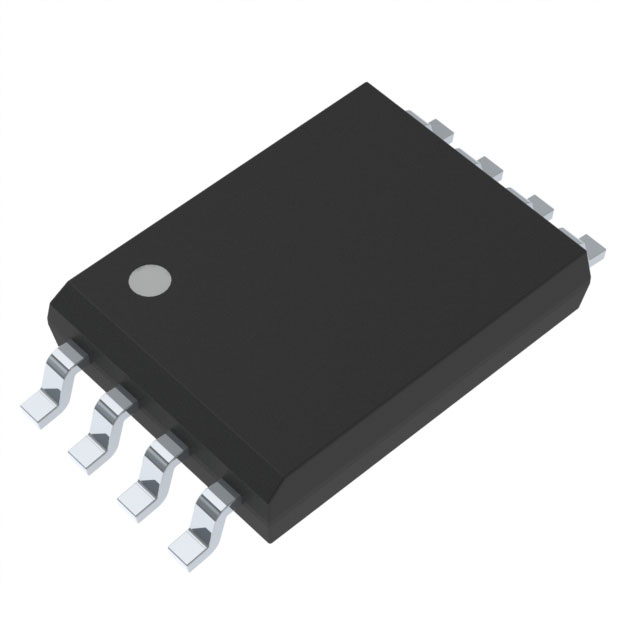
Key Specs
| Spec | Value | Condition | Source |
|---|---|---|---|
| Technology | Capacitive Coupling | Digi-Key | |
| Number Of Channels | 1 | Digi-Key | |
| Voltage Isolation | 3530Vrms | Digi-Key | |
| Common Mode Transient Immunity (Min) | 100V/ns | Digi-Key | |
| Propagation Delay Tplh Tphl (Max) | - | Digi-Key | |
| Pulse Width Distortion (Max) | 20ns | Digi-Key | |
| Rise Fall Time (Typ) | 30ns, 30ns | Digi-Key | |
| Current Output High Low | - | Digi-Key | |
| Current Peak Output | 4A | Digi-Key | |
| Voltage Forward Vf (Typ) | - | Digi-Key | |
| Voltage Output Supply | 3.1V ~ 5.25V | Digi-Key | |
| Grade | Automotive | Digi-Key | |
| Qualification | AEC-Q100 | Digi-Key | |
| Operating Temperature Range | -40°C ~ 125°C | Digi-Key | |
| Mounting Type | Surface Mount | Digi-Key | |
| Package Case | 8-SOIC (0.295”, 7.50mm Width) | Digi-Key | |
| Supplier Device Package | 8-SO | Digi-Key | |
| Approval Agency | UL | Digi-Key |
When To Use
-
Automotive Half-Bridge Gate Driver Applications: Use the STGAP2SICSACTR when designing automotive-grade half-bridge drivers requiring up to 4 A peak gate current, operating voltages up to 1200 V, and compliance with AEC-Q100 qualification. Its galvanic isolation voltage of 3530 Vrms and common mode transient immunity of 100 V/ns make it ideal for harsh automotive environments.
-
Isolated Gate Drive in High-Voltage Motor Control: When galvanic isolation with capacitive coupling and a maximum isolation withstand voltage of 3535 VRMS is required, this device fits well. Use it when a compact SO-8W package and surface mount are needed.
-
When Not To Use: Avoid using this driver in applications requiring output current above 4 A peak or switching frequencies exceeding 1 MHz, as the maximum switching frequency is limited to 1 MHz and output current max is 4 A. For higher currents or frequencies, consider dedicated high-current isolated gate drivers or drivers with integrated bootstrap circuits.
-
Not Suitable for Low-Voltage Logic Only Systems: If isolation or high-voltage operation is not required, simpler non-isolated drivers with lower propagation delay and pulse width distortion may be more cost-effective.
When Not To Use
-
Output current > 4 A continuous at 25°C: The 4 A peak driver current limit disqualifies this part for high-current loads beyond its rating. A high-current synchronous buck with external FETs controller should be used for scalable current capacity and better thermal management.
-
Switching frequency > 1 MHz for compact inductors: The max switching frequency is limited to 1 MHz. For applications needing > 500 kHz to reduce inductor size or EMI, a high-frequency buck controller is required.
-
Battery-powered IoT device with μA sleep current: Typical standby quiescent current around 700 µA is too high for ultra-low power sleep modes. A low-IQ PFM buck regulator is more suitable to achieve multi-year battery life.
Application Notes
-
The high-voltage half-bridge output node switches rapidly and must have the smallest possible loop area to minimize EMI and voltage overshoot. Keep gate drive loop lengths short and use appropriate PCB layout techniques.
-
The input logic pins are noise-sensitive and require stable, filtered signals with proper pull-down resistors (60 kΩ to 160 kΩ) to prevent false triggering due to noise or crosstalk.
-
The device’s thermal resistance of 130 °C/W requires careful thermal management at representative operating points,
Gotchas
-
Incorrect Isolation Capacitor Selection: Using a capacitor with ESR higher than specified or capacitance below 100 nF causes degraded isolation performance and potential signal distortion. This leads to unreliable gate drive signals or loss of isolation integrity. To fix, select a capacitor rated for low ESR and at least 100 nF.
-
Insufficient Decoupling on Supply Lines: Omitting or undersizing the supply decoupling capacitors may cause voltage dips during switching transients, resulting in increased propagation delay and potential device malfunction. Always use pulsed current capacitors of at least 1 µF typ and 10 µF max as recommended.
-
Floating or Improperly Biased Inputs: Failing to provide pull-down resistors (minimum 60 kΩ) on inputs can cause undefined logic states, leading to erratic switching or device latch-up. Ensure pull-down resistors are installed with typical values around 100 kΩ.
-
Exceeding Maximum Junction Temperature: Operating at or above 150 °C junction temperature without adequate thermal management can cause permanent damage. Use proper PCB thermal design and avoid continuous operation at peak currents without heat sinking.