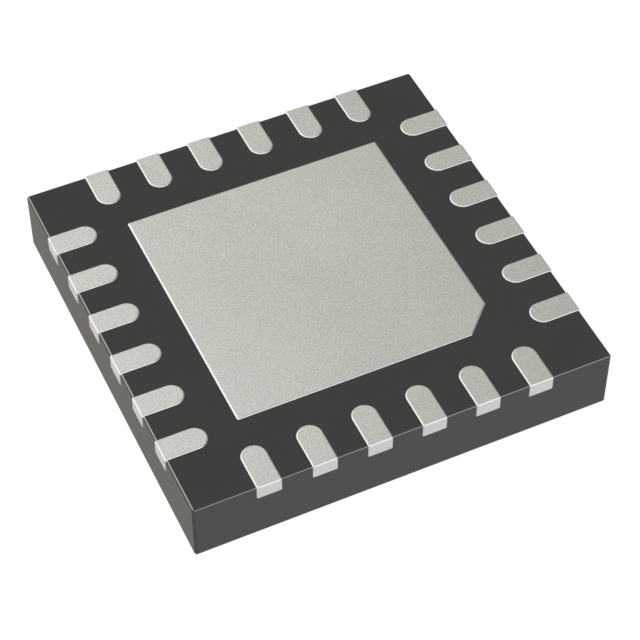
Key Specs
| Spec | Value | Condition | Source |
|---|---|---|---|
| Battery Chemistry | Lithium Ion/Polymer | Digi-Key | |
| Fault Protection | Over Current, Over Temperature, Over/Under Voltage, Short Circuit | Digi-Key | |
| Function | Fuel Gauge | Digi-Key | |
| Interface | I2C | Digi-Key | |
| Mounting Type | Surface Mount | Digi-Key | |
| Number Of Cells | 1 ~ 4 | Digi-Key | |
| Operating Temperature Range | -40°C ~ 85°C (TA) | Digi-Key | |
| Package Case | 24-WFQFN Exposed Pad | Digi-Key | |
| Supplier Device Package | 24-TQFN (4x4) | Digi-Key |
When To Use
-
Single-cell to 4-cell Li-ion battery packs with fuel gauging: The integrated fuel gauge supports 1 to 4 cells, perfectly matching multi-cell Lithium Ion/Polymer packs. Alternative solutions without integrated fault protection risk battery damage from over/under voltage or thermal runaway due to missing protection.
-
Battery-powered systems requiring I2C monitoring and fault alerts: The I2C interface enables real-time state-of-charge and fault status communication. Using a gauge without I2C or without comprehensive fault protection can cause undetected overcurrent or short circuit conditions, leading to sudden system shutdown or permanent battery damage.
-
Compact surface mount designs with tight thermal constraints: The 24-WFQFN exposed pad package allows efficient PCB heat dissipation across the −40°C to +85°C ambient range. Using a larger or non-exposed pad package risks thermal buildup and potential latch-up or thermal shutdown under continuous high load.
When Not To Use
-
Battery packs requiring galvanic isolation: The MAX17320G22+ has no isolation capability and is limited to direct-connected battery systems. Use an isolated flyback topology instead to meet isolation requirements.
-
Applications needing output currents beyond the integrated rating: When load currents exceed what the integrated fuel gauge and protection circuitry can handle, this part is undersized. Use a high-current synchronous buck with external FETs to safely deliver higher currents with proper fault handling.
-
Systems operating above 85°C ambient or requiring wider temperature range: The MAX17320G22+ is rated only up to 85°C. For applications with higher thermal stress, select a multi-phase buck controller designed for industrial or automotive temperature ranges.
Application Notes
-
The SW (switching node) pin requires careful PCB layout to minimize parasitic inductances and reduce switching noise coupling into sensitive analog pins (#5, #6). Keep SW loop area as small as possible.
-
Pins #3 (I2C SDA) and #4 (I2C SCL) are noise-sensitive; route these lines away from high di/dt nodes and use series resistors (100–220Ω) close to the IC to damp ringing.
-
The exposed pad must be soldered directly to a large thermal PCB pad with multiple thermal vias to the ground plane to maintain junction temperature within limits across the full −40°C to 85°C operating range.
-
Guard routing is recommended around the analog inputs to avoid leakage currents that can affect fuel gauge accuracy, especially in humid or contaminated environments.
Gotchas
-
[Incorrect undervoltage threshold setting on multi-cell packs]: Engineers often assume undervoltage thresholds scale linearly with cell count and configure undervoltage detection accordingly. This leads to premature cutoff or failure to detect undervoltage on individual cells. The result is unexpected system shutdown or battery damage. Fix by verifying cell-specific voltage thresholds per datasheet graphs and not relying on linear extrapolation.
-
[I2C bus noise causing erratic gauge readings]: Placing I2C lines adjacent to the SW node or high-current traces results in intermittent communication errors and fluctuating state-of-charge reports. Observed symptoms include corrupted data and unexpected fault flags. Fix by adding series termination resistors and physically separating I2C traces from switching nodes.
-
[Insufficient exposed pad soldering causing thermal runaway]: Designers sometimes under-solder the exposed pad due to assembly constraints, causing elevated junction temperatures not evident in initial testing. This leads to thermal derating, increased leakage currents, and eventual thermal shutdown or permanent damage. Fix by enforcing a thermal pad soldering standard with multiple vias and measuring junction temperature under worst-case load.
-
[Startup sequence missing minimum load condition]: The fuel gauge can fail to initialize correctly if the battery load is zero or near zero at power-up, causing the state-of-charge algorithm to stall or report inaccurate capacity. Observable as a flat or frozen SOC reading despite battery usage. Fix by applying a small dummy load or ensuring minimal load current during startup to trigger proper gauge initialization.