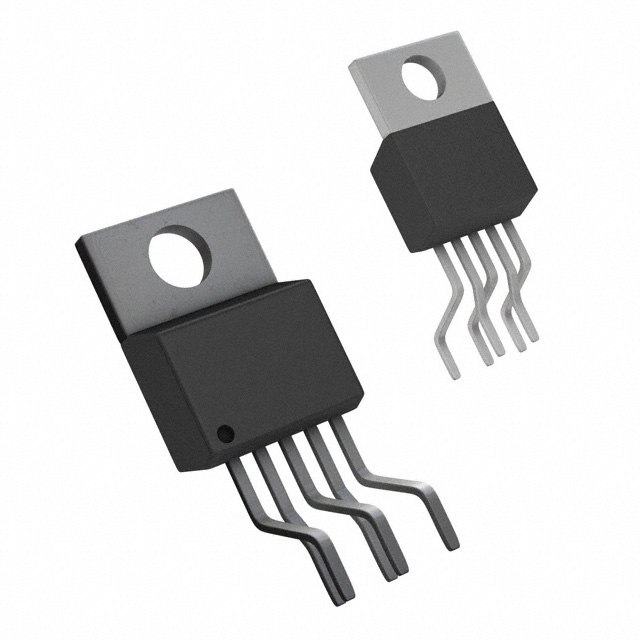
Key Specs
| Spec | Value | Condition | Source |
|---|---|---|---|
| function | Step-Down | 🔵 api | |
| output_configuration | Positive | 🔵 api | |
| topology | Buck | 🔵 api | |
| output_type | Adjustable | 🔵 api | |
| number_of_outputs | 1 | 🔵 api | |
| input_voltage_min | 4.5V | 🔵 api | |
| input_voltage_max | 40V | 🔵 api | |
| output_voltage_min | 1.2V | 🔵 api | |
| output_voltage_max | 37V | 🔵 api | |
| output_current_max | 3A | 🔵 api | |
| switching_frequency_typ | 150kHz | 🔵 api | |
| synchronous_rectifier | No | 🔵 api | |
| operating_temperature_range | -40°C ~ 125°C (TJ) | 🔵 api | |
| mounting_type | Through Hole | 🔵 api | |
| package_case | TO-220-5 Formed Leads | 🔵 api | |
| supplier_device_package | TO-220-5 | 🔵 api |
When To Use
-
24V industrial/24V bus → 16.0V @ 3A: The LM2596T-ADJ supports up to 40V input and 3A output, fitting a 24V supply with margin and delivering the full 3A load without thermal or current limit issues. A lower current-rated buck or a synchronous buck controller designed for smaller currents risks thermal runaway or premature shutdown under sustained 3A loads.
-
12V automotive/battery rail → 5.0V @ 1.5A: With a 4.5V minimum input and 3A output rating, this device comfortably regulates down from 12V at 1.5A, offering robust operation in automotive environments with transient voltages up to 40V. Linear regulators or LDOs would dissipate excessive heat ((12−5)×1.5=10.5W), causing thermal shutdown or device destruction.
-
4.5V–40V wide-input supply → 1.2V–16.0V @ 2.2A: The wide input voltage range and adjustable output voltage down to 1.2V make this part ideal for applications requiring flexible output setpoints from a variable supply. Using a synchronous buck controller instead might be preferable for efficiency but risks complexity or shoot-through if not properly designed; here, the LM2596T-ADJ’s proven topology avoids such risks.
When Not To Use
-
Efficiency-critical 3A output with minimal losses:
Disqualified by: lack of synchronous rectifier.
Use a high-current synchronous buck with external FETs to reduce diode conduction losses and avoid excessive power dissipation. -
Output current demand above 3A (e.g., 5A load):
Disqualified by: output current max 3A.
Use a multi-phase buck controller that can share current across multiple phases and handle higher load currents without thermal or current-limit failure. -
Input voltage lower than 4.5V or low dropout operation:
Disqualified by: input voltage min 4.5V, minimum dropout typically higher than LDO regulators.
Use an LDO regulator when input-to-output differential is less than 1V and low noise is critical.
Application Notes
IC dissipates ≈6.3W at Vin=40V→Vout=19.1V @ 1.5A (η≈82%). θJA = 50°C/W (TO-220, no heatsink, per datasheet). At 25°C ambient: TJ = 25 + 6.3×50 = 340°C — EXCEEDS the 125°C maximum. Heatsink is mandatory at full load. With a small heatsink (θJA ≈ 20°C/W): TJ ≈ 151°C.
- The switching node (SW) pin (pin 2) carries high di/dt and voltage spikes; minimize loop area around SW, input capacitor, and catch diode to reduce EMI and voltage ringing.
- the feedback pin and the adjust pin are noise-sensitive; route these away from noisy traces and provide a clean ground reference to maintain output voltage accuracy.
- Use a low-ESR input capacitor close to the regulator input pin to stabilize the input voltage and minimize input ripple.
- Ground returns for the input capacitor, output capacitor, and feedback pin must be star connected to avoid ground bounce affecting regulation.
Pin numbers are package-specific. Verify against the datasheet pinout diagram before routing.
Minimum External Components
Catch diode — Schottky, Vr ≥ 40V, If ≥ 3A Selection: Schottky forward recovery < 10ns vs 200–500ns for silicon. At 150kHz (period = 6.7µs), a 500ns-recovery diode is off for only 6.2µs before the next switch-on — it never fully turns off. Failure mode: Standard silicon rectifier: 200–500ns reverse recovery at 150kHz causes shoot-through current spikes every cycle — IC switch current exceeds rating, causing thermal runaway or immediate failure.
Output inductor — 68µH Selection: Isat ≥ 3.8A (peak current at max load). DCR < 100mΩ to limit conduction loss. At Vin=22V→Vout=5.5V: range is 33–68µH (30%→15% current ripple). Use 68µH for good regulation; 33µH acceptable if BOM cost is critical. Isat must be ≥ 3.8A — under-sizing Isat is the leading cause of field failures: the inductor saturates under peak current, spiking IC switch current beyond its rating. Failure mode: Isat below peak inductor current → core saturates → effective inductance collapses → switch current spikes beyond IC rating → thermal shutdown or permanent failure.
Input capacitor — ≥100µF electrolytic + 100nF ceramic (parallel) Selection: Electrolytic handles bulk ripple current; ceramic bypasses switching spikes. Voltage rating ≥ 40V with 20% margin. Failure mode: Insufficient input capacitance: supply rail collapses during switch-on current demand → output droops → erratic regulation and potential latch-up.
Output capacitor — ≥100µF electrolytic Selection: ESR < 200mΩ to keep output ripple below 50mVpp. Voltage rating ≥ 46V. Failure mode: High-ESR electrolytic: output ripple voltage = ESR × ΔIL. At 1A ripple and 500mΩ ESR → 500mVpp ripple — exceeds spec for virtually all loads.
Feedback resistors R1 / R2 — R1 = 1.21kΩ (1%), R2 = R1 × (Vout/1.2 − 1) Selection: 1% metal-film tolerance minimum. R1 sets the bias current into the FB divider; values 1.21kΩ–10kΩ keep FB current in the datasheet-recommended range. Failure mode: 5% resistors introduce ±5% Vout error. R1 too large (>100kΩ) → FB pin susceptible to noise injection → oscillation or false regulation.
Design Equations
Output voltage: Vout = 1.2V × (1 + R2/R1)
R1 is typically 1.21kΩ–10kΩ (1% tolerance). Solve for R2: R2 = R1 × (Vout/1.2 - 1). Example: for 5V with R1=1.21kΩ → R2 ≈ 3.74kΩ (use 3.74kΩ 1%).
Inductor sizing: At Vin=22V→Vout=5.5V: range is 33–68µH (30%→15% current ripple). Use 68µH for good regulation; 33µH acceptable if BOM cost is critical. Isat must be ≥ 3.8A — under-sizing Isat is the leading cause of field failures: the inductor saturates under peak current, spiking IC switch current beyond its rating.
Gotchas
-
[Mistake]: Omitting a heat sink on the TO-220 package at or near 3A load.
What happens: Junction temperature rapidly exceeds 125°C TJ max, causing thermal runaway and permanent device damage due to insufficient heat dissipation.
Fix: Attach an adequately sized heat sink per power dissipation and ambient temperature; verify junction temperature with thermal measurements. -
[Mistake]: Using a PCB layout with large copper connected to the switch pin (SW).
What happens: Increased parasitic capacitance and inductance cause high-voltage ringing and potential gate oxide stress or switching noise coupling into feedback, resulting in output instability or early component failure.
Fix: Keep copper around SW pin minimal and tightly confined; use short, wide traces for input and output but isolate SW node copper areas. -
[Mistake]: Connecting the feedback pin (pin 4) far from the output capacitor and load point without a Kelvin sense.
What happens: Voltage drops in PCB traces cause inaccurate feedback voltage reading, leading to output voltage deviations and potential overvoltage or undervoltage conditions.
Fix: Route feedback trace directly from output capacitor positive terminal; use Kelvin sensing to minimize voltage errors. -
[Mistake]: Failing to use a proper catch diode with adequate current and recovery time.
What happens: The diode’s slow recovery or insufficient current rating causes shoot-through current spikes and voltage overshoot at SW node, risking regulator latch-up or diode failure.
Fix: Use a recommended fast-recovery Schottky diode rated for at least 3A continuous current and voltage exceeding input max voltage.