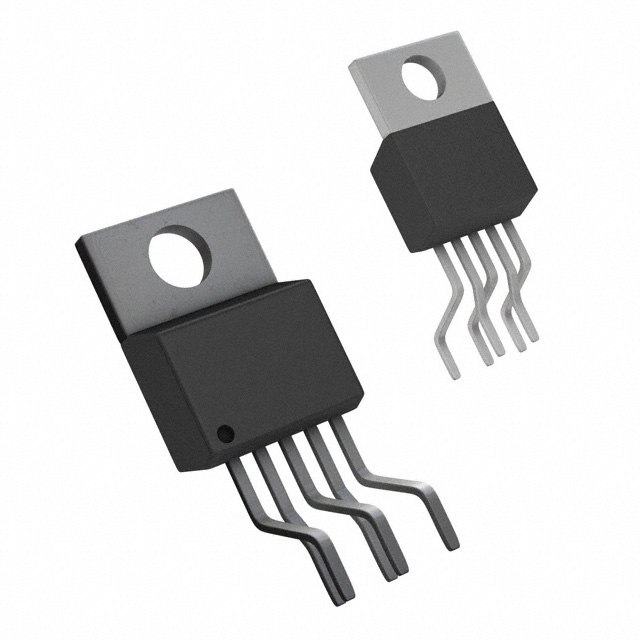
LM2596T-ADJ/NOPB vs. 400LMMT: A Practical Comparison
Quick verdict: For simple, low-cost DC-DC conversion where precise voltage regulation is paramount and thermal management is straightforward, the LM2596T-ADJ/NOPB is the clear winner. However, when dealing with high-voltage, high-current applications requiring overcurrent protection and fault interruption – such as battery string protection or industrial power distribution – the 400LMMT’s fusing capability and higher voltage ratings are essential, despite significantly lower efficiency.
Spec comparison table
| Spec | LM2596T-ADJ/NOPB | 400LMMT | Notes |
|---|---|---|---|
| function | Step-Down | Thyristor Fuse | Fundamental difference in function. |
| output_configuration | Positive | N/A | LM2596 is a regulator, 400LMMT is a fuse. |
| topology | Buck | N/A | |
| output_type | Adjustable | N/A | |
| number_of_outputs | 1 | N/A | |
| input_voltage_min | 4.5V | 50V AC / 150V DC | 400LMMT has a much higher voltage rating. |
| input_voltage_max | 40V | 660V | 400LMMT is designed for much higher voltage applications. |
| output_voltage_min | 1.2V | N/A | |
| output_voltage_max | 37V | N/A | |
| output_current_max | 3A | N/A | LM2596’s current limit is significantly lower. |
| switching_frequency_typ | 150kHz | 6 | 400LMMT’s switching frequency is essentially irrelevant to its function. |
| synchronous_rectifier | No | N/A | |
| operating_temperature_range | -40°C ~ 125°C | N/A | |
| mounting_type | Through Hole | N/A | |
| package_case | TO-220-5 | N/A | Different form factors. |
| voltage_rating_ac_min | N/A | 240Vac | N/A |
| voltage_rating_ac_typ | N/A | 240Vac/150Vdc | N/A |
| voltage_rating_dc_min | N/A | 150Vdc | N/A |
| voltage_rating_dc_typ | N/A | 240Vac/150Vdc | N/A |
| current_rating_min | N/A | 6 Amps | 400LMMT’s current rating is a critical safety parameter. |
| current_rating_typ | N/A | 6 - 900 Amps | 400LMMT is designed for much higher current applications. |
| interrupting_rating_min | N/A | 200kA RMS | The interrupting rating is the key safety feature of the 400LMMT. |
| i2t_rating_min | N/A | N/A | N/A |
| rated_current_clearing_at_120v | N/A | 6 2 Amps | N/A |
| rated_current_clearing_at_240v | N/A | 10 3.8 Amps | N/A |
| watt_loss_at_rated_current_min | N/A | 1.0 Watts | N/A |
| watt_loss_at_rated_current_typ | N/A | 2.5 Watts | N/A |
| carton_weight_min | N/A | 0.110 Kg | N/A |
| carton_weight_typ | N/A | 0.110 Kg | N/A |
| carton_qty_min | N/A | 20 | N/A |
| rated_current_min | N/A | 1.8 | N/A |
| output_power_max | N/A | 220W | N/A |
| rated_current_typ | N/A | 10 | N/A |
| voltage_ac_min | N/A | 50V AC | N/A |
| voltage_dc_typ | N/A | 75-1500V DC | N/A |
| rating_iec | N/A | 350V DC(IEC) | N/A |
Design trade-offs
The LM2596T-ADJ/NOPB, being a switching regulator, inherently suffers from efficiency losses due to switching and conduction losses. At 3A output, and depending on the input voltage and selected external components, efficiency can range from 60% to 80%. Careful component selection (low RDS(on) MOSFET, Schottky diode) is crucial to maximizing efficiency. Layout sensitivity is moderate; proper ground plane routing is essential to minimize EMI. The LM2596’s adjustable output requires external feedback components, adding complexity and potential for instability if not properly designed.
The 400LMMT, on the other hand, is a thyristor fuse. Its primary function is overcurrent protection and fault interruption. Efficiency is essentially irrelevant; power dissipation is a consequence of the fault current being interrupted. Thermal management is critical; the fuse must be mounted in a location with adequate airflow or heat sinking to prevent overheating and premature failure. The interrupting rating is the most important parameter, dictating the maximum fault current the fuse can safely handle. The fuse’s ability to provide a visual indication of a tripped condition (via a trip indicator link) is a significant advantage in many applications.
Use-case fit
Choose LM2596T-ADJ/NOPB when…
- You need a regulated 5V output for a microcontroller in an embedded system, where precise voltage is critical for stable operation.
- You’re building a simple battery charger for a 12V lead-acid battery, requiring a fixed output voltage.
- You’re creating a DC-DC converter to power a small fan, prioritizing efficiency and quiet operation.
- You need to step down a 24V input to a stable 3.3V for a sensor network.
- You’re designing a point-of-load regulator for a power amplifier, where precise voltage control is essential for optimal performance.
Choose 400LMMT when…
- You’re protecting a battery string (e.g., 12S Li-ion) from overcurrent conditions and short circuits.
- You need to protect a high-voltage DC power distribution system in an industrial setting.
- You’re designing a safety circuit for a DC motor drive, preventing damage from motor faults.
- You’re building a DC power supply for a medical device, requiring robust overcurrent protection.
- You’re protecting a solar panel array from short circuit conditions.
Drop-in compatibility
The LM2596T-ADJ/NOPB and 400LMMT are fundamentally different components and are not pin-compatible or footprint-compatible. Substituting one for the other is impossible without a complete redesign of the circuit and power system. The TO-220 package of the LM2596 is a common form factor, but the 400LMMT’s physical dimensions and mounting requirements are different.
Alternatives to consider
- LM2596S-ADJ: A similar regulator with a slightly different pinout, offering a slightly different feature set.
- Littelfuse 47623: A similar thyristor fuse with a slightly different interrupting rating and physical size.
- TPS54331: A more modern synchronous buck regulator offering higher efficiency and more features, but at a higher cost and increased complexity.