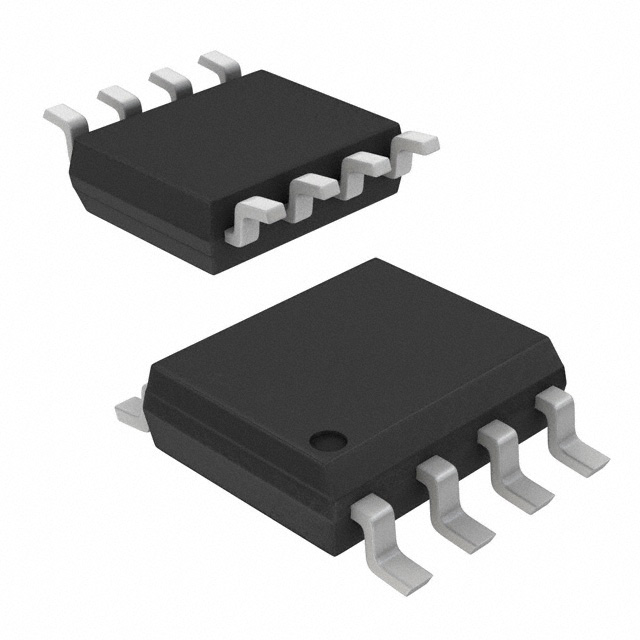
Key Specs
| Spec | Value | Condition | Source |
|---|---|---|---|
| Current Continuous Drain ID 25 C | 5.3A (Ta) | Digi-Key | |
| Drain-source Voltage (Max) | 30 V | Digi-Key | |
| Drive Voltage Max RDS On Min RDS On | 4.5V, 10V | Digi-Key | |
| FET Feature | - | Digi-Key | |
| FET Type | P-Channel | Digi-Key | |
| Gate Charge Qg Max VGS | 14 nC @ 10 V | Digi-Key | |
| Gate-source Voltage (Max) | ±25V | Digi-Key | |
| Grade | - | Digi-Key | |
| Input Capacitance Ciss Max VDS | 528 pF @ 15 V | Digi-Key | |
| Mounting Type | Surface Mount | Digi-Key | |
| Operating Temperature Range | -55°C ~ 155°C (TJ) | Digi-Key | |
| Package Case | 8-SOIC (0.154”, 3.90mm Width) | Digi-Key | |
| Power Dissipation (Max) | 2.5W (Ta) | Digi-Key | |
| Qualification | - | Digi-Key | |
| RDS On Max ID VGS | 50mOhm @ 5.3A, 10V | Digi-Key | |
| Supplier Device Package | 8-SOIC | Digi-Key | |
| Technology | MOSFET (Metal Oxide) | Digi-Key | |
| VGS Th Max ID | 3V @ 250µA | Digi-Key |
When To Use
-
3.3V @ 3A load from 12V supply: The 30V drain-source max rating provides sufficient margin for a 12V rail with transient spikes. Its 50mΩ Rds(on) at 10V gate drive supports efficient conduction at 3A, avoiding excessive thermal dissipation that would cause thermal runaway. Using a device with higher Rds(on) would lead to significantly more power loss and possible overheating.
-
High-side load switch at 5V, 5A max: The P-channel MOSFET simplifies high-side switching with a max continuous drain current of 5.3A at room temperature, matching the load current. A synchronous buck controller or N-channel MOSFET with a charge pump would be more complex and risk shoot-through if not carefully designed.
-
Battery reverse-polarity protection in 12V system: The low gate charge (14nC @ 10V) and 30V max Vds allow the device to switch quickly and survive transient spikes during battery insertion/removal without latch-up. Using a linear diode would cause a voltage drop and excessive power loss, while a synchronous controller might fail without proper control logic.
When Not To Use
-
Load current > 6A continuous: The 5.3A continuous drain current max at 25°C disqualifies this device due to risk of thermal runaway and device failure. Use a high-current synchronous buck with external FETs designed for >6A loads.
-
Switching frequency > 500kHz for compact inductor: The relatively high gate charge (14nC) and input capacitance (528pF) limit switching speed and increase switching losses. Use a high-frequency buck controller optimized for low gate charge and fast transitions.
-
Input-output voltage differential below 1V with noise-sensitive analog circuitry: The device’s Rds(on) and switching noise can cause unacceptable voltage ripple and noise. Use an LDO regulator for low dropout and low output noise.
Application Notes
-
The gate (G) pin is highly sensitive to voltage spikes; keep gate-source voltage strictly within ±25V to prevent gate oxide stress. Use a low-ESR gate resistor close to the gate pin to damp ringing.
-
The switching node (SW) connected to the drain (D) must have a compact, low-inductance loop with the source (S) return to minimize EMI and voltage overshoot during switching transitions.
-
Pins 1 and the source and drain pin should have wide copper areas for heat dissipation; use multiple vias if on a multilayer PCB to improve thermal conduction.
-
Guard routing: Keep sensitive control signals physically separated from the switching node to reduce capacitive and inductive coupling that can cause false triggering or gate voltage oscillations.
-
Avoid floating or unused gate pins; ensure the gate is driven or pulled to a defined level to prevent inadvertent turn-on from noise pickup.
Gotchas
-
[Gate drive overshoot beyond ±25V]: Designers often rely on the gate driver’s nominal voltage swing without accounting for ringing caused by PCB parasitic inductance and MOSFET input capacitance. This can exceed the ±25V max gate-source voltage, causing gate oxide breakdown, device degradation, or early failure.
Fix: Use a low-value gate resistor (e.g., 10Ω) and add a small gate-source Zener clamp or TVS diode to limit gate voltage spikes. Measure gate waveform with a high-bandwidth probe during switching. -
[Thermal derating ignored at elevated junction temperatures]: The 5.3A continuous drain current rating is at 25°C ambient; in real applications, junction temperatures can rise significantly, reducing current capability and risking thermal runaway unnoticed during initial testing.
Fix: Use thermal simulations combined with board-level temperature measurements; derate current in final design to maintain junction below 125°C TJ max for reliability. -
[Switching node layout causing oscillations]: Long PCB traces or improper parasitic inductance near the switching node (drain pin) cause voltage spikes that couple back into the gate drive, leading to erratic switching or partial conduction (“chatter”). This can look like unstable output voltage or increased EMI.
Fix: Minimize loop area around drain-source current path; place the MOSFET close to the load and source return; use Kelvin gate drive if possible. -
[No minimum load causing incomplete turn-off]: At very light loads, leakage current or device threshold voltage variation can keep the MOSFET partially on, causing unexpected standby power loss or output voltage drift.
Fix: Add a small bleed resistor or ensure control logic fully drives gate below threshold voltage under all conditions to guarantee full turn-off.