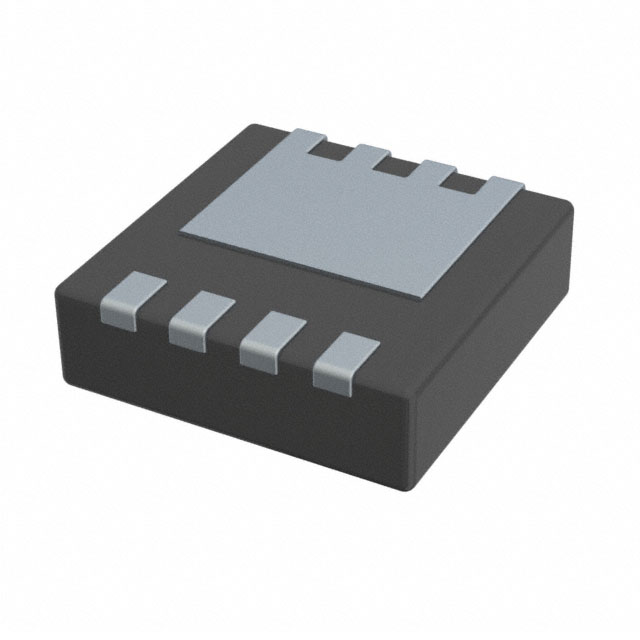
Key Specs
| Spec | Value | Condition | Source |
|---|---|---|---|
| Current Continuous Drain ID 25 C | 11A (Ta), 40A (Tc) | Digi-Key | |
| Drain-source Voltage (Max) | 30 V | Digi-Key | |
| Drive Voltage Max RDS On Min RDS On | 6V, 10V | Digi-Key | |
| FET Feature | - | Digi-Key | |
| FET Type | P-Channel | Digi-Key | |
| Gate Charge Qg Max VGS | 45 nC @ 10 V | Digi-Key | |
| Gate-source Voltage (Max) | ±25V | Digi-Key | |
| Grade | - | Digi-Key | |
| Input Capacitance Ciss Max VDS | 3360 pF @ 15 V | Digi-Key | |
| Mounting Type | Surface Mount | Digi-Key | |
| Operating Temperature Range | -55°C ~ 150°C (TJ) | Digi-Key | |
| Package Case | 8-PowerTDFN | Digi-Key | |
| Power Dissipation (Max) | 2.1W (Ta), 52W (Tc) | Digi-Key | |
| Qualification | - | Digi-Key | |
| RDS On Max ID VGS | 12mOhm @ 20A, 10V | Digi-Key | |
| Supplier Device Package | PG-TSDSON-8 | Digi-Key | |
| Technology | MOSFET (Metal Oxide) | Digi-Key | |
| VGS Th Max ID | 3.1V @ 73µA | Digi-Key |
When To Use
Use the BSZ120P03NS3GATMA1 P-Channel MOSFET in low-voltage, high-current applications such as DC-DC converters or load switches where a maximum drain-source voltage of 30 V and a continuous drain current up to 11 A (at Ta) or 40 A (at Tc) are required. Its low Rds(on) of 12 mΩ at 20 A and 10 V gate drive voltage makes it suitable for efficient power switching with minimal conduction losses. The device’s surface mount 8-PowerTDFN package facilitates compact designs with good thermal performance.
When Not To Use
Do not use the BSZ120P03NS3GATMA1 in applications requiring drain-source voltages above 30 V, such as 48 V automotive systems, because the device’s maximum Vds rating is limited to 30 V. Also avoid using it in circuits where the gate drive voltage exceeds ±25 V or where extremely low gate threshold voltage below 3.1 V at 73 µA is critical; in these cases, select a MOSFET with higher voltage ratings or different threshold characteristics better suited to the application.
Application Notes
The drain node switches and requires minimizing the switching loop area to reduce EMI and switching losses. The gate pin is noise-sensitive and should be driven with a low-impedance source to avoid false triggering or oscillations. Given the maximum power dissipation of 2.1 W at ambient temperature and up to 52 W at case temperature, a suitable PCB copper area or thermal pad is recommended for effective heat dissipation under high current conditions.
Gotchas
-
Mistake: Applying gate voltage beyond ±25 V.
Failure mode: Permanent damage to the gate oxide leads to device failure.
Fix: Ensure gate drive voltage remains within ±25 V by using appropriate gate driver circuits or level shifting. -
Mistake: Operating the MOSFET continuously at high current without adequate thermal management.
Failure mode: Device overheats, causing thermal runaway or reduced lifetime.
Fix: Use proper PCB thermal design and consider forced cooling or heatsinking to maintain junction temperature within -55°C to 150°C limits. -
Mistake: Using the device in circuits with drain-source voltage exceeding 30 V.
Failure mode: Avalanche breakdown damages the MOSFET.
Fix: Confirm application voltage ratings do not exceed 30 V; select a MOSFET with higher voltage rating if necessary.