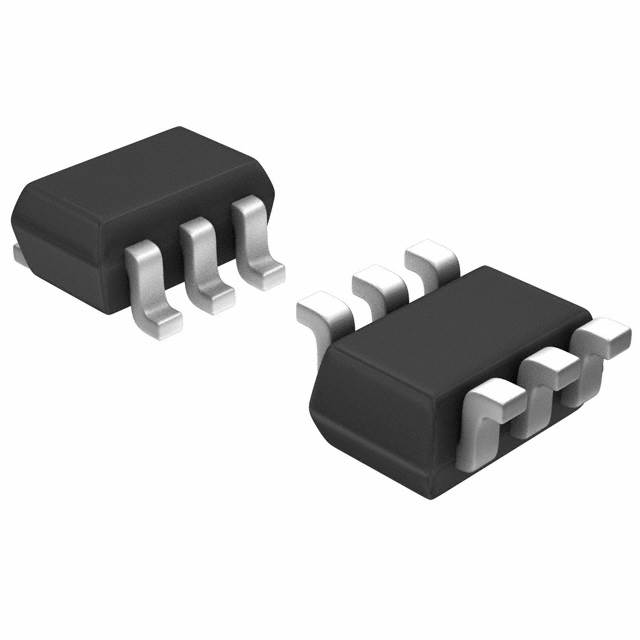
NX3008NBKS,115 vs BSZ120P03NS3GATMA1 MOSFET Comparison
Quick verdict
For low-current, dual N-channel switching applications requiring logic-level drive and small footprint, the NX3008NBKS,115 is clearly the better choice due to its integrated dual devices, low gate charge, and automotive qualification. For high-current, single P-channel applications where low R_DS(on) at 10 V gate drive and high power dissipation are critical, the BSZ120P03NS3GATMA1 is the superior option thanks to its 11 A continuous current rating and 12 mΩ R_DS(on) at 20 A.
Spec comparison table
| Spec | NX3008NBKS,115 | BSZ120P03NS3GATMA1 | Notes |
|---|---|---|---|
| MOSFET type | Dual N-Channel | Single P-Channel | N vs P channel; affects polarity and driver complexity |
| Drain-Source Voltage (V_DS max) | 30 V | 30 V | Equal |
| Continuous Drain Current (I_D @ 25°C) | 350 mA | 11 A (Ta), 40 A (Tc) | BSZ120P03NS3GATMA1 supports significantly higher current |
| Drain Current Spiking Max | 1.4 A | Not specified | NX3008NBKS can handle short spikes up to 1.4 A |
| R_DS(on) @ 25°C | 1.0–1.4 Ω @ 350 mA, 4.5 V gate | 12 mΩ @ 20 A, 10 V gate | BSZ120P03NS3GATMA1 has orders of magnitude lower R_DS(on) at high current |
| Gate Threshold Voltage (V_GS(th)) | Typ 0.6–1.1 V (max 1.1 V @ 250 µA) | 3.1 V @ 73 µA | NX3008NBKS is logic-level gate, BSZ120P03NS3GATMA1 requires higher gate voltage |
| Gate Charge (Q_g) | Typ 0.52–0.68 nC @ 4.5 V | Max 45 nC @ 10 V | NX3008NBKS has dramatically lower gate charge, easier to drive |
| Input Capacitance (C_iss) | 34–50 pF (typ) @ 25°C | 3360 pF max @ 15 V | NX3008NBKS has much lower input capacitance, faster switching, less driver loading |
| Output Capacitance (C_oss) | 6.5 pF (typ) | Not specified | NX3008NBKS lower output capacitance favors fast switching |
| Reverse Transfer Capacitance (C_rss) | 2.2 pF (typ) | Not specified | NX3008NBKS lower feedback capacitance reduces Miller effect |
| Power Dissipation (P_D max) | 445 mW (device), 990 mW total | 2.1 W (Ta), 52 W (Tc) | BSZ120P03NS3GATMA1 supports much higher power dissipation |
| Package | 6-TSSOP (SC-88/SOT-363) | 8-PowerTDFN | Different packages; BSZ120P03NS3GATMA1 larger and thermally optimized |
| Dimensions (L×W) | 2.2 mm × 1.35 mm | Not specified | NX3008NBKS smaller footprint |
| Operating Temperature Range (TJ) | -55°C to +150°C | -55°C to +150°C | Equal |
| Electrostatic Discharge (ESD) Rating | 2 kV | Not specified | NX3008NBKS has guaranteed ESD rating |
| Max Gate-Source Voltage (V_GS max) | ±8 V | ±25 V | BSZ120P03NS3GATMA1 supports higher gate voltage swings |
| Transient Thermal Impedance (Zth) | Typ 0.5 K/W (100 ms), max 300 K/W device | Not specified | NX3008NBKS has high thermal resistance due to small die/package |
| Gate Leakage Current | Typ 0.2–1 µA @ ±8 V | Not specified | NX3008NBKS low gate leakage |
| Qualification | AEC-Q101 Automotive | None specified | NX3008NBKS suited for automotive/high reliability applications |
Design trade-offs
The NX3008NBKS,115 is a dual N-channel MOSFET array optimized for low-current switching with very low gate charge (~0.6 nC) and extremely low input capacitance (~50 pF). This makes it well-suited for logic-level drive in battery-powered or signal-level switching applications where gate drive power and switching losses must be minimized. The relatively high R_DS(on) (1–1.4 Ω at 350 mA) and low current rating reflect its intended use for low-power loads rather than power switching. The dual device configuration is useful for half-bridge or complementary switch configurations, but the small 6-TSSOP package results in poor thermal dissipation (300 K/W junction-to-ambient), requiring careful layout and potentially limiting continuous power dissipation to under 1 W.
In contrast, the BSZ120P03NS3GATMA1 is a single P-channel MOSFET designed for high-current applications with a very low R_DS(on) of 12 mΩ at 20 A and 10 V gate drive, supporting continuous currents of 11 A at ambient and 40 A at case temperature. The gate charge is significantly higher at 45 nC, reflecting the larger die size and higher capacitances (C_iss = 3360 pF), which means the gate driver circuitry must be capable of supplying higher peak currents and faster transitions to avoid switching losses. Its package (8-PowerTDFN) supports much better thermal performance with power dissipation ratings up to 52 W (case), making it suitable for power stages, synchronous buck converters, or load switches handling several amps.
The gate threshold voltage difference is notable: NX3008NBKS,115 has a low V_GS(th) (~0.6 V), enabling direct drive from 3.3 V or 5 V logic, while the BSZ120P03NS3GATMA1 requires a higher gate drive voltage (~3.1 V threshold, recommended 6–10 V drive) which complicates gate drive design in low-voltage systems. Also, the BSZ120P03NS3GATMA1 is P-channel, which is generally less efficient than N-channel for high-current low-R_DS(on) applications but simplifies high-side switching in some topologies.
Thermally, the NX3008NBKS,115’s high thermal resistance demands conservative power dissipation and excellent PCB thermal management for continuous operation. The BSZ120P03NS3GATMA1 is engineered for power dissipation orders of magnitude higher, enabling direct mounting on heatsinks or large thermal planes.
Cost-wise, the NX3008NBKS,115 is likely cheaper per unit and per channel due to its small size and simpler process but is unsuitable for high-power applications. The BSZ120P03NS3GATMA1, being a high-current discrete transistor with advanced packaging, will be more expensive but necessary for power stages.
Use-case fit
Choose NX3008NBKS,115 when…
- You need a compact dual N-channel MOSFET array for low-current load switching under 350 mA.
- Your system runs on 3.3–5 V logic levels and requires minimal gate drive power.
- Automotive or harsh environment qualification (AEC-Q101) is mandatory.
- Space-constrained designs require a tiny 6-TSSOP package.
- Switching speed and low gate charge are critical, but power dissipation is low (<1 W).
Choose BSZ120P03NS3GATMA1 when…
- Your application demands a single P-channel MOSFET capable of continuous currents above 10 A.
- You require very low conduction losses with R_DS(on) of 12 mΩ at 20 A for power stages or load switches.
- Thermal management is robust, supporting up to 52 W dissipation at case temperature.
- Gate drive voltage of 6–10 V is available or can be implemented.
- High-side switching with P-channel is preferred to avoid bootstrap or charge pump complexity.
Drop-in compatibility
These two parts are not pin-compatible due to differing channel types (dual N-channel vs single P-channel), package outlines (6-TSSOP vs 8-PowerTDFN), and pin assignments. The NX3008NBKS,115 integrates two transistors in a small footprint, while the BSZ120P03NS3GATMA1 is a single transistor in a larger package with a different pinout. Substituting one for the other would require redesign of PCB layout, gate drive circuitry, and potentially power stage topology. No direct drop-in replacement is possible.
Alternatives to consider
- BSS138 (N-Channel, 50 V, low current): Very common logic-level MOSFET for general switching, low cost, but lower