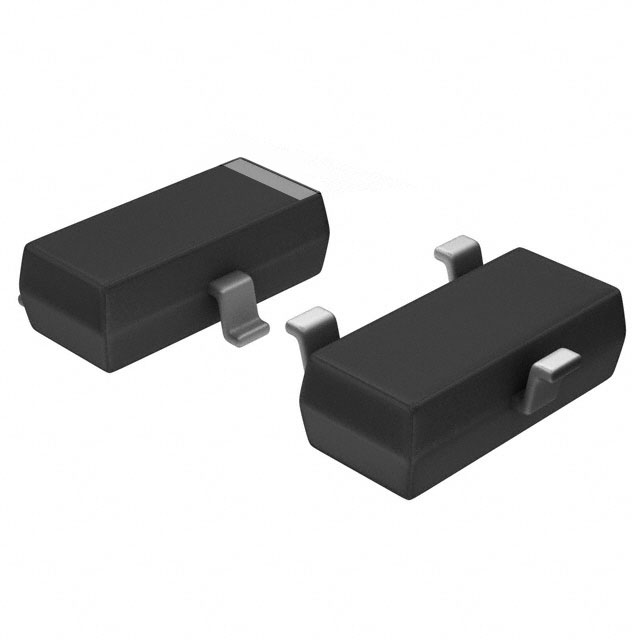
Key Specs
| Spec | Value | Condition | Source |
|---|---|---|---|
| Current Continuous Drain ID 25 C | 3.8A (Ta) | Digi-Key | |
| Drain-source Voltage (Max) | 30 V | Digi-Key | |
| Drive Voltage Max RDS On Min RDS On | 2.5V, 10V | Digi-Key | |
| FET Feature | - | Digi-Key | |
| FET Type | N-Channel | Digi-Key | |
| Gate Charge Qg Max VGS | 3.2 nC @ 4.5 V | Digi-Key | |
| Gate-source Voltage (Max) | ±12V | Digi-Key | |
| Grade | - | Digi-Key | |
| Input Capacitance Ciss Max VDS | 270 pF @ 15 V | Digi-Key | |
| Mounting Type | Surface Mount | Digi-Key | |
| Operating Temperature Range | -55°C ~ 150°C (TJ) | Digi-Key | |
| Package Case | 3-SMD, SOT-23-3 Variant | Digi-Key | |
| Power Dissipation (Max) | 1.4W (Ta) | Digi-Key | |
| Qualification | - | Digi-Key | |
| RDS On Max ID VGS | 80mOhm @ 2A, 10V | Digi-Key | |
| Supplier Device Package | SOT-23-3 | Digi-Key | |
| Technology | MOSFET (Metal Oxide) | Digi-Key | |
| VGS Th Max ID | 1.8V @ 250µA | Digi-Key |
When To Use
-
3.3V load @ 2.5A from 12V rail: The AO3424’s 30 V drain-source rating provides ample margin for 12 V input transients, while the 80 mΩ RDS(on) at 10 V gate drive ensures low conduction losses at moderate currents. A logic-level MOSFET with higher RDS(on) would overheat or cause efficiency loss, potentially leading to thermal runaway under sustained load.
-
Battery-powered system switching between 3.3 V and 5 V rails at 3.8A max: The gate charge of 3.2 nC at 4.5 V enables fast switching and low gate drive losses, critical for efficiency in battery-powered designs. Using a MOSFET with significantly higher gate charge would increase switching losses, risking thermal stress and reduced battery life.
-
High-temperature industrial sensor operating at 125°C junction: The wide operating temperature range up to 150°C TJ allows the AO3424 to maintain reliable conduction and switching performance where high ambient temperatures are expected. Devices with lower maximum TJ ratings risk early failure or erratic threshold voltage shifts causing latch-up.
When Not To Use
-
Load current exceeding 4A continuous at ambient: The 3.8 A continuous drain current limit and 1.4 W max power dissipation at Ta restrict high-current use. For currents above this, use a high-current synchronous buck with external FETs to handle higher currents and maintain efficiency.
-
Switching frequency above 500 kHz in a compact DC-DC converter: The gate charge and input capacitance limit switching speed efficiency and thermal performance. For frequencies >500 kHz, use a high-frequency buck controller designed for low gate charge and optimized gate drive.
-
Low dropout linear regulation with <1 V input-output differential: The relatively high RDS(on) and switching characteristics make it unsuitable for low dropout applications where low noise and dropout voltage are critical. Use an LDO regulator for cleaner, low dropout operation.
Application Notes
-
The AO3424’s gate (G) pin is noise-sensitive; minimize loop area between gate drive source and gate to reduce EMI and switching transients. Use a short, low-inductance path.
-
The device’s source (S) is typically connected to ground or the low-side node; routing the source trace with a solid ground plane reduces parasitic inductance and improves thermal dissipation.
-
The drain (D) pin switches the load current and acts as the switching node (SW); careful PCB layout with appropriate decoupling capacitors placed close reduces voltage overshoot and ringing on the drain line.
-
Due to the ±12 V maximum gate-source voltage rating, transient voltage suppression or gate drive clamping should be implemented to prevent gate oxide damage from voltage spikes during switching or ESD events.
-
Guard routing or ground shielding around the gate trace is recommended in noisy environments to prevent false triggering or erratic switching behavior caused by capacitive coupling from the switching node.
Gotchas
-
[Ignoring thermal derating at high ambient temperature]: The AO3424’s max power dissipation of 1.4 W is specified at Ta, not junction temperature. Operating near the 150°C TJ limit without accounting for PCB thermal resistance leads to junction overheating, causing threshold voltage shifts and premature failure.
Fix: Measure junction temperature via thermal imaging or use conservative thermal resistance assumptions; design for at least 50% derating of power dissipation at expected ambient. -
[Gate drive voltage margin assumed unlimited]: Designers sometimes apply gate voltages near or above ±12 V, assuming “higher is better” for RDS(on). Exceeding ±12 V gate-source damages the gate oxide, causing shifts in threshold voltage and increased leakage current, often seen as elevated off-state current or device failure.
Fix: Use regulated gate drive supplies, clamp gate voltage, and verify gate waveforms on the oscilloscope during switching tests. -
[Neglecting Miller charge-induced oscillations]: The input capacitance (Ciss) of 270 pF at 15 V combined with switching node ringing can cause gate voltage oscillations during turn-off, leading to shoot-through or excessive switching losses, especially in half-bridge topologies.
Fix: Add a small gate resistor (10–22 Ω) to damp oscillations and verify switching waveforms for clean transitions. -
[Assuming stable operation without minimum load]: In some synchronous buck topologies, the AO3424 may exhibit erratic switching or incomplete turn-off at very low load current due to insufficient gate drive discharge, causing output ripple or intermittent conduction.
Fix: Include a minimum load resistor or active load to ensure stable gate drive and clean switching transitions under all load conditions.