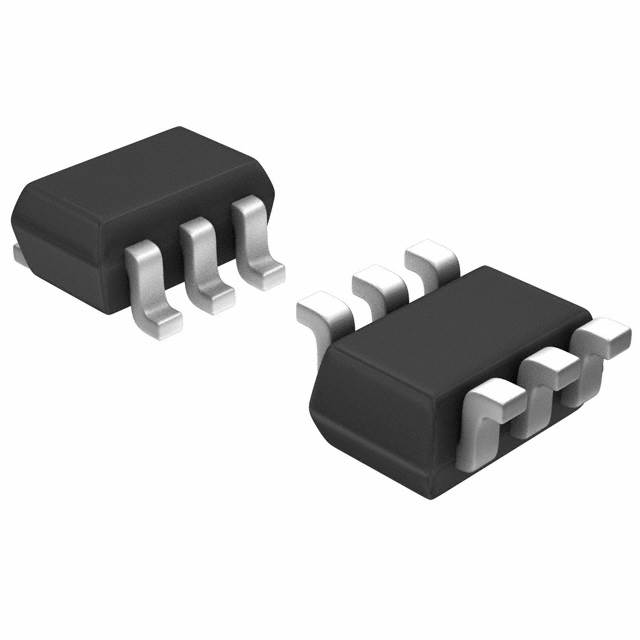
NX3008NBKS,115 vs AO3424 MOSFET Comparison
Quick verdict
For low-current switching or level-shifting applications requiring dual MOSFETs in a compact package, the NX3008NBKS,115 offers a reliable automotive-grade solution with integrated dual devices and extremely low gate charge. For higher-current, single-switch applications up to about 3.8A continuous, the AO3424 delivers significantly lower R_DS(on) and higher power dissipation capability, making it the better choice for power switching and load driving at 30V.
Spec comparison table
| Spec | NX3008NBKS,115 | AO3424 | Notes |
|---|---|---|---|
| Configuration | 2 N-Channel (Dual) | 1 N-Channel | Dual MOSFETs vs single device; NX3008NBKS better for space-saving dual switch needs. |
| Drain-Source Voltage (V_DS max) | 30 V | 30 V | Equal voltage rating. |
| Continuous Drain Current (I_D) | 350 mA | 3.8 A | AO3424 supports >10x current, suitable for higher power loads. |
| Max Power Dissipation (P_D) | 445 mW (per device), 990 mW total | 1.4 W (at ambient) | AO3424 handles ~3x power dissipation, better for power applications. |
| R_DS(on) @ I_D, V_GS | 1.4 Ω @ 350mA, 4.5 V | 80 mΩ @ 2A, 10 V | AO3424 has dramatically lower on-resistance, better efficiency at higher currents. |
| Gate Charge (Q_g) @ 4.5 V | 0.68 nC | 3.2 nC | NX3008NBKS has ~5x lower gate charge, reducing gate drive losses and switching energy. |
| Input Capacitance (C_iss) @ 15 V | 50 pF | 270 pF | NX3008NBKS has significantly lower input capacitance, easing gate drive and EMI. |
| Gate-Source Threshold Voltage (V_GS(th)) | 0.5 – 1.1 V (typ 0.6–1.1 V) | 1.8 V @ 250µA | NX3008NBKS has lower gate threshold, better for logic-level drive. |
| Gate-Source Voltage Max | ±8 V | ±12 V | AO3424 supports higher gate voltage margin, useful for some gate driver circuits. |
| Drain Current Spiking Max | 1.4 A | Not specified | NX3008NBKS supports short spikes up to 1.4A; AO3424 data not provided. |
| Thermal Resistance Junction-to-Ambient | 300 K/W (typ per device) | Not specified | NX3008NBKS data available; AO3424 lacks explicit thermal resistance in datasheet. |
| Ambient Operating Temperature Range | -55°C to +150°C | -55°C to +150°C | Both suitable for extended temperature ranges. |
| Package | 6-TSSOP (SC-88, SOT-363) | SOT-23-3 | Different packages; AO3424 smaller footprint but single device only. |
| Electrostatic Discharge (ESD) Rating | 2000 V | Not specified | NX3008NBKS rated for 2kV ESD, AO3424 ESD rating not stated. |
| Power Dissipation Max (Ta) | 445 mW per device | 1.4 W | AO3424 allows more than triple the continuous power dissipation at ambient. |
| Typical Forward Transconductance (g_fs) | 310 mS | Not specified | NX3008NBKS has moderate transconductance; AO3424 data unavailable. |
| Package Dimensions | 2.2 mm x 1.35 mm | SOT-23-3 (approx. 2.9 mm x 1.3 mm) | AO3424 slightly wider but thinner package. |
| Qualification | AEC-Q101 Automotive | None | NX3008NBKS suited for automotive applications; AO3424 not automotive qualified. |
| Leakage Current (I_DSS) @ 25°C | 1 µA | Not specified | NX3008NBKS low leakage suitable for low power applications. |
Design trade-offs
The most obvious difference between the NX3008NBKS,115 and AO3424 is the current handling capability. The NX3008NBKS is a dual MOSFET array rated at only 350mA continuous per transistor, with a relatively high R_DS(on) of around 1.4Ω at 4.5V gate drive. This makes it unsuitable for power switching or load driving beyond small signal or level-shifting applications. In contrast, the AO3424 supports continuous drain currents up to 3.8A with an R_DS(on) of 80mΩ at 10V gate drive, making it a better candidate for power switching in 30V systems.
Gate charge and input capacitance also differ substantially. The NX3008NBKS features an extremely low gate charge (~0.68 nC) and input capacitance (50pF), which reduces switching losses and gate driver power requirements, especially in high-frequency or low-power logic-level switching. The AO3424 has roughly 5x higher gate charge (3.2 nC) and over 5x input capacitance (270 pF), which will increase switching losses and require a stronger gate driver to maintain fast switching speeds and reduce EMI.
Thermally, the AO3424 can dissipate nearly three times the power (1.4W vs 445mW per device) at ambient temperature, indicating a more robust die and package for power applications. The NX3008NBKS datasheet provides detailed thermal resistance data, which is useful for precise thermal design in automotive or industrial environments, while the AO3424 datasheet lacks explicit thermal resistance specs, requiring more conservative assumptions or empirical testing.
The NX3008NBKS is automotive qualified (AEC-Q101), making it suitable for harsh environments with tight reliability requirements. The AO3424 lacks automotive qualification, so it is more appropriate for consumer or industrial applications where formal qualification is less critical.
Package and pinout differences mean the parts are not drop-in replacements. The NX3008NBKS is a dual MOSFET array in a 6-TSSOP package (SC-88, SOT-363 equivalent), whereas the AO3424 is a single MOSFET in a SOT-23-3 package. The NX3008NBKS’s dual device in a compact footprint is advantageous for space-constrained designs requiring two low-current switches, while the AO3424’s single device serves better as a high-current switch.
Finally, the gate voltage ratings differ: the NX3008NBKS supports ±8V max gate voltage, while the AO3424 supports ±12V. If your gate driver voltage swings near or above 8V, the AO3424 provides more margin.
Use-case fit
Choose NX3008NBKS,115 when…
- You require two low-current (≤350mA) N-channel MOSFETs in a single compact package for signal switching or level shifting.
- Your design demands automotive-grade qualification (AEC-Q101) for reliability in harsh environments.
- Minimizing gate drive power consumption and EMI is critical, thanks to the low gate charge and input capacitance.
- You need a logic-level MOSFET with a low gate threshold voltage (as low as 0.5V) for direct drive from low-voltage logic.
- Your application involves switching small loads with minimal thermal dissipation, such as in sensor interfaces or multiplexers.
Choose AO3424 when…
- Your application requires switching or driving loads up to several amps (up to 3.8A continuous) at 30V.
- Lower conduction losses are critical, as the AO3424’s 80mΩ R_DS(on) at 10V is more than an order of magnitude lower than the NX3008NBKS.
- You need higher power dissipation capability (1.4W vs 445mW per device), enabling operation in less thermally constrained environments.
- Your gate drive voltage can range up to ±12V, offering more design flexibility.
- Space is limited but you only need a single MOSFET switch with a small SOT-23-3 package.
Drop-in compatibility
These devices are not pin-compatible or footprint-compatible. The NX3008NBKS,115 is a dual MOSFET array in a 6-TSSOP package (equivalent to SC-88 or SOT-363), while the AO3424 is a single MOSFET in a SOT-23-3 package. The pinouts differ notably due to the difference in device count and package style.
Substituting one for the other requires PCB redesign, including different footprints and routing. Additionally, the electrical parameters differ significantly (current rating, R_DS(on), gate charge), so circuit performance and thermal management will change accordingly.
Alternatives to consider
- BSS138 (NXP/ON Semiconductor): A common dual N-channel logic-level MOSFET array with similar low current rating, often used in level shifting and signal switching.
- **