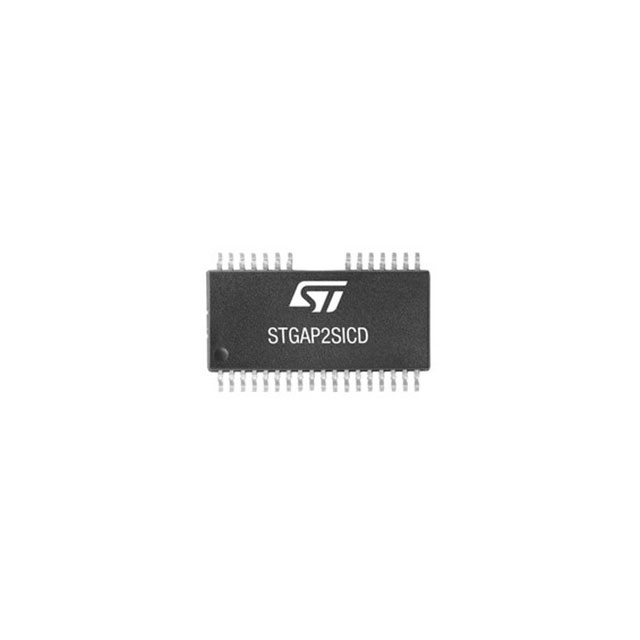
STGAP2SICDTR vs 2ED2106S06FXUMA1 Gate Driver ICs: A Detailed Comparison
Quick verdict
For isolated gate driving in high-voltage industrial or automotive applications requiring robust isolation and high peak drive current (4A), the STGAP2SICDTR is the better choice due to its capacitive coupling isolation and 3535 Vrms rating. For lower-voltage, non-isolated or bootstrap-driven half-bridge applications with moderate current needs (up to 700mA peak) and compact footprint, the 2ED2106S06FXUMA1 offers a simpler, smaller solution with integrated high-side/low-side drivers.
Spec comparison table
| Spec | STGAP2SICDTR | 2ED2106S06FXUMA1 | Notes |
|---|---|---|---|
| Ambient temperature range | -40 °C to +125 °C | -40 °C to +125 °C | Equivalent; both cover industrial temperature range. |
| Approval agency | UL, VDE | Not specified | STGAP2SICDTR has certifications relevant for safety-critical designs. |
| Capacitor max range | 1 µF to 10 µF | N/A | STGAP2SICDTR requires external capacitors; 2ED2106S06FXUMA1 does not need external coupling capacitors. |
| Clamp voltage | 1.3 V to 2.6 V (typ 2 V) | Not specified | Clamp voltage helps protect gate; ST part provides explicit clamp specs beneficial for ruggedness. |
| Common mode transient immunity | 100 V/ns | Not specified | STGAP2SICDTR specified for 100 V/ns CMTI, important for noisy power stages. |
| Current peak output source/sink | 4 A | 290 mA source / 700 mA sink | STGAP2SICDTR can drive larger MOSFET/IGBT gates faster; 2ED2106S06FXUMA1 limited to <1A peak. |
| Driver configuration | 2 Channel, isolated capacitive coupling | 2 Channel, independent high-side/low-side | STGAP2SICDTR provides galvanic isolation; Infineon part is non-isolated with bootstrap high-side. |
| Fall/rise times (typ) | 30 ns / 30 ns | 100 ns / 35 ns | ST has faster fall time; Infineon has faster rise time; ST’s balanced speeds favor switching symmetry. |
| Floating grounds differential voltage | ±1700 V | Not specified | STGAP2SICDTR supports high isolation voltage; critical for safety and EMI. |
| Gate driving voltage max | 26 V | 20 V (supply voltage 10 V ~ 20 V) | ST supports higher gate voltages, useful for IGBTs or high gate voltage MOSFETs. |
| Hysteresis (typ) | 750 mV | Not specified | Hysteresis affects noise immunity; ST part provides explicit hysteresis. |
| Input logic voltage levels | 0 V typical, VIH ~0.33·VDD, VIL ~0.66·VDD | VIL=1.1 V, VIH=1.7 V | STGAP2SICDTR supports lower logic voltage thresholds, compatible with 3.3 V logic; Infineon designed for 5 V CMOS/TTL. |
| Isolation voltage | 3535 Vrms (typ) / 5000 V transient | No galvanic isolation | STGAP2SICDTR provides reinforced isolation; Infineon is non-isolated. |
| Junction temperature range | -40 °C to +150 °C | -40 °C to +125 °C | ST rated for higher max junction temperature. |
| Package | 36-BSOP (7.5 mm wide, 32 leads) | PG-DSO-8-69 (3.9 mm wide, 8 leads) | Infineon part is significantly smaller and simpler for compact layouts. |
| Supply voltage | VDD typical 5.5 V, max 6.5 V | 10 V to 20 V | Different supply voltage domains; ST operates at logic-level voltages; Infineon requires higher supply voltage typical for bootstrap operation. |
| Operating temperature range | -40 °C to +125 °C | -40 °C to +125 °C | Equivalent. |
| Thermal resistance (junction to ambient) | 52 °C/W | Not specified | ST datasheet provides thermal resistance; Infineon does not specify, likely lower due to smaller package. |
| Switching frequency max | 1 MHz | Not specified | ST supports high switching frequencies explicitly, beneficial for high-speed PWM. |
| Input type | TTL compatible | CMOS, TTL | Both compatible with standard logic levels, but ST supports lower voltage logic inputs better. |
| Mounting type | Surface Mount | Surface Mount | Equivalent. |
| Number of drivers | 2 | 2 | Equivalent. |
| Rise/fall time typ | 30 ns / 30 ns | 100 ns / 35 ns | ST has faster fall times, Infineon faster rise times; ST’s balanced switching may reduce EMI and losses. |
| Quiescent current typical | 1.8 mA | Not specified | ST datasheet provides quiescent current; Infineon does not specify, may be lower due to simpler function. |
| Surge isolation voltage | 6000 VPEAK (1.2/50 µs IEC 62368-1) | Not specified | ST supports high surge voltage rating; important for industrial reliability. |
| Input/output propagation delay typ | 75 ns | Not specified | ST provides explicit delay, useful for timing design. |
| Safe state on fault | High impedance (Gon), ON state (Goff) | Not specified | ST includes defined safe state behavior, critical for fail-safe designs. |
Design trade-offs
The STGAP2SICDTR is a capacitive coupling isolated gate driver designed for high-voltage applications where galvanic isolation between the low-voltage control side and high-voltage power stage is mandatory. Its peak output current capability of 4A allows fast charging and discharging of large MOSFET or IGBT gates, which is essential in high-frequency or high-power applications to minimize switching losses. The 3535 Vrms isolation rating and surge withstand capability up to 6000 VPEAK make it suitable for industrial environments with significant electrical noise and safety requirements. However, the part requires external capacitors (1 µF to 10 µF) for its internal coupling, increasing BOM complexity and layout sensitivity. Its package is relatively large (36-BSOP, 7.5 mm wide), which may impact PCB real estate.
In contrast, the Infineon 2ED2106S06FXUMA1 is a non-isolated, high-side/low-side driver IC designed for half-bridge MOSFET or IGBT applications with bootstrap supply. It operates at higher supply voltages (10-20 V), typical for bootstrap gate drivers, and delivers peak sink currents up to 700 mA, with 290 mA source current. This makes it suited for driving smaller MOSFETs or IGBTs with moderate gate charge but unsuitable for large power devices requiring higher peak currents. Its package is compact (8-SOIC, 3.9 mm wide), beneficial for space-constrained applications. The lack of galvanic isolation limits its use in applications requiring safety isolation or noise immunity across domains.
From a thermal standpoint, the STGAP2SICDTR’s higher quiescent current (1.8 mA typ) and larger package imply higher power dissipation, though this is expected given its isolation functionality. The Infineon part does not specify quiescent current but likely dissipates less power due to simpler circuitry and smaller package. The faster rise and fall times of the ST device (30 ns typical) versus the Infineon’s slower rise time (100 ns) can reduce switching losses and improve efficiency in high-frequency designs, but the Infineon’s faster fall time (35 ns) may benefit certain switching waveforms.
Layout considerations differ significantly: ST’s capacitive coupling and high isolation demand careful PCB creepage and clearance design, and external capacitors for the coupling stage increase BOM and layout complexity. The Infineon part’s simpler 8-pin SOIC footprint is easier to integrate but offers no isolation, so it requires careful system-level design to ensure safety and noise immunity.
Cost-wise, the STGAP2SICDTR will typically be more expensive due to its specialized isolation technology and larger package, while the Infineon 2ED2106S06FXUMA1 is a more cost-effective solution for standard half-bridge drivers without isolation.
Use-case fit
Choose STGAP2SICDTR when…
- Designing isolated gate