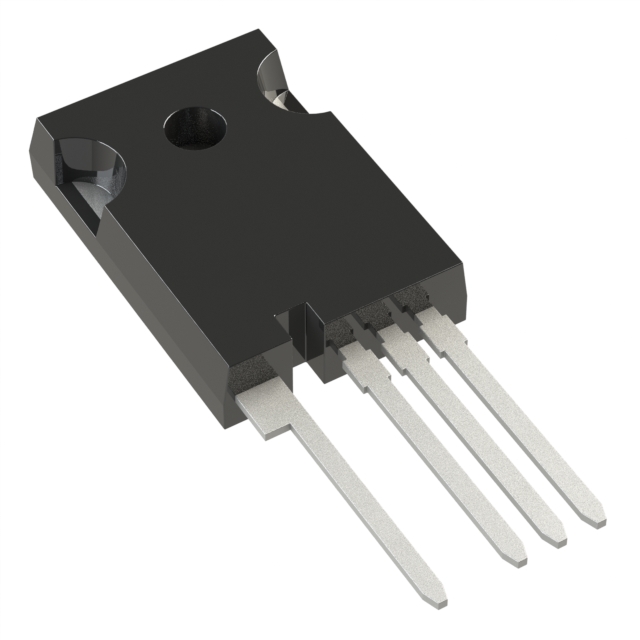
Key Specs
| Spec | Value | Condition | Source |
|---|---|---|---|
| Current Continuous Drain ID 25 C | 54A (Tc) | Digi-Key | |
| Drain-source Voltage (Max) | 1200 V | Digi-Key | |
| Drive Voltage Max RDS On Min RDS On | 18V | Digi-Key | |
| FET Feature | - | Digi-Key | |
| FET Type | N-Channel | Digi-Key | |
| Gate Charge Qg Max VGS | 75 nC @ 18 V | Digi-Key | |
| Gate-source Voltage (Max) | +22V, -10V | Digi-Key | |
| Grade | - | Digi-Key | |
| Input Capacitance Ciss Max VDS | 1700 pF @ 800 V | Digi-Key | |
| Mounting Type | Through Hole | Digi-Key | |
| Operating Temperature Range | -55°C ~ 175°C (TJ) | Digi-Key | |
| Package Case | TO-247-4 | Digi-Key | |
| Power Dissipation (Max) | 231W (Tc) | Digi-Key | |
| Qualification | - | Digi-Key | |
| RDS On Max ID VGS | 54mOhm @ 20A, 18V | Digi-Key | |
| Supplier Device Package | TO-247-4L | Digi-Key | |
| Technology | SiCFET (Silicon Carbide) | Digi-Key | |
| VGS Th Max ID | 4.4V @ 10mA | Digi-Key |
When To Use
Use the NTH4L040N120M3S in high-voltage, high-current switching applications such as industrial motor drives or power inverters where a drain-to-source voltage rating of 1200 V and continuous drain current of 54 A (typ) are required. Its low typical on-resistance of 40 mΩ at 54 A and fast switching characteristics (typical fall time of 10 ns) make it well-suited for efficient power conversion in SiC-based systems. The device’s ability to operate at case temperatures up to 150°C also supports demanding thermal environments.
When Not To Use
Do not use this device in low-voltage, low-current applications where the 1200 V rating and 54 A continuous current capability are excessive, as this may lead to unnecessary cost and size. For example, in low-voltage DC-DC converters operating below 100 V and currents under 10 A, a MOSFET with lower voltage and current ratings and smaller gate charge should be selected to optimize efficiency and cost. Additionally, avoid use in applications requiring gate-source voltage beyond +22 V or below -10 V, as this device’s maximum gate voltage ratings limit its gate drive range.
Application Notes
The drain node switches rapidly and thus requires minimizing the switching loop area to reduce parasitic inductances and voltage overshoot. The gate pin is noise-sensitive; use short, low-inductance gate drive traces and proper gate resistors to avoid false triggering or oscillations. Given the maximum power dissipation rating of 231 W (Tc), a suitable heatsink is mandatory during continuous operation at typical conditions (e.g., 54 A continuous current at 25°C case temperature) to maintain junction temperature below 175°C. Ensure the gate-to-source voltage remains within -10 V to +22 V to avoid device damage.
Gotchas
-
Incorrect Gate Drive Voltage Range
- Mistake: Applying gate voltages exceeding +22 V or below -10 V.
- Failure Mode: Permanent damage to the gate oxide leading to device failure.
- Fix: Use a gate driver that limits the gate voltage within the specified range and verify gate voltage levels during testing.
-
Insufficient Heatsinking
- Mistake: Operating the device at high current without adequate cooling.
- Failure Mode: Junction temperature exceeds 175°C resulting in thermal runaway and device destruction.
- Fix: Implement a heatsink with thermal resistance low enough to maintain junction temperature within safe limits under maximum power dissipation (231 W).
-
Excessive Gate Drive Loop Inductance
- Mistake: Using long or poorly routed gate drive traces without proper gate resistor.
- Failure Mode: Oscillations causing erratic switching, increased EMI, and potential device damage.
- Fix: Minimize gate drive loop area, use a gate resistor around 3.8 Ω, and ensure tight layout control.