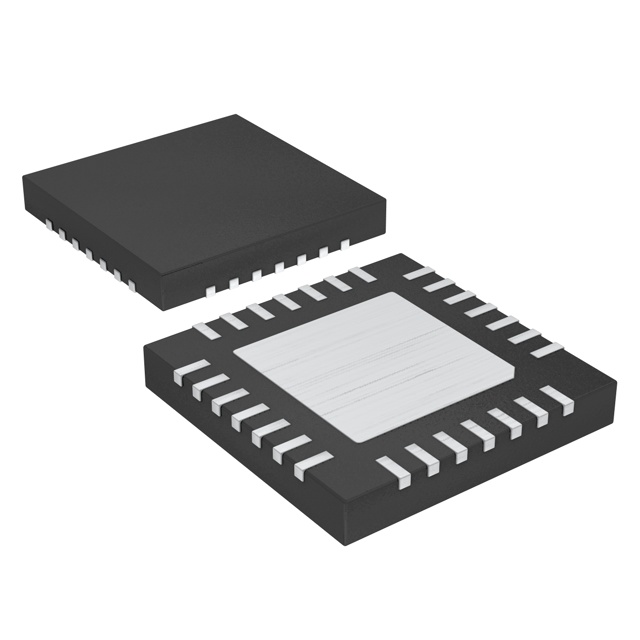
Key Specs
| Spec | Value | Condition | Source |
|---|---|---|---|
| Applications | Fan Motor Driver | Digi-Key | |
| Function | Driver - Fully Integrated, Control and Power Stage | Digi-Key | |
| Interface | I2C | Digi-Key | |
| Motor Type AC DC | Brushless DC (BLDC) | Digi-Key | |
| Motor Type Stepper | - | Digi-Key | |
| Mounting Type | Surface Mount | Digi-Key | |
| Operating Temperature Range | -40°C ~ 125°C (TA) | Digi-Key | |
| Output Configuration | Low Side (6) | Digi-Key | |
| Output Current (Max) | - | Digi-Key | |
| Package Case | 28-WFQFN Exposed Pad | Digi-Key | |
| Step Resolution | - | Digi-Key | |
| Supplier Device Package | 28-TQFN (4x4) | Digi-Key | |
| Technology | Power MOSFET | Digi-Key | |
| Voltage Load | - | Digi-Key | |
| Voltage Supply | 3V ~ 5.5V | Digi-Key |
When To Use
Use the MAX31790ATI+T in applications requiring a fully integrated fan motor driver for Brushless DC (BLDC) motors where a low side output configuration is preferred. Its I2C interface and integrated power MOSFET technology make it ideal for compact surface mount designs operating from 3 V to 5.5 V supply voltages, such as cooling fans in consumer electronics or industrial equipment.
Do not use this device for stepper motor control or applications requiring high output current beyond the integrated device capability, as it lacks stepper motor functionality and explicit output current specification. In such cases, consider dedicated stepper motor drivers or discrete MOSFET driver solutions.
When Not To Use
-
Output current exceeds MAX31790ATI+T capacity: This part does not specify a maximum output current rating suitable for heavy loads. Use a high-current synchronous buck with external FETs to handle higher current while maintaining efficiency and thermal safety.
-
Input voltage above 5.5V: The 3V to 5.5V supply range disqualifies this part from higher-voltage rails common in industrial power buses. Use a synchronous buck controller designed for higher input voltages to avoid MOSFET breakdown or latch-up.
-
Sub-1V dropout, low-noise linear regulation: When the input-output voltage differential is less than 1V and noise sensitivity is critical (e.g. analog front-ends), the switching nature and integrated MOSFETs of this driver make it unsuitable. Choose an LDO regulator for clean, low-noise supply rails.
Application Notes
The low side output MOSFETs switch the motor phases and require careful PCB layout to minimize loop area and reduce EMI. The exposed pad on the 28-WFQFN package must be soldered to a large copper area on the PCB to efficiently dissipate heat, especially at higher operating temperatures near 125°C.
The I2C interface pins are noise-sensitive; routing these lines away from high-current switching nodes and using proper filtering or shielding techniques is recommended to maintain reliable communication.
No external heatsink is typically required if the PCB layout includes adequate thermal vias and copper area under the exposed pad, but ensure thermal design is verified under the maximum operating conditions.
Gotchas
-
Incorrect I2C Bus Configuration:
If the engineer neglects proper I2C bus pull-up resistors or uses incompatible I2C voltage levels, communication with the MAX31790ATI+T will fail, resulting in no motor control.
Fix: Ensure the I2C bus is correctly terminated with pull-up resistors compatible with the 3 V to 5.5 V supply range and verify signal integrity. -
Improper Thermal Management:
Operating near the upper limit of the -40°C to 125°C temperature range without adequate PCB thermal design can cause device overheating and premature failure.
Fix: Use the exposed pad on the 28-WFQFN package for effective heat sinking on the PCB and maintain proper airflow to keep junction temperature within limits.