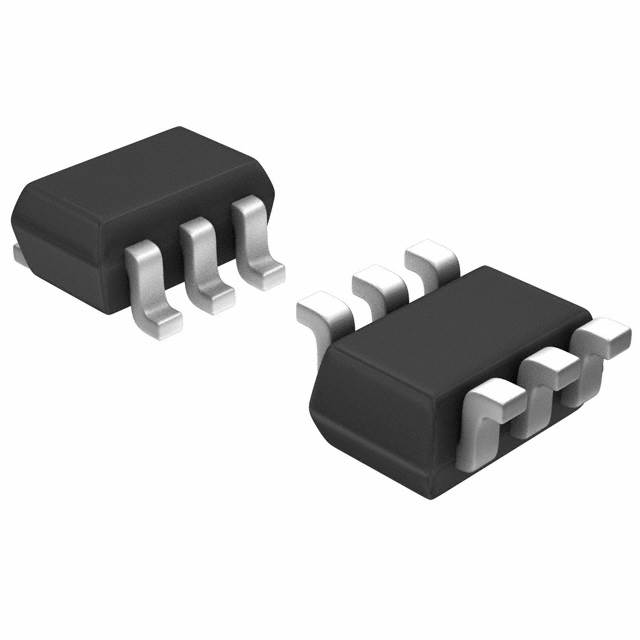
Component Comparison: NX3008NBKS,115 vs MAX31790ATI+T
Quick verdict
For low-voltage, low-current discrete MOSFET switching or small-signal load switching, the NX3008NBKS,115 is the superior choice due to its simple dual N-channel MOSFET array, automotive-grade qualification, and well-characterized static and dynamic parameters. In contrast, for integrated motor driver applications requiring digital control, fault management, and multiple low-side outputs with I2C interface, the MAX31790ATI+T is the better fit, providing a fully integrated power stage and driver logic in a compact package.
Spec comparison table
| Spec | NX3008NBKS,115 | MAX31790ATI+T | Notes |
|---|---|---|---|
| Device type | MOSFET Array, Dual N-Channel | Integrated Motor Driver with Power MOSFETs | NX3008 is discrete MOSFETs; MAX31790 is integrated driver + MOSFETs |
| Voltage rating (Drain-Source) | 30 V | Not specified | NX3008 explicitly rated for 30 V, MAX31790 load voltage unspecified |
| Continuous Drain Current | 350 mA (typ) | Not specified | NX3008 rated for low current; MAX31790 does not specify max output current |
| Drain Current Spiking Max | 1.4 A | Not specified | NX3008 can handle brief spikes up to 1.4 A |
| Power dissipation max | 445 mW | Not specified | NX3008 power dissipation given; MAX31790 not specified |
| Package | 6-TSSOP (2.2 × 1.35 mm) | 28-TQFN (4 × 4 mm) | NX3008 smaller discrete MOSFET package; MAX31790 larger, integrated device |
| Operating temperature | -55°C to +150°C (junction) | -40°C to +125°C (ambient) | NX3008 supports wider and higher temperature range |
| Gate charge (Qg) | Typ 0.52 to 0.68 nC @ 4.5 V | Not specified | NX3008 gate charge known, low gate charge suitable for low gate drive power |
| Gate threshold voltage (Vgs_th) | Typ 0.6–1.1 V; Max 1.1 V @ 250 µA | Not specified | NX3008 logic-level gate MOSFET, known threshold |
| Input capacitance (Ciss) | Typ 34–50 pF @ 25°C | Not specified | NX3008 small input capacitance aids switching speed |
| Output capacitance (Coss) | Typ 6.5 pF | Not specified | NX3008 low output capacitance |
| Reverse transfer capacitance (Crss) | Typ 2.2 pF | Not specified | NX3008 low Crss reduces Miller effect |
| ESD rating | 2000 V | Not specified | NX3008 ESD rating documented |
| Thermal resistance junction-to-ambient | Typ 300 K/W per device | Not specified | NX3008 thermal resistance indicates limited power dissipation capability |
| Transient thermal impedance | Typ 0.5 K/W (100 ms) | Not specified | NX3008 documented transient thermal performance |
| Gate voltage max/min | ±8 V | Not specified | NX3008 gate voltage limits known |
| Current leakage (Id, Ig) | Typ Id 1 µA @ 25°C; 10 µA @ 150°C; Ig 0.2–1 µA typ | Not specified | NX3008 leakage currents specified, important for low power and precision circuits |
| Technology | MOSFET (discrete) | Integrated Power MOSFET + Driver | Different device classes, impacting application and design |
| Interface | None | I2C | MAX31790 includes digital interface for control |
| Function | MOSFET array | Fully integrated motor driver | NX3008 raw MOSFETs; MAX31790 includes control logic and power stage |
| Motor type supported | N/A | Brushless DC (BLDC) | MAX31790 specialized for BLDC motor control |
| Output configuration | N/A | 6 low-side MOSFET outputs | MAX31790 multiple outputs for motor phases |
| Supply voltage | N/A (MOSFET drain-source max 30 V) | 3 V – 5.5 V | MAX31790 operates at low DC supply voltage typical for logic and motor driver |
| Mounting type | Surface mount | Surface mount | Both surface mount, but different package sizes |
| Qualification | AEC-Q101 Automotive | Not specified | NX3008 meets automotive reliability standard |
Design trade-offs
The NX3008NBKS,115 is a dual discrete N-channel MOSFET array optimized for low-voltage, low-current switching applications where small size, automotive qualification, and well-characterized electrical parameters are critical. Its 30 V rating and low continuous drain current (350 mA) make it suitable for signal-level loads or low power switching, but its relatively high R_DS(on) (typ 1 to 1.4 Ω at 350 mA) limits its usefulness in power switching applications. The low gate charge (~0.6 nC) and small input/output capacitances allow for moderate switching speeds with minimal gate drive power, which is beneficial in low-power microcontroller-driven designs.
In contrast, the MAX31790ATI+T integrates multiple low-side MOSFETs with a digital I2C interface and control logic tailored for BLDC motor driving. This integration greatly simplifies system design by offloading PWM generation, fault detection, and motor commutation to the driver IC. However, the absence of detailed MOSFET electrical parameters such as R_DS(on), gate charge, or maximum current ratings in the datasheet limits the ability to optimize thermal design or gate drive power precisely. The operating temperature range of -40°C to +125°C is narrower compared to the NX3008, which may restrict its use in harsher environments.
Thermal management is a clear consideration: the NX3008’s high thermal resistance junction-to-ambient (~300 K/W) and low power dissipation rating (445 mW max) force conservative power budgets and careful PCB layout with thermal vias to avoid overheating. The MAX31790, with its exposed pad 28-TQFN package, likely offers better thermal dissipation, but exact values are not provided. The integrated driver logic on the MAX31790 reduces external component count and complexity but requires firmware support for I2C communication and motor control algorithms, increasing design complexity on the software side.
From a cost perspective, the NX3008 is likely cheaper at volume due to its simpler function and smaller package, suitable for high-reliability automotive or industrial signal switching. The MAX31790, as a specialized integrated motor driver, will command a premium but reduces overall BOM cost and board space in motor control applications.
Use-case fit
Choose NX3008NBKS,115 when…
- You need a small dual N-channel MOSFET array for low-voltage, low-current switching (≤350 mA) in automotive or industrial environments requiring AEC-Q101 qualification.
- Your design demands simple, discrete MOSFETs with well-documented electrical parameters for precise analog or switching circuit modeling.
- Operating temperatures may exceed +125°C, up to +150°C junction temperature.
- You require minimal external control complexity with direct gate drive from logic-level signals.
- You want a compact 6-TSSOP package with low gate charge for low switching losses in signal-level PWM or level shifting.
Choose MAX31790ATI+T when…
- Designing a BLDC motor driver system requiring integrated low-side MOSFETs and digital control via I2C.
- You need multiple low-side outputs (6 channels) for motor phase control with integrated fault monitoring and PWM generation.
- Your system power supply is within 3 V to 5.5 V, and you want a single-chip solution to reduce component count.
- You prefer offloading motor commutation and driver management to an integrated IC to minimize firmware complexity around power stage control.
- The ambient temperature range of -40°C to +125°C is sufficient, and you can accommodate the larger 28-TQFN package footprint.
Drop-in compatibility
These parts are not pin- or footprint-compatible. The NX3008NBKS,115 is a 6-TSSOP dual MOSFET array, while the MAX31790ATI+T is a fully integrated 28-pin TQFN device with embedded driver logic and multiple MOSFET outputs. The MAX31790 requires an I2C interface and power supply wiring, whereas the NX3008 is a passive MOSFET array controlled directly via gate drive signals. Substituting one for the other would require significant schematic and PCB redesign, firmware changes, and power stage re-qualification.
Alternatives to consider
- Si2302DS (Vishay): Single N-channel MOSFET, logic-level gate, similar voltage rating, compact package, suitable for low-current