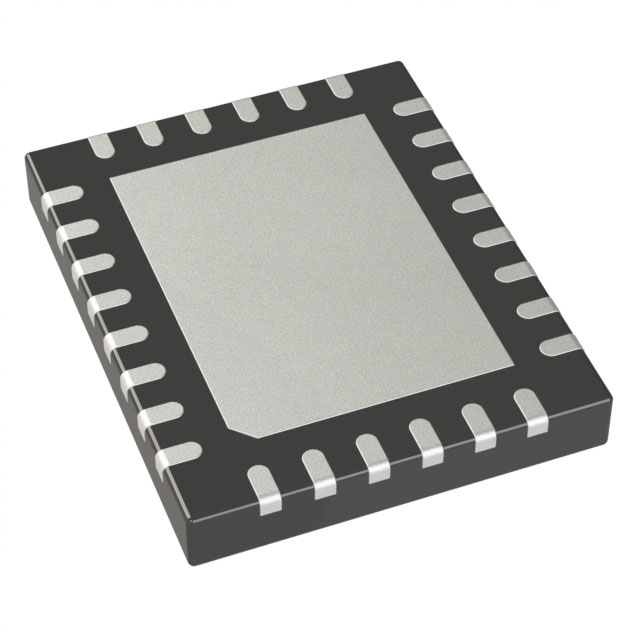
Key Specs
| Spec | Value | Condition | Source |
|---|---|---|---|
| Battery Chemistry | Lithium Iron Phosphate | Digi-Key | |
| Battery Pack Voltage | - | Digi-Key | |
| Charge Current (Max) | - | Digi-Key | |
| Current Charging | Constant - Programmable | Digi-Key | |
| Fault Protection | Reverse Current | Digi-Key | |
| Interface | - | Digi-Key | |
| Mounting Type | Surface Mount | Digi-Key | |
| Number Of Cells | - | Digi-Key | |
| Operating Temperature Range | -40°C ~ 125°C (TJ) | Digi-Key | |
| Package Case | 28-WFQFN Exposed Pad | Digi-Key | |
| Programmable Features | Timer | Digi-Key | |
| Supplier Device Package | 28-QFN (4x5) | Digi-Key | |
| Voltage Supply (Max) | 60V | Digi-Key |
When To Use
-
LiFePO4 battery pack charging at up to 60V input: The 60V maximum supply voltage rating accommodates the full voltage range of Lithium Iron Phosphate battery packs with ample margin, preventing breakdown during transients. Using a synchronous buck controller with a lower voltage rating risks latch-up or permanent damage during voltage spikes.
-
Programmable constant current charging with timer fault protection: The built-in programmable timer and constant current charging features enable precise control of charge termination and safety, avoiding overcharge conditions. A generic buck regulator lacking timer-based fault protection can permit thermal runaway or battery damage if charging stalls.
-
High-temperature environments up to 125°C junction: The device’s qualified operating temperature range to 125°C junction suits automotive or industrial LiFePO4 battery chargers exposed to elevated ambient temperatures. Using standard controllers without this rating risks early device failure or performance drift due to latch-up at elevated temperatures.
When Not To Use
-
Output current requirement above the device’s rating: When load current exceeds the maximum charge current programmable in this device, it is unsuitable. Use a high-current synchronous buck with external FETs to handle higher current and maintain efficiency.
-
Applications requiring galvanic isolation: This device has no isolation features and is not designed for isolated power systems. Use an isolated flyback topology to safely separate input and output grounds.
-
Designs with switching frequency requirements > 500 kHz: If the application demands very high switching frequencies for reduced inductor size or noise spectrum, this controller’s switching frequency capability is insufficient. Use a high-frequency buck controller instead.
Application Notes
-
The switching node (SW) pin must be routed with minimal parasitic inductance and closely coupled to the input bulk capacitor to prevent voltage spikes that could trigger device undervoltage lockout or damage.
-
Pins sensitive to noise such as the timer programming and current sense inputs (check datasheet pinout) should be routed away from high dV/dt nodes and shielded with ground guard traces to prevent false triggering of fault timers or current limit.
-
The exposed pad on the 28-WFQFN package must be soldered directly to a large PCB copper area connected to system ground to optimize thermal dissipation and reduce junction temperature rise under continuous charge current.
-
Proper layout of the current sense resistor and its return path is critical; ground loops or shared current paths can induce measurement errors, causing erratic charge current regulation or premature fault trips.
-
Avoid routing sensitive analog signals under or near the SW node trace to minimize capacitive coupling and switching noise injection that could degrade charge current accuracy and timer operation.
Gotchas
-
[Timer misprogramming interaction]: Setting the programmable timer too short while charging a high-capacity LiFePO4 pack can cause premature termination of charge, resulting in incomplete battery charge with no obvious error indication. On scope, output voltage will saturate below target, and current will drop abruptly. Fix by verifying timer duration against expected full charge time, and bench-test with representative battery loads.
-
[Current sense ground loop]: Routing the sense resistor return through a noisy ground node or shared current path causes fluctuating sensed current signals, triggering intermittent reverse current fault protection and unexpected shutdowns. Symptom includes erratic switching on scope and unexplained charge cycle aborts. Fix by isolating the sense resistor ground return directly to the device’s ground pin reference.
-
[SW node ringing causing fault trips]: Insufficient decoupling or layout parasitics on the SW pin can cause high-voltage ringing that falsely triggers internal fault detection circuits. This results in repeated charge cycle resets or fault lockouts with no visible hardware damage. Fix by adding a small snubber or improving PCB layout to minimize loop area and using low-ESR capacitors close to the switch node.
-
[Startup sequencing with zero load]: Applying input voltage before a minimum load is connected can prevent the device from initiating charge, appearing as a dead or non-responsive charger on bench test. This occurs because the device requires a minimum current path to regulate properly. Fix by ensuring a minimum load or precharge resistor is present during startup tests.