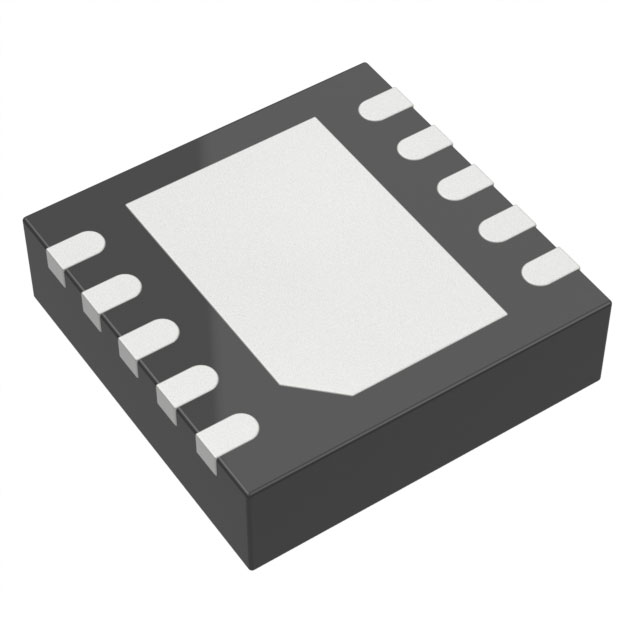
Key Specs
| Spec | Value | Condition | Source |
|---|---|---|---|
| Function | Step-Up, Step-Up/Step-Down | Digi-Key | |
| Input Voltage (Max) | 16V | Digi-Key | |
| Input Voltage (Min) | 2.2V | Digi-Key | |
| Mounting Type | Surface Mount | Digi-Key | |
| Number Of Outputs | 2 | Digi-Key | |
| Operating Temperature Range | 0°C ~ 70°C (TA) | Digi-Key | |
| Output Configuration | Positive and Negative (Dual Rail) | Digi-Key | |
| Output Current (Max) | 50mA | Digi-Key | |
| Output Type | Adjustable | Digi-Key | |
| Output Voltage (Max) | ±34V | Digi-Key | |
| Output Voltage (Min) | ±2.2V | Digi-Key | |
| Package Case | 10-WFDFN Exposed Pad | Digi-Key | |
| Supplier Device Package | 10-DFN (3x3) | Digi-Key | |
| Switching Frequency (Typ) | 1.1MHz | Digi-Key | |
| Synchronous Rectifier | No | Digi-Key | |
| Topology | Boost, Cuk | Digi-Key |
When To Use
-
Battery-powered 3.0–4.2V input → ±34V dual-rail @ 20mA/50mA: The wide input voltage range starting at 2.2V with a maximum of 16V and the dual positive and negative output rails make this ideal for powering analog front-ends requiring symmetrical high voltage rails from a single Li-ion cell. Lower current synchronous buck solutions would fail due to inability to generate negative rails, while LDOs would dissipate excessive heat and cannot boost above input voltage.
-
Compact sensor system with 1.25V regulated output @ 20mA: The integrated step-up/step-down topology with a 1.25V internal reference and minimum output capacitor of 2.2µF enables small, stable output voltages at low load current. Using a linear regulator here would fail due to thermal limits at input voltages above 2.2V, while a synchronous buck controller cannot generate output voltages below input voltage.
-
High-frequency switching at 1.1MHz for size-constrained LED driver with 20mA load: The typical switching frequency of 1.1MHz and maximum of 1.4MHz allows for small inductors (22µH–47µH) and capacitors, minimizing solution size. A lower frequency synchronous buck controller would require larger magnetics and could lead to poor transient response; a flyback converter would add unnecessary complexity and size.
When Not To Use
-
Output current demand > 50mA continuous: The maximum output current rating of 50mA is insufficient for higher loads. Use a high-current synchronous buck with external FETs to handle larger currents with improved efficiency and thermal management.
-
Quiescent current critical battery-powered device (μA sleep mode): The typical quiescent current runs from 3mA up to 5.8mA, which is too high for ultra-low power sleep modes. Use a low-IQ PFM buck regulator to achieve µA-level standby current and extend battery life.
-
Input voltage close to output voltage (< 1V headroom): The minimum input voltage of 2.2V and step-up/down topology cannot efficiently regulate with differential under 1V due to internal reference and switching thresholds. Use an LDO regulator when input-output differential is small and noise or ripple must be minimal.
Application Notes
-
The switching node (SW) pin must be routed with a short, low-inductance copper area to minimize EMI and voltage spikes; keep this trace away from noise-sensitive feedback pins (FBP and FBN, pins 3 and 4) to prevent erratic regulation.
-
the FBN pin and the FBP pin are high-impedance feedback inputs and must be routed with guarded traces or ground shields to reduce noise pickup; use 50kΩ feedback resistors as typical to maintain stable feedback current (~25µA).
-
Use a minimum input capacitor of 2.2µF placed close to the VIN pin (pin 1) to stabilize input voltage and minimize input ripple caused by the internal switching current peaks up to 0.89A.
-
The shutdown pin voltage should remain below 0.3V for guaranteed device off and above 0.8V for on; ensure no floating or slow ramps on this pin to prevent unintended switching or quiescent current spikes.
-
The device package is a 10-WFDFN with exposed pad; solder the exposed pad to a large PCB copper area connected to ground for optimal thermal dissipation and electrical performance.
Pin numbers are package-specific. Verify against the datasheet pinout diagram before routing.
Design Equations
Output voltage: Vout = 1.25V × (1 + R2/R1)
R1 is typically 1.21kΩ–10kΩ (1% tolerance). Solve for R2: R2 = R1 × (Vout/1.25 - 1). Example: for 5V with R1=1.21kΩ → R2 ≈ 3.74kΩ (use 3.74kΩ 1%).
Gotchas
-
[Assuming any ceramic capacitor ≥1µF is acceptable on output]: The datasheet mandates a minimum output capacitance of 2.2µF. Using a lower capacitance (e.g., 1µF) can cause unstable feedback loops and output voltage oscillations, visible as ringing or erratic output on the scope. Fix by verifying capacitor value and ESR meets or exceeds 2.2µF minimum with stable dielectric (X7R or better).
-
[Neglecting feedback pin bias currents in resistor selection]: The 25µA typical current through the feedback pins means using very high-value feedback resistors (e.g., >100kΩ) shifts the feedback node voltage, causing output voltage errors or startup issues. Fix by choosing feedback resistors around the nominal 50kΩ value and measuring actual feedback bias current during characterization.
-
[Routing SW node traces too close to FBP/ FBN]: The high dV/dt on the SW pin induces noise coupling into the sensitive feedback pins, causing jitter and output voltage ripple beyond the ±5mV typical feedback voltage window. Observable symptoms include output voltage instability and increased output noise floor. Fix by separating SW node routing from feedback traces by at least 5mm and adding grounded guard traces if possible.
-
[Startup with no load or very light load]: The device may fail to regulate properly or exhibit output voltage overshoot if the load current is below the minimum 20mA typical load current specification. This can cause the internal control loop to oscillate or latch off, seen as startup voltage spikes or no output regulation. Fix by ensuring a minimum load resistor or active load during startup to maintain regulation stability.