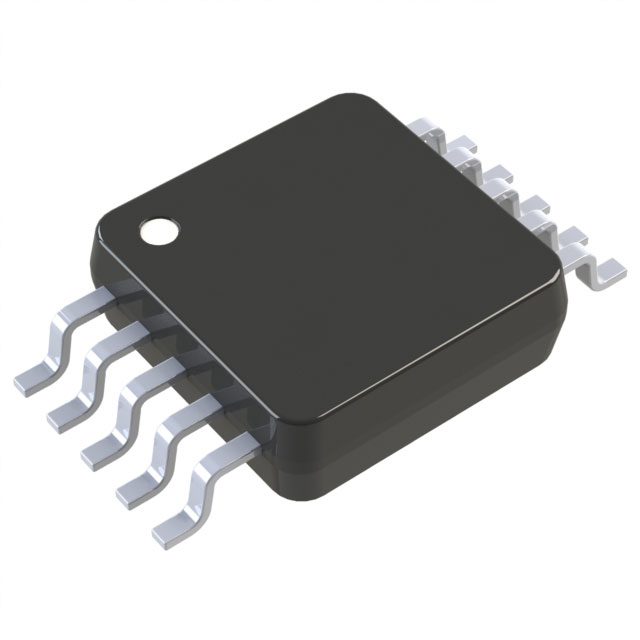
Key Specs
| Spec | Value | Condition | Source |
|---|---|---|---|
| Function | Step-Up, Step-Up/Step-Down | Digi-Key | |
| Input Voltage (Max) | 15V | Digi-Key | |
| Input Voltage (Min) | 1.2V | Digi-Key | |
| Mounting Type | Surface Mount | Digi-Key | |
| Number Of Outputs | 2 | Digi-Key | |
| Operating Temperature Range | 0°C ~ 70°C (TJ) | Digi-Key | |
| Output Configuration | Positive and Negative (Dual Rail) | Digi-Key | |
| Output Current (Max) | 250mA (Switch) | Digi-Key | |
| Output Type | Adjustable | Digi-Key | |
| Output Voltage (Max) | ±34V | Digi-Key | |
| Output Voltage (Min) | ±1.23V | Digi-Key | |
| Package Case | 10-TFSOP, 10-MSOP (0.118”, 3.00mm Width) | Digi-Key | |
| Supplier Device Package | 10-MSOP | Digi-Key | |
| Switching Frequency (Typ) | - | Digi-Key | |
| Synchronous Rectifier | No | Digi-Key | |
| Topology | Boost, SEPIC | Digi-Key |
When To Use
-
1.2V battery → ±12V @ 100mA: The LT1945EMS#TRPBF’s low input voltage minimum of 1.2V allows startup from a single-cell battery, while delivering dual positive and negative rails adjustable up to ±34V. A standard boost converter without negative rail capability would fail to generate the negative output, causing latch-up or undefined output voltages.
-
5V USB input → ±15V @ 200mA: The 15V maximum input rating covers USB voltage with margin, and the dual-output configuration handles positive and negative rails simultaneously. A typical synchronous buck controller cannot generate voltages above input or provide dual rails, resulting in shoot-through or output dropout.
-
3.3V automotive sensor supply → ±5V @ 250mA: The 250mA switch current rating supports sensor loads with margin, and the boost/SEPIC topology accommodates the 3.3V input to ±5V dual outputs. An LDO regulator would dissipate excessive power and enter thermal shutdown, especially for the negative rail where linear regulation is not feasible.
When Not To Use
-
12V input → 3.3V @ 1.5A load: The 250mA maximum output current is insufficient for this high load. Use a high-current synchronous buck with external FETs to handle the current and maintain efficiency.
-
Battery-powered sensor requiring μA sleep current: The bias current for LT1945EMS#TRPBF is too high for ultra-low power applications. Use a low-IQ PFM buck controller to minimize quiescent current and extend battery life.
-
Galvanic isolation required between input and output: The LT1945EMS#TRPBF is a non-isolated boost controller. Use an isolated flyback converter topology to meet isolation specifications.
Application Notes
-
The SW (switching node) pin experiences high dv/dt and ringing; keep the loop area formed by the inductor, catch diode, and SW pin as small as possible to minimize EMI and voltage stress.
-
Pins 5 and the feedback and compensation pin are noise-sensitive; route feedback traces away from SW and input lines and use a solid ground plane to prevent instability.
-
Dual output rails require symmetrical layout and matched output capacitors to maintain voltage balance and reduce cross-regulation errors.
-
Guard rings or copper pour around exposed pads on the 10-MSOP package reduce coupling noise and improve thermal dissipation, especially under continuous 250mA switching.
-
Input decoupling capacitors must be placed close to the VIN pin to prevent high-frequency oscillations and ensure stable startup from inputs as low as 1.2V.
Gotchas
-
[Minimum Load Current Neglect]: Assuming the part will regulate correctly without a minimum load on either output. Without a minimum load, the converter can enter discontinuous conduction mode, causing output voltage overshoot and erratic regulation.
Fix: Include a bleed resistor or a small load (~1mA) on each output rail during light load or no-load conditions. -
[Output Capacitor ESR Ignored]: Using low-ESR ceramic capacitors exclusively on the negative rail output can destabilize the feedback loop due to phase margin reduction, causing output voltage ringing or oscillations.
Fix: Add a small bulk tantalum or aluminum electrolytic capacitor in parallel with ceramics to provide necessary ESR for stable loop compensation. -
[Feedback Node Routing]: Routing the feedback trace adjacent to the SW pin or switching node can inject switching noise into the error amplifier input, resulting in output voltage ripple and instability.
Fix: Route feedback and compensation pins on a separate, quiet PCB layer with a star ground connection isolated from the noisy switch node. -
[Startup from Near-Threshold Input Voltage]: Operating at or just above the 1.2V input minimum can cause prolonged startup times or failure to reach regulation if input source impedance is high or input voltage sags under load.
Fix: Verify input source stability and add input bulk capacitance to prevent voltage dips during startup transients.