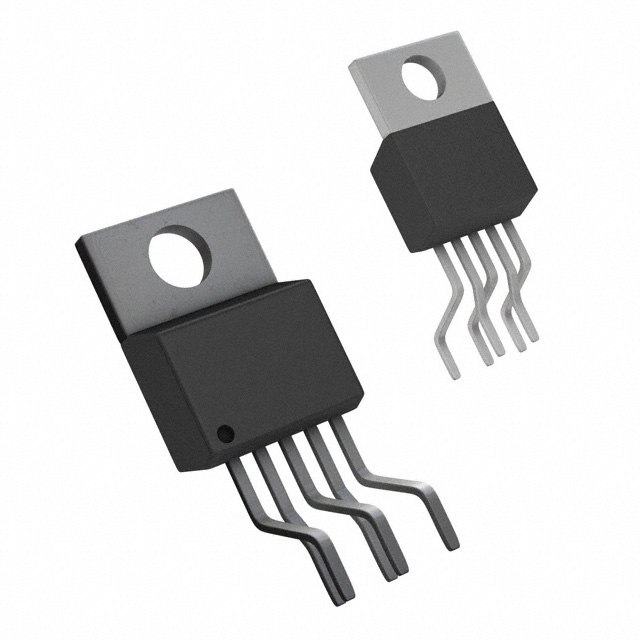
LM2596T-ADJ/NOPB vs. TGM-240NSLFTR: A Practical Comparison
Quick Verdict: For simple, non-isolated step-down applications where board space and cost are paramount, the LM2596T-ADJ/NOPB remains a viable choice. However, when galvanic isolation is a requirement – and it often is in industrial or medical applications – the TGM-240NSLFTR offers a compact, integrated solution, albeit with a narrower operating temperature range and a higher bill of materials cost.
Spec Comparison Table
| Spec | LM2596T-ADJ/NOPB | TGM-240NSLFTR | Notes |
|---|---|---|---|
| type | Step-Down | For DC/DC Converters | TGM-240NSLFTR is a component within a DC/DC converter. |
| applications | General purpose step-down | Isolated Buck Converters | Significant difference in application scope. |
| intended_chipset | N/A | MAX253, MAX845, MAX3535, MXL1535 | TGM-240NSLFTR is designed to work with these specific ICs. |
| chipset_manufacturer | N/A | Analog Devices, Inc | Indicates a dependency on external ICs for functionality. |
| voltage_isolation | None | 1500 Vrms | Critical difference: TGM-240NSLFTR provides galvanic isolation. |
| operating_temperature_range | -40°C ~ 125°C | -40°C ~ 85°C | LM2596 has a wider operating temperature range, beneficial for harsh environments. |
| mounting_type | Through Hole | Surface Mount | Surface mount simplifies automated assembly and can reduce board footprint. |
| size_dimension | N/A | 0.320” L x 0.280” W (8.13mm x 7.11mm) | TGM-240NSLFTR is significantly smaller, enabling more compact designs. |
| output_voltage_min | 1.2V | N/A | Output voltage is determined by the external IC. |
| output_voltage_max | 37V | N/A | Output voltage is determined by the external IC. |
| output_current_max | 3A | N/A | Output current is determined by the external IC. |
| switching_frequency_typ | 150kHz | N/A | Switching frequency is determined by the external IC. |
| turns_ratio_pri_ll | N/A | ±3% | Indicates winding accuracy. |
| primary_inductance_min | N/A | 960 μH | Inductance value is a key parameter for transformer design. |
| primary_inductance_typ | N/A | 960 μH | Inductance value is a key parameter for transformer design. |
| secondary_inductance_min | N/A | 960 μH | Inductance value is a key parameter for transformer design. |
| secondary_inductance_typ | N/A | 960 μH | Inductance value is a key parameter for transformer design. |
| dcr_max | N/A | 0.8 Ω | Lower DCR reduces conduction losses. |
| switching_frequency_max | N/A | 11 V-μs | Switching speed affects transient response and EMI. |
Design Trade-offs
The LM2596T-ADJ/NOPB is a classic, simple solution. Its primary advantage is its low cost and ease of implementation. However, its lack of isolation makes it unsuitable for applications where safety or signal integrity are paramount. Its through-hole design can increase board size and assembly time, particularly for high-volume production. The 150kHz switching frequency, while adequate, can lead to increased EMI compared to more modern, higher-frequency solutions. Efficiency will be dictated by external component selection; expect 60-75% efficiency depending on load and component quality.
The TGM-240NSLFTR represents a different approach. It’s a component within an isolated DC-DC converter, integrating a transformer and a discrete IC (e.g., MAX253). This drastically reduces the overall size and simplifies the design process compared to building a discrete isolated solution. The 1500 Vrms isolation is the key benefit, essential for safety-critical applications. However, the narrower operating temperature range (-40°C to 85°C) limits its use in extreme environments. The integrated transformer introduces a fixed turns ratio and inductance, restricting design flexibility. The 0.8Ω DCR on the transformer will contribute to losses, and the 11 V-μs switching speed may impact transient response and EMI performance. Efficiency is also dependent on the external IC and transformer design, but expect values in the 70-85% range.
Use-case Fit
Choose LM2596T-ADJ/NOPB when…
- You need a simple, low-cost step-down regulator for a non-isolated application.
- Board space is not a critical constraint, and through-hole components are acceptable.
- The application operates within a moderate temperature range (-40°C to 125°C).
- You’re building a DIY power supply or prototype where isolation isn’t required.
- You need a regulator for a 3.3V to 5V conversion in a battery-powered device where cost is a primary concern.
Choose TGM-240NSLFTR when…
- Galvanic isolation is mandatory for safety or signal integrity.
- You need a compact, integrated solution to minimize board footprint.
- The application operates within a moderate temperature range (-40°C to 85°C).
- You’re designing a power supply for a medical device or industrial automation system.
- You need to power a logic board from a higher voltage source in a noisy environment.
Drop-in Compatibility
These parts are not pin-compatible or footprint-compatible. The LM2596T-ADJ/NOPB is a discrete regulator requiring external components (inductor, capacitors, resistors) and a through-hole footprint. The TGM-240NSLFTR is a surface-mount component designed to work with a specific external IC and requires a dedicated footprint. Substituting one for the other would require a complete redesign of the power supply circuit and PCB layout.
Alternatives to Consider
- LM2596S-ADJ: A synchronous version of the LM2596, offering improved efficiency, but still lacking isolation.
- HIP2501: A discrete synchronous buck regulator with a wider input voltage range, but requiring more design effort.
- LT8364: A monolithic, isolated buck-boost converter offering a more integrated solution with adjustable isolation voltage.