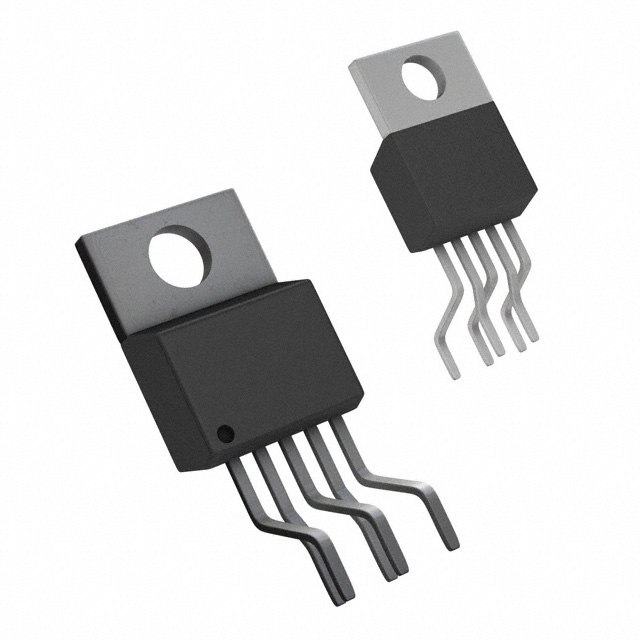
LM2596T-ADJ/NOPB vs LTM8074IY#PBF: Component Comparison for Power Supply Design
Quick verdict
For straightforward, high-current, through-hole buck regulator designs requiring up to 3A output and simple implementation, the LM2596T-ADJ/NOPB is the preferred choice due to its higher output current capability and easier thermal management. Conversely, for compact, high-frequency, surface-mount point-of-load (PoL) applications with space constraints and moderate current requirements (up to 1.2A), the LTM8074IY#PBF offers a complete µModule solution with integrated passives and superior EMI performance.
Spec comparison table
| Spec | LM2596T-ADJ/NOPB | LTM8074IY#PBF | Notes |
|---|---|---|---|
| Function | Step-Down Buck Regulator | Non-Isolated PoL Module DC/DC Converter | Both are buck regulators; LTM8074 is a µModule with integrated passives, simplifying design. |
| Input Voltage Min | 4.5 V | 3.2 V | LTM8074IY#PBF supports lower input voltage, useful for battery-powered or low-voltage rails. |
| Input Voltage Max | 40 V | 40 V | Equal input voltage range. |
| Output Voltage Min | 1.2 V | 0.8 V | LTM8074IY#PBF supports lower output voltage, beneficial for newer low-voltage digital cores. |
| Output Voltage Max | 37 V | 12 V | LM2596T offers a much wider output voltage range, suitable for high-voltage rails. |
| Output Current Max | 3 A | 1.2 A | LM2596T supports significantly higher output current, critical for power-hungry loads. |
| Number of Outputs | 1 | 1 | Both single-output devices. |
| Mounting Type | Through Hole | Surface Mount | LM2596T is through-hole (easier prototyping, less dense PCB); LTM8074 is surface-mount (space-saving). |
| Package/Case | TO-220-5 Formed Leads | 25-FBGA (4x4 mm) | LTM8074 provides a tiny footprint, ideal for compact designs; LM2596T is physically larger. |
| Switching Frequency Typical | 150 kHz | 850 kHz (typ), up to 2.2 MHz max | LTM8074 operates at much higher frequency, reducing inductor and capacitor size but increasing layout complexity. |
| Synchronous Rectifier | No | Yes (implied by µModule, datasheet not explicit) | LM2596T does not have synchronous rectification, leading to higher conduction losses and lower efficiency. |
| Operating Temperature Range | -40°C to 125°C | -40°C to 125°C | Equal operating temperature range. |
| Output Voltage Ripple Typical | Not specified | 15 mV | LTM8074 offers low output ripple, beneficial for noise-sensitive applications. |
| Line Regulation Typical | Not specified | 0.5% | LTM8074 provides tighter line regulation. |
| Load Regulation Typical | Not specified | 0.8% | LTM8074 provides tighter load regulation. |
| Quiescent Current Typical | Not specified | 3 µA | LTM8074 has extremely low quiescent current, suitable for low-power or always-on applications. |
| Thermal Resistance (Junction-to-Ambient) | Not specified | 48.9 °C/W | LTM8074’s thermal resistance is high due to small size; requires careful PCB thermal design. |
| Package Weight | Not specified | 0.08 g | LTM8074 is very lightweight, relevant for high-density or mobile applications. |
| Efficiency | Not specified | Minimum 80% | LTM8074 guarantees a minimum efficiency of 80%, but exact curves depend on load and voltage. |
| Power Loss Max | Not specified | 3 W | LTM8074 power loss max is 3W, indicating thermal design must consider this dissipation. |
| Soft-Start | Not specified | Programmable via TR/SS pin | LTM8074 supports soft-start control, helping reduce inrush current and output overshoot. |
| Switching Frequency Range | Fixed 150 kHz | 200 kHz to 2.2 MHz | LTM8074’s adjustable and higher switching frequency allows smaller passive components but increases EMI. |
| Control Features | Not specified | Burst Mode, Pulse Skipping, Spread Spectrum, Sync | LTM8074 provides sophisticated control modes for EMI and efficiency optimization; LM2596T is simpler. |
| Input Current Typical | Not specified | 1.2 A | LTM8074 typical input current matches max output current, indicating efficient power conversion. |
| Output Current Typical | Not specified | 1.2 A | LTM8074 typical output current is 1.2A. |
| Peak Output Current | Not specified | 1.75 A | LTM8074 supports short peak current above nominal rating. |
| Power Good Feature | No | Yes | LTM8074 includes a power-good signal for system monitoring. |
| Package Thermal Resistance (Junction-to-Case, Bottom) | Not specified | 17.2 °C/W | LTM8074 dissipates heat mainly through PCB; careful layout critical. |
| Board Size (recommended) | Not specified | 58 cm² | LTM8074 requires a relatively large PCB area for thermal management despite small package. |
Design trade-offs
The LM2596T-ADJ/NOPB is a classic, through-hole buck regulator IC designed around a 150 kHz fixed switching frequency, which simplifies EMI filtering and reduces switching losses. Its maximum output current of 3A and wide output voltage range up to 37V make it versatile for power rails up to medium currents and voltages. However, it lacks synchronous rectification, which translates to higher conduction losses and lower efficiency at high loads. This means more heat dissipation and often larger heat sinks, but the TO-220 package facilitates thermal management via a metal tab and external heatsink. The through-hole package also simplifies prototyping and rework but limits PCB space savings.
In contrast, the LTM8074IY#PBF is a µModule DC/DC converter with integrated inductors and capacitors in a tiny 4x4 mm BGA package. It operates at a much higher switching frequency (typical 850 kHz, up to 2.2 MHz), which allows the use of smaller external passives and reduces overall solution size. The LTM8074 supports synchronous rectification (typical for Analog Devices µModules), improving efficiency, especially at light to moderate loads. Its sophisticated control options (Burst Mode, pulse-skipping, spread spectrum, synchronization) enable lower EMI and better transient response but require more careful layout and potentially firmware interaction to optimize.
Thermally, the LM2596T benefits from a large metal tab and through-hole mounting that allows direct heatsinking, making it easier to handle 3A continuous loads without excessive PCB thermal design. The LTM8074’s small size and high power density result in high thermal resistance (~48.9 °C/W junction-to-ambient), relying heavily on PCB copper planes and design to dissipate heat. Its power loss can reach up to 3W, necessitating careful thermal planning in compact designs. The LTM8074’s low quiescent current (3 µA typical) and soft-start capabilities make it suitable for power-sensitive and complex sequencing systems, but add complexity compared to the LM2596T.
From a cost and manufacturing perspective, the LM2596T is generally lower cost per unit and simpler to assemble due to through-hole format and minimal external parts (mostly an inductor and capacitors). The LTM8074, being a µModule, integrates many components but comes at a higher BOM cost and requires precise reflow soldering for the BGA package. Volume production with LTM8074 benefits from reduced board area and potentially better EMI compliance but demands more upfront PCB design effort.
Firmware-wise, the LM2596T is mostly an analog device with fixed frequency and no digital control interface, requiring minimal firmware interaction. The LTM8074 offers mode programming and synchronization pins, which can be used to optimize efficiency and EMI but require additional firmware or configuration logic.
Use-case fit
Choose LM2596T-ADJ/NOPB when…
- You need up to 3A output current for powering motors, high-current analog rails, or legacy systems.
- Your design tolerates through-hole components or requires easy prototyping and manual assembly.
- The output voltage needs to be above 12V or up to 37V, such as 24V or 30V rails.
- Thermal management via an external heatsink or chassis is straightforward and cost-effective.
- You want a low-complexity, low-cost regulator with minimal control interface and simple layout constraints.
Choose LTM8074IY#PBF when…
- PCB area is at a premium and you need a compact, surface-mount PoL solution.
- Output current requirements are