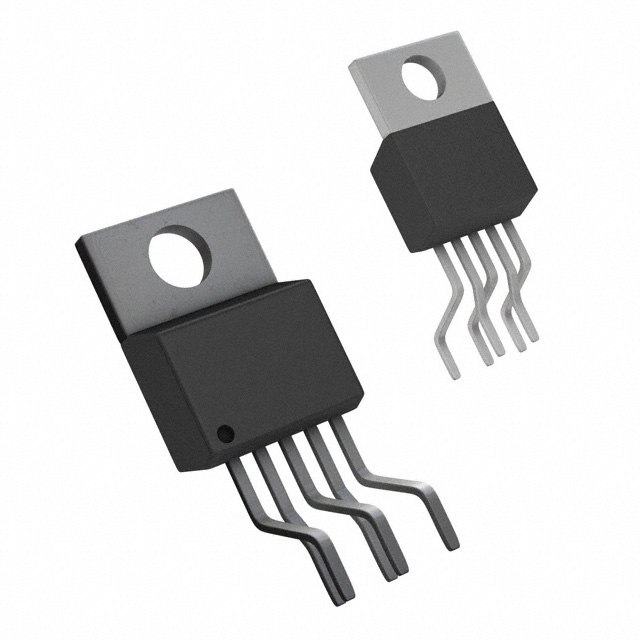
LM2596T-ADJ/NOPB vs. LT1172CS8#PBF: A Practical Comparison
Quick verdict: For simple, robust step-down regulation where component count and cost are primary concerns, the LM2596T-ADJ is the clear winner. However, if you need a versatile regulator capable of buck, boost, or Cuk topologies and a wider input voltage range, the LT1172CS8#PBF, despite its lower current rating, offers significantly more flexibility, though at the expense of higher complexity.
Spec comparison table
| Spec | LM2596T-ADJ/NOPB | LT1172CS8#PBF | Notes |
|---|---|---|---|
| Function | Step-Down | Step-Up, Step-Down, Step-Up/Step-Down | LT1172’s versatility is a significant advantage for adaptable power architectures. |
| Output Configuration | Positive | Positive or Negative | LT1172’s negative output capability simplifies designs requiring both positive and negative rails. |
| Topology | Buck | Buck, Boost, Cuk, Flyback, Forward Converter | LT1172’s broader topology support adds considerable design flexibility. |
| Output Type | Adjustable | Adjustable | Both offer adjustable output voltage, a common requirement. |
| Number of Outputs | 1 | 1 | Both are single-output regulators. |
| Input Voltage Min | 4.5V | 3V | LT1172’s lower input voltage requirement broadens its application range. |
| Input Voltage Max | 40V | 40V | Both share the same maximum input voltage. |
| Output Voltage Min | 1.2V | 1.244V | Minimal difference, unlikely to be a deciding factor. |
| Output Voltage Max | 37V | 65V (Switch) | LT1172’s higher maximum output voltage is useful for higher voltage applications. |
| Output Current Max | 3A | 1.25A (Switch) | LM2596’s higher current rating is crucial for higher power applications. |
| Switching Frequency Typ | 150kHz | 100kHz | LM2596’s higher frequency can reduce component size, but increases switching losses. |
| Synchronous Rectifier | No | No | Both lack synchronous rectification, impacting efficiency at lower voltages. |
| Operating Temperature Range | -40°C ~ 125°C | 0°C ~ 100°C | LM2596’s wider temperature range is advantageous in harsh environments. |
| Mounting Type | Through Hole | Surface Mount | LM2596’s through-hole package simplifies prototyping, while LT1172’s surface mount is better for automated assembly. |
| Package Case | TO-220-5 Formed Leads | 8-SOIC (0.154”, 3.90mm Width) | LT1172’s smaller SOIC package saves board space. |
Design trade-offs
The most significant difference lies in the application flexibility. The LT1172’s ability to operate in buck, boost, and Cuk topologies makes it suitable for more complex power architectures, such as isolated power supplies or DC-DC converters requiring both step-up and step-down capabilities. However, this versatility comes at the cost of a lower maximum output current (1.25A vs. 3A for the LM2596) and a narrower operating temperature range. The LM2596, being a dedicated buck regulator, is simpler to implement and offers higher current handling capability.
The LM2596’s 150kHz switching frequency, while potentially allowing for smaller external components, also increases switching losses, particularly at higher currents. The LT1172’s 100kHz frequency, while lower, can result in lower switching losses, but may require larger inductor and capacitor values. Without synchronous rectification, both regulators suffer from diode forward voltage losses, which become more significant at lower output voltages.
The LM2596’s TO-220 package is easier to handle for prototyping and manual assembly, but the LT1172’s SOIC package is much more compact and suitable for automated assembly and space-constrained applications. The LM2596’s through-hole nature also increases layout sensitivity to parasitic inductance.
Use-case fit
Choose LM2596T-ADJ/NOPB when…
- You need a simple, robust step-down regulator for a 5V to 3.3V conversion in a microcontroller power supply.
- You’re prototyping a power supply and prefer the ease of through-hole components.
- Cost is a primary concern and a 3A current rating is sufficient.
- You need a regulator that can operate reliably over a wider temperature range (-40°C to 125°C).
- You are building a power supply for a simple LED driver where a 3A current limit is adequate.
Choose LT1172CS8#PBF when…
- You need to design a DC-DC converter capable of both buck and boost operation.
- You are designing an isolated power supply using a flyback topology.
- You need a regulator that can operate from a lower input voltage (e.g., 3V).
- You are designing a compact power supply where board space is at a premium.
- You need the flexibility to easily switch between positive and negative output rails.
Drop-in compatibility
These parts are not pin-compatible or footprint-compatible. The LM2596 uses a TO-220 package, while the LT1172 uses an SOIC package. The pinout is also different, requiring a complete redesign of the power supply circuit. The control circuitry and external component selection will also need significant adjustments due to the different operating characteristics.
Alternatives to consider
- LM2596S: A slightly improved version of the LM2596 with better thermal performance.
- TPS5430: A synchronous buck regulator from TI offering higher efficiency and smaller size.
- LM2576: A lower-cost alternative to the LM2596, suitable for less demanding applications.