LM2596T-ADJ/NOPB vs. LM2596T-5.0/LF03: A Practical Comparison
The LM2596 family remains a workhorse for simple, cost-sensitive step-down regulation. The adjustable LM2596T-ADJ/NOPB provides flexibility for a wider range of output voltages, while the fixed-output LM2596T-5.0/LF03 simplifies design and reduces BOM cost when a 5V output is sufficient. For applications requiring a precise output voltage or needing to adapt to varying input conditions, the adjustable version is the clear winner. However, for simple 5V power supplies where BOM cost and design time are paramount, the fixed-output version offers a compelling advantage.
Spec Comparison Table
| Spec | LM2596T-ADJ/NOPB | LM2596T-5.0/LF03 | Notes |
|---|---|---|---|
| Function | Step-Down | Step-Down | Identical |
| Output Configuration | Positive | Positive | Identical |
| Topology | Buck | Buck | Identical |
| Output Type | Adjustable | Fixed | ADJ offers flexibility; Fixed simplifies design. |
| Number of Outputs | 1 | 1 | Identical |
| Input Voltage Min | 4.5V | 4.5V | Identical |
| Input Voltage Max | 40V | 40V | Identical |
| Output Voltage Min | 1.2V | 5V | ADJ covers a much wider range. |
| Output Voltage Max | 37V | - | Fixed output limits application scope. |
| Output Current Max | 3A | 3A | Identical |
| Switching Frequency Typ | 150kHz | 150kHz | Identical |
| Synchronous Rectifier | No | No | Identical |
| Operating Temperature Range | -40°C ~ 125°C (TJ) | -40°C ~ 125°C (TJ) | Identical |
| Mounting Type | Through Hole | Through Hole | Identical |
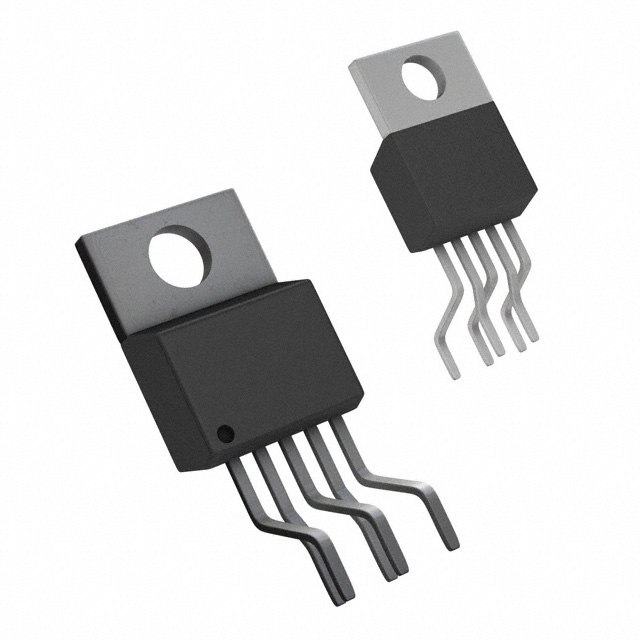
| Package Case | TO-220-5 Formed Leads | TO-220-5 Formed Leads | Identical |
| Supplier Device Package | TO-220-5 | TO-220-5 | Identical |
Design Trade-offs
The most significant difference is the adjustable output of the LM2596T-ADJ/NOPB. This necessitates external resistors to set the output voltage, adding a few cents to the BOM and requiring slightly more careful layout to minimize noise and ensure stable operation. The fixed output of the LM2596T-5.0/LF03 eliminates this complexity, reducing design time and potentially improving initial production yields.
Efficiency curves for both parts will be nearly identical assuming the external resistors are chosen appropriately for the ADJ version. Poor resistor selection can easily degrade efficiency. For example, using very low-value resistors to achieve a low output voltage will increase gate drive losses and conduction losses, potentially exceeding the losses of a slightly higher voltage setpoint. The ADJ version also introduces a slight increase in layout sensitivity due to the feedback network. Care must be taken to minimize parasitic capacitance and inductance in the feedback loop.
Thermal considerations are essentially the same for both parts, given identical operating conditions and heat sinking. Both are packaged in a TO-220, which requires careful attention to thermal management, especially at higher output currents. Gate drive requirements are also identical, as both use the same internal circuitry.
Cost at volume will favor the LM2596T-5.0/LF03. The elimination of the external resistors and potentially simpler assembly process translate to a lower overall cost per unit.
Use-Case Fit
Choose LM2596T-ADJ/NOPB when…
- Variable Input Voltage: You need to regulate a load from a battery string that varies in voltage (e.g., a 3S to 6S Li-ion pack).
- Custom Output Voltage: Your application requires an output voltage other than 5V, such as 3.3V for microcontroller logic or 12V for a motor driver.
- Programmable Output: You need to adjust the output voltage during operation, perhaps for calibration or to compensate for component aging.
- Input Voltage Range Variation: Your input voltage fluctuates significantly, requiring a wider output voltage range to maintain regulation.
- Testing and Calibration: You’re designing a test fixture or calibration system where the output voltage needs to be adjustable.
Choose LM2596T-5.0/LF03 when…
- Simple 5V Power Supply: You’re building a basic 5V power supply for a microcontroller or other device.
- Cost-Sensitive Application: BOM cost is a primary concern and a 5V output is sufficient.
- Fast Time-to-Market: You need to get a product to market quickly and want to minimize design effort.
- High-Volume Production: You’re producing a large quantity of devices and want to reduce assembly costs.
- Fixed Voltage Requirement: The application requires a stable and predictable 5V output.
Drop-in Compatibility
Pin compatibility is likely, as both parts use the same TO-220 package and internal circuitry. Footprint compatibility is also expected. However, substituting the LM2596T-ADJ/NOPB for the LM2596T-5.0/LF03 will require removing the external resistors and replacing them with appropriate values for the desired output voltage. Conversely, substituting the fixed output version for the adjustable one will require adding the necessary resistors and ensuring their placement minimizes noise and instability. Without careful consideration of resistor selection and layout, instability or poor regulation could result.
Alternatives to Consider
- LM2596S-ADJ: Offers slightly improved performance and a smaller package option (SOIC-8), but requires more complex PCB layout.
- LM2576: A lower-cost alternative with slightly lower performance.
- TPS5430: A synchronous buck regulator offering higher efficiency, but with increased complexity.