LM2596T-ADJ/NOPB vs. LM2596T-5.0: A Practical Comparison
Quick verdict: For applications requiring a variable output voltage, the LM2596T-ADJ/NOPB is the only choice. However, for simple 5V power applications where a fixed output is sufficient and circuit complexity needs to be minimized, the LM2596T-5.0 offers a slightly faster design cycle and potentially lower component count.
Spec comparison table
| Spec | LM2596T-ADJ/NOPB | LM2596T-5.0 | Notes |
|---|---|---|---|
| Function | Step-Down | Step-Down | Identical. |
| Output Configuration | Positive | Positive | Identical. |
| Topology | Buck | Buck | Identical. |
| Output Type | Adjustable | Fixed | This is the key differentiator. |
| Number of Outputs | 1 | 1 | Identical. |
| Input Voltage Min | 4.5V | 4.5V | Identical. |
| Input Voltage Max | 40V | 40V | Identical. |
| Output Voltage Min | 1.2V | 5V | ADJ offers significantly wider range. |
| Output Voltage Max | 37V | - | LM2596T-5.0 is fixed at 5V. |
| Output Current Max | 3A | 3A | Identical. |
| Switching Frequency Typ | 150kHz | 150kHz | Identical. |
| Synchronous Rectifier | No | No | Identical. |
| Operating Temperature Range | -40°C ~ 125°C (TJ) | -40°C ~ 125°C (TJ) | Identical. |
| Mounting Type | Through Hole | Through Hole | Identical. |
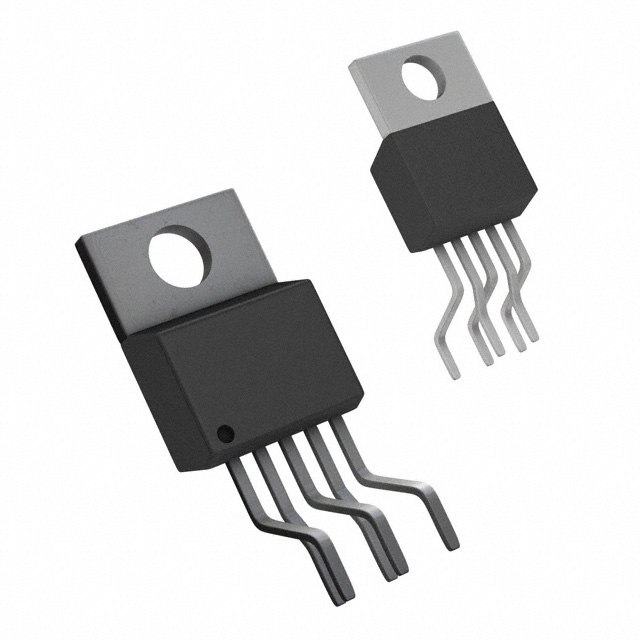
| Package Case | TO-220-5 Formed Leads | TO-220-5 Formed Leads | Identical. |
| Supplier Device Package | TO-220-5 | TO-220-5 | Identical. |
Design trade-offs
The most obvious difference is the adjustable output of the LM2596T-ADJ/NOPB versus the fixed 5V output of the LM2596T-5.0. This dictates the entire design approach. The adjustable version requires external resistors to set the output voltage, adding two components and increasing the board area slightly. However, it also provides flexibility to adapt to different voltage requirements without swapping hardware. The fixed version eliminates these resistors, simplifying the circuit and potentially reducing BOM cost.
Efficiency curves for both parts are likely very similar, as the core switching circuitry is identical. However, the external resistor selection for the adjustable version can impact efficiency slightly. Poor resistor choices (high equivalent series resistance – ESR) will introduce additional losses. The fixed version avoids this potential source of inefficiency. At higher output currents (approaching 3A), the inductor’s DC resistance (DCR) will be the dominant factor in losses for both parts, regardless of the output voltage.
Thermal considerations are essentially identical for both parts, assuming similar heatsinking. The TO-220 package necessitates attention to thermal management, especially at higher currents. The power dissipation will be slightly higher for the adjustable version if the output voltage is significantly lower than 5V, due to increased duty cycle losses.
Layout sensitivity is typical for this class of regulator. Proper grounding and minimizing loop areas are crucial for both parts to avoid oscillations and ensure stability. The adjustable version introduces the feedback network, which requires careful layout to minimize noise coupling.
Cost at volume will likely be slightly lower for the LM2596T-5.0 due to the reduced component count. However, the added flexibility of the adjustable version can outweigh this cost difference in many applications.
Use-case fit
Choose LM2596T-ADJ/NOPB when…
- You need to power a microcontroller with a specific voltage requirement (e.g., 3.3V) and the input voltage is higher than that.
- You’re designing a modular power supply where the output voltage needs to be configurable for different customer needs.
- You need to adapt to different voltage requirements in the field without swapping hardware.
- You’re building a battery charging circuit where the cell voltage varies.
- You are prototyping a design and want the flexibility to easily change the output voltage.
Choose LM2596T-5.0 when…
- You need a simple, reliable 5V power supply for a fixed application (e.g., powering a legacy device).
- You’re building a high-volume product where minimizing BOM cost and circuit complexity are paramount.
- You’re designing a low-cost power adapter for a specific device.
- You need a straightforward power solution for a simple embedded system.
- You are designing a power distribution board that exclusively needs 5V rails.
Drop-in compatibility
Pin compatibility is excellent. The pinout is identical. Footprint compatibility is also excellent, as both parts are packaged in a TO-220-5. Substituting one for the other requires no hardware changes. However, the output voltage will change, so a thorough voltage verification is essential after substitution. The feedback network for the adjustable version will need to be omitted or removed if substituting the fixed version.
Alternatives to consider
- LM2596S-ADJ: A synchronous version of the LM2596, offering improved efficiency but increased complexity.
- LM2576: A similar regulator with slightly different specifications, worth evaluating if a different input voltage range is required.
- TPS5430: A more modern, synchronous buck regulator offering higher efficiency and more advanced features.