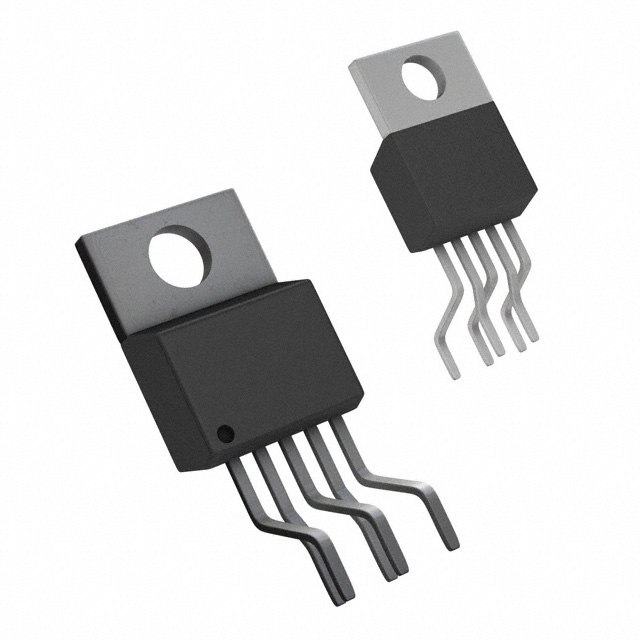
LM2596 Regulator Showdown: ADJ vs. 12-Volt Fixed
The LM2596 is a workhorse regulator, but choosing between the adjustable (ADJ) and fixed 12-volt (12) versions is a surprisingly nuanced decision. For battery-powered devices needing flexible voltage rails, the ADJ version reigns supreme, offering unparalleled design freedom. However, for simple, 12-volt output applications where precision isn’t paramount and component count must be minimized, the fixed 12-volt version offers a compelling, cost-effective solution.
Spec Comparison Table
| Spec | LM2596T-ADJ/NOPB | LM2596T-12/NOPB | Notes |
|---|---|---|---|
| Output Voltage | 3.3V - 40V (adjustable) | 12V (fixed) | ADJ offers flexibility; 12V simplifies design. |
| Output Current | 3A | 3A | Identical current capability. |
| Input Voltage Range | 4.5V - 40V | 4.5V - 40V | Identical input voltage range. |
| Switching Frequency | ~150 kHz (typical) | ~150 kHz (typical) | Identical, impacting component size and noise. |
| Quiescent Current | 30mA | 30mA | Identical, important for battery-powered applications. |
| Line Regulation | ±0.4% | ±0.4% | Identical, reflecting output voltage stability with input voltage changes. |
| Load Regulation | ±1.0% | ±1.0% | Identical, reflecting output voltage stability with load current changes. |
| Short Circuit Current Limit | 2.3A | 2.3A | Identical, providing protection against short circuits. |
| Operating Temperature Range | -40°C to 125°C | -40°C to 125°C | Identical, defining the acceptable temperature range. |
| Material Type | Prototypes/Experimental Devices | Prototypes/Experimental Devices | Identical, reflecting their development stage. |
| RoHS Values | Yes, No, RoHS Exempt | Yes, No, RoHS Exempt | Identical, indicating compliance with environmental regulations. |
| Pin1 Quadrant | Q2 | Q2 | Identical, defining the physical layout of the pins. |
Design Trade-offs
The most significant difference lies in the adjustable output. This seemingly small feature has cascading effects. With the ADJ version, you’re responsible for setting the output voltage using external resistors. This adds a couple of components and requires a little more design effort, but it unlocks the ability to tailor the regulator to a specific application. The 12V fixed version, conversely, eliminates this external circuitry, reducing component count and simplifying the layout.
Efficiency curves are likely to be similar between the two, as the core switching action is identical. However, the external resistor network in the ADJ version could introduce a small amount of additional quiescent current draw, though this is typically negligible. Thermal considerations are also largely the same; both parts dissipate heat based on input voltage, output current, and ambient temperature. Careful PCB layout is still required for both, ensuring adequate copper area for heat sinking.
Gate drive requirements are identical; both rely on the internal MOSFET. Layout sensitivity is also comparable. The ADJ version’s resistor network needs to be placed strategically to minimize noise coupling, but this is a manageable concern. The cost difference at volume is likely to be small, perhaps a few cents per unit, but the labor savings from reduced assembly can be significant.
Use-Case Fit
Choose LM2596T-ADJ/NOPB when…
- Battery-powered device with variable voltage rails: A portable instrument requiring both 5V and 12V outputs benefits immensely from the ADJ version’s flexibility.
- Custom voltage required for a sensor or communication interface: If a specific voltage (e.g., 3.3V for an SD card) is needed, the ADJ version provides the necessary control.
- Multiple output voltages needed from a single input: A system with several voltage requirements (e.g., 5V, 12V, and 3.3V) can be efficiently managed with a few ADJ regulators.
- Experimentation and prototyping: The ADJ version is ideal for exploring different voltage levels and optimizing performance in a new design.
- Isolated DC-DC conversion: When combined with a flyback transformer, the adjustable output allows for precise control of the secondary voltage.
Choose LM2596T-12/NOPB when…
- Simple 12V power supply for a fixed load: A device requiring a constant 12V output, such as a fan or a relay driver, is a perfect fit.
- Cost-sensitive application where precision isn’t critical: For applications where a slight variation in output voltage is acceptable, the 12V fixed version offers a cost-effective solution.
- Minimal component count is essential: Reducing the number of external components simplifies assembly and reduces overall system size.
- Rapid prototyping of a 12V system: The fixed output eliminates the need for resistor selection and calculation, speeding up the prototyping process.
- Replacing a failed 12V regulator: A direct replacement for a failed 12V regulator simplifies the repair process.
Drop-in Compatibility
Pin compatibility is highly likely, as both parts have the same pinout. However, footprint compatibility is also expected, given the identical package dimensions. Substituting one for the other will change the output voltage. Careful consideration of the load requirements is crucial to avoid damage or malfunction.
Alternatives to Consider
- LM2596-5.0: A fixed 5V version for applications needing a constant 5V output.
- LM317: An adjustable regulator with similar functionality but potentially lower efficiency in some applications.
- TPS5430: A synchronous buck regulator offering higher efficiency and smaller size for demanding applications.