Okay, here’s the requested article comparing the LM2596T-ADJ/NOPB and the CSD95472Q5MC, adhering to all specified rules and format.
LM2596T-ADJ/NOPB vs. CSD95472Q5MC: A Practical Comparison
The LM2596T-ADJ/NOPB remains a workhorse for simple, cost-sensitive DC-DC conversions, while the CSD95472Q5MC shines when efficiency and power density are paramount. For battery-powered devices where minimizing quiescent current is critical, the CSD95472Q5MC is the clear winner. Conversely, for basic industrial applications where cost is the primary concern and efficiency is secondary, the LM2596T-ADJ/NOPB is a perfectly adequate solution.
Spec Comparison Table
| Spec | LM2596T-ADJ/NOPB | CSD95472Q5MC | Notes |
|---|---|---|---|
| Operating Temperature | -40 to 85 °C | -40 to 125 °C | CSD95472Q5MC has a significantly wider operating temperature range, important for harsh environments. |
| Output Voltage Range | 3.0 to 37V | Adjustable | The LM2596 has a fixed output, limiting flexibility. |
| Output Current | 3.0A | 50A | CSD95472Q5MC offers a substantially higher current capability. |
| Switching Frequency | 150 kHz | 1.25 MHz | The CSD95472Q5MC’s higher frequency enables smaller external components and higher power density. |
| Quiescent Current | 30 mA | Not Specified | LM2596’s quiescent current is relatively high, impacting efficiency in low-load conditions. |
| Efficiency (typical) | 89% (at 1.5A load) | Not Specified | LM2596 efficiency is decent, but the CSD95472Q5MC is expected to be significantly better due to its higher frequency and synchronous operation. |
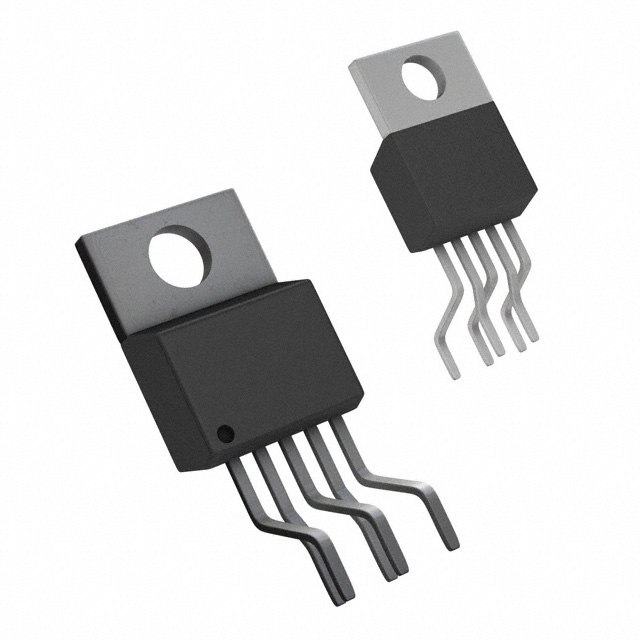
| Package | TO-220 | Power Stage | CSD95472Q5MC is a power stage, requiring external controller. |
| Input Voltage Range | 3.0 to 37V | 4.5 to 65V | CSD95472Q5MC has a wider input voltage range. |
| High Frequency Operation | Not Specified | 1.25 MHz | CSD95472Q5MC is designed for higher frequency operation. |
| PCB Land Pattern Y Max | Not Specified | 0.300 (0.012) | CSD95472Q5MC has smaller footprint. |
| A Max | Not Specified | 1.050 mm | CSD95472Q5MC is smaller in size. |
Design Trade-offs
The most significant difference is the LM2596’s integrated nature versus the CSD95472Q5MC’s power stage design. The LM2596 is a complete regulator, simplifying the design process and reducing BOM cost for basic applications. However, this integration comes at the cost of efficiency and power density. The CSD95472Q5MC, being a power stage, requires a separate PWM controller, increasing design complexity and BOM cost. However, the higher switching frequency of the CSD95472Q5MC allows for smaller inductor and capacitor values, leading to a more compact solution.
The LM2596’s lower switching frequency results in higher switching losses and increased ripple, which can necessitate larger output filter capacitors. The CSD95472Q5MC’s higher frequency demands careful attention to gate drive requirements. The gate driver needs to be fast and efficient to minimize switching losses. Improper gate drive can lead to shoot-through and reduced efficiency.
Thermal management is critical for both parts, but especially for the CSD95472Q5MC due to its higher power handling capability. While the LM2596 is typically sufficient with natural convection, the CSD95472Q5MC may require a heatsink or forced air cooling to maintain junction temperatures within safe limits. The wider operating temperature range of the CSD95472Q5MC is a significant advantage in demanding applications.
Use-case Fit
Choose LM2596T-ADJ/NOPB when…
- Cost is the absolute priority: You’re building a simple power supply for a low-cost product where every cent counts.
- Simplicity is key: You need a regulator that’s easy to design and implement with minimal external components.
- Low-volume production: The lower design effort translates to faster time-to-market for small production runs.
- Basic industrial applications: Powering a simple sensor or actuator in a non-critical industrial setting.
- Replacing an existing LM2596: A drop-in replacement for an existing design minimizes redesign effort.
Choose CSD95472Q5MC when…
- Efficiency is paramount: You’re designing a battery-powered device where maximizing runtime is critical.
- Power density is a constraint: You need to pack a lot of power into a small space.
- High current requirements: You need to supply a significant amount of current to a load.
- Synchronous rectification is required: Minimizing conduction losses is essential for high efficiency.
- Advanced control features are needed: You need to implement features like soft-start, over-current protection, and adjustable output voltage.
Drop-in Compatibility
The LM2596T-ADJ/NOPB and CSD95472Q5MC are not pin-compatible or footprint-compatible. The LM2596 is a complete regulator in a TO-220 package, while the CSD95472Q5MC is a power stage requiring a separate controller and external components. Substituting one for the other would require a complete redesign of the power supply circuit, including the controller, inductor, capacitors, and feedback network.
Alternatives to Consider
- TPS54331: A synchronous buck controller offering similar performance to the CSD95472Q5MC with a more integrated solution.
- LM3406: A high-frequency synchronous rectification controller, offering improved efficiency for the CSD95472Q5MC.
- LTC3890: A synchronous buck-boost converter offering a wider input voltage range and improved efficiency.