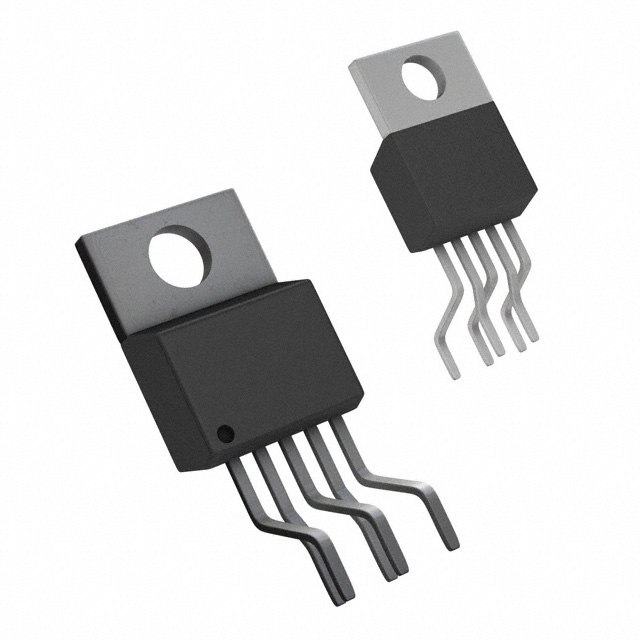
LM2596T-ADJ/NOPB vs. CLB30I1200PZ-TRL: A Practical Comparison
Quick Verdict: For low-power, cost-sensitive applications where a simple, adjustable voltage regulator is sufficient and a microcontroller is already handling gate drive, the LM2596T-ADJ/NOPB remains a reasonable choice. However, for applications requiring significantly higher current handling (30A continuous) and the ability to operate independently without microcontroller intervention, the CLB30I1200PZ-TRL offers a more robust, albeit more complex, solution.
Spec Comparison Table
| Spec | LM2596T-ADJ/NOPB | CLB30I1200PZ-TRL | Notes |
|---|---|---|---|
| Function | Step-Down [source: Digikey] | Thyristor [source: Mouser] | Fundamentally different devices. One is a regulator, one is a switch. |
| Output Configuration | Positive [source: Digikey] | N/A | N/A |
| Topology | Buck [source: Digikey] | N/A | N/A |
| Output Type | Adjustable [source: Digikey] | N/A | N/A |
| Number of Outputs | 1 [source: Digikey] | N/A | N/A |
| Input Voltage Min | 4.5V [source: Digikey] | 18.3V [source: Mouser] | CLB requires higher input voltage. |
| Input Voltage Max | 40V [source: Digikey] | 53.5V [source: Mouser] | CLB has slightly lower input voltage range. |
| Output Voltage Min | 1.2V [source: Digikey] | N/A | N/A |
| Output Voltage Max | 37V [source: Digikey] | N/A | N/A |
| Output Current Max | 3A [source: Digikey] | 30A (typ) [source: Mouser] | CLB handles significantly higher current. |
| Switching Frequency (typ) | 150kHz [source: Digikey] | 50Hz (typ) [source: Mouser] | LM2596 switches much faster, potentially leading to higher switching losses at higher currents. |
| Synchronous Rectifier | No [source: Digikey] | N/A | LM2596’s lack of synchronous rectification means higher conduction losses. |
| Operating Temperature Range (TJ) | -40°C ~ 125°C [source: Digikey] | -40°C ~ 150°C [source: Mouser] | CLB has a wider operating temperature range. |
| Mounting Type | Through Hole [source: Digikey] | N/A | LM2596 is through-hole, requiring more board space and potentially more robust mechanical support. |
| Package Case | TO-220-5 [source: Digikey] | TO-263D2 [source: Mouser] | Different footprints, not interchangeable. |
| Reverse Voltage Max | N/A | 400V [source: Mouser] | CLB is designed to withstand much higher reverse voltage. |
| Forward Voltage Drop (typ) | N/A | 1.30V [source: Mouser] | CLB’s forward voltage drop contributes to conduction losses. |
| RMS Forward Current | N/A | 47A [source: Mouser] | CLB’s RMS current rating is substantially higher. |
| Thermal Resistance (J-C) | N/A | 0.5 K/W [source: Mouser] | CLB has a lower thermal resistance from junction to case, improving heat dissipation. |
| Thermal Resistance (C-HS) | N/A | 0.25 K/W [source: Mouser] | CLB has a lower thermal resistance from case to heatsink, further aiding heat dissipation. |
| Surge Current Max | N/A | 300A (max) [source: Mouser] | CLB can handle a much higher surge current. |
| Gate Power Dissipation Max | N/A | 10 W (typ) [source: Mouser] | CLB requires significantly more power for gate drive. |
| Critical Rate of Rise of Current | N/A | 150 A/μs (typ) [source: Mouser] | CLB’s critical dI/dt is relevant for proper gate drive circuit design. |
Design Trade-offs
The LM2596 is a simple, cost-effective solution for lower-power applications. However, its 3A current limit and lack of synchronous rectification become significant drawbacks at higher loads. The 150kHz switching frequency, while allowing for smaller external components, also contributes to higher switching losses, especially when combined with the diode rectification. Layout sensitivity is moderate; proper ground plane and trace width are necessary but not overly critical.
The CLB30I1200PZ-TRL, on the other hand, is a thyristor, requiring a separate gate drive circuit. This adds complexity but allows for independent operation without a microcontroller, crucial for applications requiring fast response times or redundancy. The lower switching frequency (50Hz) reduces switching losses but increases the size of inductor and capacitor required for filtering. The forward voltage drop across the thyristor contributes to conduction losses, particularly at higher currents. Thermal management is critical; a heatsink is almost always necessary to dissipate the power generated by conduction and switching losses. The critical rate of rise of current (dI/dt) necessitates careful gate drive circuit design to prevent false triggering and ensure reliable operation. The higher input voltage requirement also impacts component selection.
Use-case Fit
Choose LM2596T-ADJ/NOPB when…
- You need a simple, adjustable voltage regulator for a low-power application (e.g., powering a microcontroller peripheral).
- Cost is the primary concern and efficiency is not critical.
- A microcontroller is already present and can handle any necessary adjustments or protection features.
- The application requires a compact solution and a through-hole package is acceptable.
- You’re replacing an existing LM2596 and minimizing board changes.
Choose CLB30I1200PZ-TRL when…
- You need to switch significantly higher currents (e.g., driving a motor, powering a high-power LED array).
- Independent operation without a microcontroller is required (e.g., in a redundant power system).
- Fast switching times and high efficiency are paramount.
- You have the space and resources to implement a robust gate drive circuit and heatsinking solution.
- You need to handle large surge currents.
Drop-in Compatibility
These parts are not pin-compatible or footprint-compatible. The LM2596 is a regulator with a fixed internal structure and a TO-220 package. The CLB30I1200PZ-TRL is a thyristor requiring external gate drive circuitry and a TO-263D2 package. Substituting one for the other requires a complete redesign of the power supply circuit and a new PCB layout.
Alternatives to Consider
- LM7470: A synchronous buck regulator offering higher efficiency than the LM2596.
- IR2110: A gate drive IC specifically designed for driving thyristors, simplifying gate drive circuit design.
- MC34763: Another adjustable buck regulator with similar performance characteristics to the LM2596.