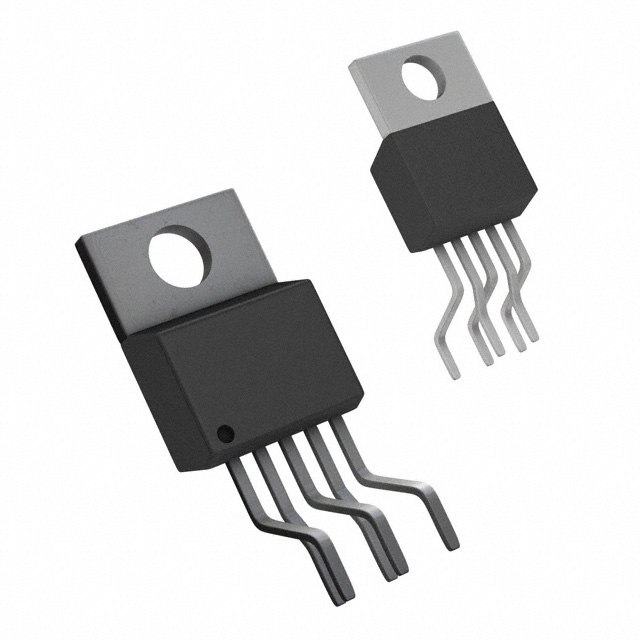
LM2596T-ADJ/NOPB vs. CLB30I1200HB: A Practical Comparison
Quick Verdict: For low-voltage, moderate-power applications where simplicity and ease of use are paramount, the LM2596T-ADJ/NOPB is the clear winner. However, when dealing with higher voltages, higher currents, and a willingness to manage gate drive and thermal considerations, the CLB30I1200HB offers significantly lower conduction losses and higher power density, albeit with increased complexity.
Spec Comparison Table
| Spec | LM2596T-ADJ/NOPB | CLB30I1200HB | Notes |
|---|---|---|---|
| function | Step-Down | SCR Thyristor | LM2596 is a regulator; CLB30I1200HB is a switching element. Fundamentally different applications. |
| input_voltage_min | 4.5V | 50Hz (min) | CLB30I1200HB’s minimum is frequency-dependent and much higher. |
| input_voltage_max | 40V | 50Hz (max) | Similar voltage limits, but CLB30I1200HB’s is also frequency-dependent. |
| output_voltage_min | 1.2V | N/A | Regulator output, not a switching element. |
| output_voltage_max | 37V | N/A | Regulator output, not a switching element. |
| output_current_max | 3A | 30A (at 120°C) | CLB30I1200HB handles significantly higher current. |
| switching_frequency_typ | 150kHz | 280 Hz | LM2596 operates at much higher frequency, enabling smaller passive components. |
| synchronous_rectifier | No | N/A | LM2596 lacks synchronous rectification; CLB30I1200HB is a switching element. |
| operating_temperature_range | -40°C ~ 125°C | -40°C ~ 125°C | Identical operating temperature range. |
| mounting_type | Through Hole | Through Hole | Identical mounting type. |
| package_case | TO-220-5 | N/A | Different package types; not directly comparable. |
| input_voltage_non_repetitive_reverse_forward_blocking_max | N/A | 1300 V | CLB30I1200HB’s voltage blocking capability is substantially higher. |
| input_voltage_repetitive_reverse_forward_blocking_max | N/A | 1200 V | CLB30I1200HB’s voltage blocking capability is substantially higher. |
| input_current_typ | N/A | 10 µA | CLB30I1200HB’s quiescent current is extremely low. |
| input_current_max_at_25_celsius | N/A | 2 mA | CLB30I1200HB’s maximum input current is very low. |
| input_voltage_drop_typ_at_30_ampere | N/A | 1.28 V | CLB30I1200HB has a voltage drop, impacting efficiency at higher currents. |
| average_forward_current_max_at_120_celsius_and_150_celsius | N/A | 30 A | CLB30I1200HB’s maximum current is higher. |
| rms_forward_current_typ | N/A | 47 A | CLB30I1200HB’s RMS current is higher. |
| threshold_voltage_typ_at_150_celsius | N/A | 0.86 V | CLB30I1200HB has a threshold voltage, impacting turn-on characteristics. |
| slope_resistance_typ | N/A | 12.5 mΩ | CLB30I1200HB’s slope resistance influences switching behavior. |
| thermal_resistance_junction_to_case_typ | N/A | 0.5 K/W | CLB30I1200HB’s thermal resistance is relatively low. |
| total_power_dissipation_typ_at_25_celsius | N/A | 250 W | CLB30I1200HB dissipates significantly more power. |
| max_forward_surge_current_typ_at_45_celsius | N/A | 300 A | CLB30I1200HB handles a very high surge current. |
| junction_capacitance_typ_at_25_celsius_and_400_volt | N/A | 13 pF | CLB30I1200HB’s junction capacitance impacts switching speed. |
| max_gate_power_dissipation_typ_at_150_celsius | N/A | 10 W | CLB30I1200HB requires more gate drive power. |
| critical_rate_of_rise_of_current_typ_at_150_celsius_and_50_hz | N/A | 150 A/µs | CLB30I1200HB’s critical dI/dt impacts switching control. |
Design Trade-offs
The LM2596T-ADJ/NOPB offers simplicity. Its internal compensation network means minimal external components are needed for basic operation. However, its fixed frequency (150kHz) and lack of synchronous rectification limit efficiency, especially at higher currents. The CLB30I1200HB, on the other hand, presents a different set of challenges. Its gate drive requirements are significant. Achieving clean, fast switching requires careful consideration of gate resistor values and potentially active gate drive circuitry. The 1.28V voltage drop at 30A translates to substantial conduction losses, impacting overall efficiency. Thermal management is also crucial; the 250W typical power dissipation necessitates a substantial heatsink, increasing board size and cost. The slope resistance of 12.5 mΩ needs to be accounted for in the feedback loop to prevent false triggering. Finally, the 13 pF junction capacitance can introduce ringing and overshoot if not properly damped.
Use-case Fit
Choose LM2596T-ADJ/NOPB when…
- You need a simple, low-cost step-down regulator for 5V to 3.3V conversion in a microcontroller-based project.
- You’re building a power supply for a small, low-power device where efficiency is not the primary concern.
- You need a regulator for a battery-powered device where minimizing BOM cost is critical.
- You’re prototyping a power supply and need a quick, easy-to-use solution.
- You’re designing a power supply for a sensor network where board space is limited and efficiency is secondary.
Choose CLB30I1200HB when…
- You’re designing a high-power DC-DC converter for an electric vehicle charging system.
- You need to switch high voltages (e.g., 24V to 48V) with minimal losses.
- You’re building an industrial power supply where efficiency and power density are paramount.
- You need to handle high surge currents, such as those found in inductive loads.
- You’re designing a solar inverter and need a robust switching element for high-voltage DC conversion.
Drop-in Compatibility
These parts are not drop-in compatible. The LM2596T-ADJ/NOPB is a regulator, while the CLB30I1200HB is a switching element. They operate on fundamentally different principles. Substituting one for the other would require a complete redesign of the power supply circuit, including the gate drive circuitry for the CLB30I1200HB and a complete rethinking of the feedback loop. The TO-220 package is shared, but the pinout and internal operation are entirely different.
Alternatives to Consider
- TPS5430: A synchronous buck regulator offering higher efficiency than the LM2596.
- IRG4PC50UD: An IGBT providing similar functionality to the CLB30I1200HB, but with different gate drive characteristics.
- SG3524: A versatile PWM controller suitable for building custom DC-DC converters.