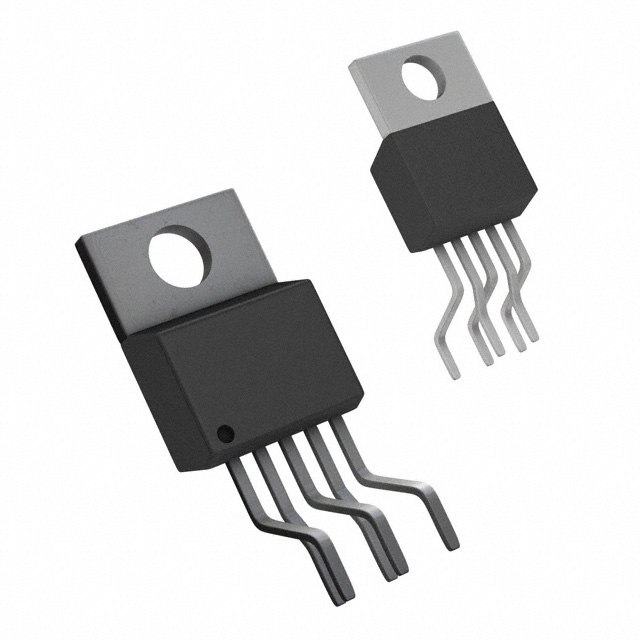
LM2596T-ADJ/NOPB vs. AOZ5311NQI_2: A Practical Comparison
Quick verdict: For simple, low-cost, power-down applications where efficiency isn’s paramount and a through-hole package is advantageous, the LM2596T-ADJ/NOPB remains a viable choice. However, for designs demanding higher efficiency, higher power handling (beyond 2-3A), and the benefits of synchronous rectification, the AOZ5311NQI_2 is the clear winner, despite its increased complexity and surface-mount requirement.
Spec comparison table
| Spec | LM2596T-ADJ/NOPB | AOZ5315NQI_2 | Notes |
|---|---|---|---|
| Function | Step-Down | Half Bridge Driver | AOZ5311 is a driver, LM2596 is a full regulator. This fundamentally changes the design. |
| Output Configuration | Positive | Half Bridge | AOZ5311 requires external MOSFETs; LM2596 integrates everything. |
| Topology | Buck | Buck | Both are buck topologies, but AOZ5311’s driver nature means it controls external MOSFETs. |
| Output Type | Adjustable | N/A | LM2596 is adjustable; AOZ5311 requires external components to set the output voltage. |
| Number of Outputs | 1 | N/A | LM2596 has one output; AOZ5311 controls two MOSFETs for a single output. |
| Input Voltage Min | 4.5V | 2.5V | AOZ5311 has a lower input voltage requirement. |
| Input Voltage Max | 40V | 20V | LM2596 can handle higher input voltages. |
| Output Voltage Min | 1.2V | 2.5V | AOZ5311’s minimum output voltage is higher. |
| Output Voltage Max | 37V | 20V | LM2596 has a higher maximum output voltage. |
| Output Current Max | 3A | 55A | AOZ5311 handles significantly higher currents. |
| Switching Frequency Typ | 150kHz | 2MHz | AOZ5311’s higher frequency allows for smaller external components, but increases switching losses if not carefully managed. |
| Synchronous Rectifier | No | Yes (implicit) | AOZ5311 utilizes synchronous rectification, reducing conduction losses. |
| Package | TO-220 | 5x6 QFN | TO-220 is through-hole, QFN is surface mount. |
| Cost (at volume) | ~$1.00 | ~$3.00 | AOZ5311 is significantly more expensive. |
| Junction Temperature Max | N/A | 150°C | AOZ5311 has a higher maximum junction temperature. |
| Input Bypass Capacitor Min | N/A | 1F | AOZ5311 requires a minimum input bypass capacitor. |
| Bootstrap Capacitor Min | N/A | 100nF | AOZ5311 requires a bootstrap capacitor. |
Design trade-offs
The most significant difference lies in the integrated versus driver architecture. The LM2596T-ADJ/NOPB is a complete regulator, simplifying the design and reducing BOM count. However, its fixed switching frequency and lack of synchronous rectification limit efficiency, especially at higher currents. The AOZ5311NQI_2, as a driver, requires external MOSFETs, increasing design complexity and BOM cost. However, it offers significantly improved efficiency due to synchronous rectification and allows for more precise control over the MOSFETs, enabling optimization for specific load profiles.
Efficiency curves would demonstrate a substantial advantage for the AOZ5311NQI_2 at currents above 1A, with losses increasing rapidly for the LM2596 as current increases. The LM2596’s fixed frequency (150kHz) makes layout simpler but less flexible for optimizing performance. The AOZ5311’s 2MHz frequency necessitates careful layout to minimize parasitic inductance and capacitance, which can lead to ringing and EMI issues if not addressed.
Thermal considerations are also critical. While the LM2596’s TO-220 package allows for easier heatsinking, its internal losses mean it will run hotter at higher currents. The AOZ5311, while having a higher maximum junction temperature, still requires careful thermal management due to its higher power dissipation and surface-mount package.
Gate drive requirements are vastly different. The LM2596’s internal gate driver is fixed. The AOZ5311 requires careful selection of gate resistors to optimize MOSFET switching speed and minimize losses. The AOZ5311’s layout sensitivity is higher due to the need to minimize parasitic inductance in the gate drive loops.
Use-case fit
Choose LM2596T-ADJ/NOPB when…
- Cost is the primary concern: The LM2596 is significantly cheaper, making it ideal for budget-constrained applications.
- Through-hole mounting is required: The TO-220 package simplifies assembly and allows for easier prototyping.
- Low to moderate current applications (under 1A): Efficiency is less critical in these scenarios.
- Simple, fixed output voltage is sufficient: No need for complex feedback loops or external components.
- Power-down applications: Where minimizing quiescent current is more important than high efficiency.
Choose AOZ5311NQI_2 when…
- High efficiency is paramount: Synchronous rectification significantly reduces conduction losses.
- High current applications (2A – 10A+): The AOZ5311’s higher current handling capability is essential.
- Precise control over MOSFET switching is needed: Allows for optimization of efficiency and EMI performance.
- Surface-mount technology is preferred: Enables smaller form factors and higher density designs.
- Dynamic load conditions are present: The ability to adjust switching frequency and MOSFET drive strength allows for optimization of efficiency under varying loads.
Drop-in compatibility
These parts are not pin-compatible or footprint-compatible. The LM2596 is a complete regulator in a TO-220 package. The AOZ5311 is a driver requiring external MOSFETs and associated circuitry. Substituting one for the other would require a complete redesign of the power supply circuit.
Alternatives to consider
- LM2596-ADJ: Similar to the LM2596T-ADJ but with a slightly different output voltage range.
- TPS54331: A synchronous buck regulator offering similar functionality to the LM2596 but with improved efficiency.
- IR3535: Another MOSFET driver IC, offering similar features to the AOZ5311 but with different drive characteristics.