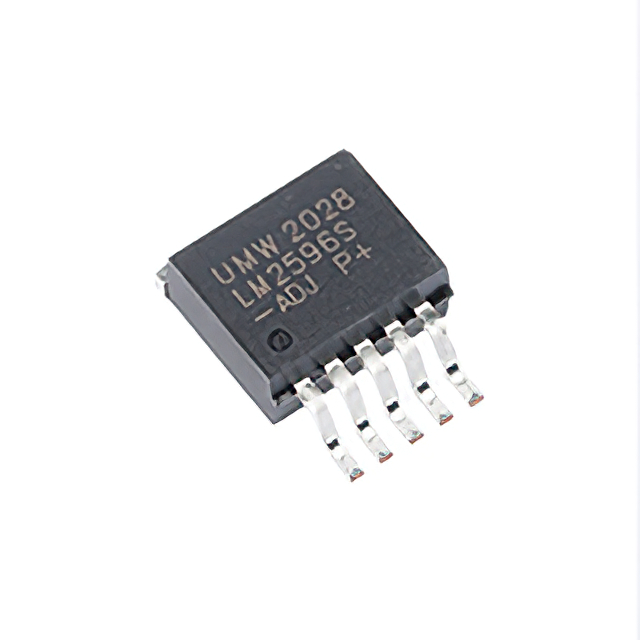
Key Specs
| Spec | Value | Condition | Source |
|---|---|---|---|
| Function | Step-Down | [Digi-Key] | |
| Output Configuration | Positive | [Digi-Key] | |
| Topology | Buck | [Digi-Key] | |
| Output Type | Adjustable | [Digi-Key] | |
| Number Of Outputs | 1 | [Digi-Key] | |
| Input Voltage (Min) | - | [Digi-Key] | |
| Input Voltage (Max) | 40V | [Digi-Key] | |
| Output Voltage (Min) | 1.2V | [Digi-Key] | |
| Output Voltage (Max) | 37V | [Digi-Key] | |
| Output Current (Max) | 3A | [Digi-Key] | |
| Switching Frequency (Typ) | 150kHz | [Digi-Key] | |
| Synchronous Rectifier | No | [Digi-Key] | |
| Operating Temperature Range | -40°C ~ 125°C (TA) | [Digi-Key] | |
| Mounting Type | Surface Mount | [Digi-Key] | |
| Package Case | TO-263-6, D2PAK (5 Leads + Tab), TO-263BA | [Digi-Key] | |
| Supplier Device Package | TO-263-5L | [Digi-Key] |
When To Use
-
24V industrial supply → 5V @ 3A: The 40V maximum input voltage rating covers a 24V nominal rail with margin for transient spikes. The 3A continuous current rating ensures reliable operation without thermal runaway. Using a linear regulator here would dissipate nearly 57W at full load, causing immediate thermal shutdown.
-
5V battery pack → 1.2V core rail @ 3A: The adjustable output down to 1.2V supports low-voltage digital cores. The integrated fixed-frequency 150kHz switching avoids excessive EMI and maintains stable regulation. A non-synchronous buck with lower current rating would risk shoot-through or current foldback under this load.
-
12V automotive accessory → 12V @ 3A: The TO-263 package and 125°C operating range handle automotive ambient temperatures and power dissipation. The built-in undervoltage lockout prevents the device from enabling prematurely during cold crank. Using a low-current or LDO regulator would overheat or fail to handle load surges.
When Not To Use
-
Output current > 3A continuous: The 3A max output current rating limits heavy loads. Use a multi-phase buck controller designed for higher current to avoid thermal runaway and device overstress.
-
Battery-powered sensor needing ultra-low quiescent current: The typical standby current of 80µA is too high for μA-level sleep modes. Use a low-IQ PFM buck to prevent premature battery drain.
-
Input voltage > 40V absolute max: The 40V input limit restricts higher-voltage rails. Use a high-voltage synchronous buck controller with external FETs rated above 45V to avoid catastrophic latch-up or device failure.
Application Notes
IC dissipates ≈6.3W at Vin=40V→Vout=19.1V @ 1.5A (η≈82%). This is IC loss only — the catch diode dissipates additional power. At elevated ambient, a heatsink is required for sustained operation above ~1.5A.
-
The switching node (SW) pin carries high di/dt and voltage spikes; keep PCB traces short and use a low-inductance loop with input capacitor close to VIN and GND pins to minimize EMI and voltage ringing.
-
The feedback pin (pin 4) is noise-sensitive; route feedback traces away from switching node and noisy signals and use a ground reference plane to ensure stable regulation.
-
The ON/OFF pin (pin 5) supports undervoltage lockout and delayed startup; adding a capacitor here allows controlled soft-start, preventing inrush current surges.
-
The diode connected externally must be a fast recovery Schottky with a voltage and current rating exceeding 40V and 3A to prevent reverse recovery losses causing erratic switching.
-
The output capacitor ESR must be low enough to maintain stability but not so low as to cause loop oscillations; typical recommended electrolytic capacitors are 220µF to 470µF with appropriate voltage rating.
Pin numbers are package-specific. Verify against the datasheet pinout diagram before routing.
Minimum External Components
Catch diode — Schottky, Vr ≥ 40V, If ≥ 3A Selection: Schottky forward recovery < 10ns vs 200–500ns for silicon. At 150kHz (period = 6.7µs), a 500ns-recovery diode is off for only 6.2µs before the next switch-on — it never fully turns off. Failure mode: Standard silicon rectifier: 200–500ns reverse recovery at 150kHz causes shoot-through current spikes every cycle — IC switch current exceeds rating, causing thermal runaway or immediate failure.
Output inductor — 68µH Selection: Isat ≥ 3.8A (peak current at max load). DCR < 100mΩ to limit conduction loss. At Vin=20V→Vout=5.5V: range is 33–68µH (30%→15% current ripple). Use 68µH for good regulation; 33µH acceptable if BOM cost is critical. Isat must be ≥ 3.8A — under-sizing Isat is the leading cause of field failures: the inductor saturates under peak current, spiking IC switch current beyond its rating. Failure mode: Isat below peak inductor current → core saturates → effective inductance collapses → switch current spikes beyond IC rating → thermal shutdown or permanent failure.
Input capacitor — ≥100µF electrolytic + 100nF ceramic (parallel) Selection: Electrolytic handles bulk ripple current; ceramic bypasses switching spikes. Voltage rating ≥ 40V with 20% margin. Failure mode: Insufficient input capacitance: supply rail collapses during switch-on current demand → output droops → erratic regulation and potential latch-up.
Output capacitor — ≥100µF electrolytic Selection: ESR < 200mΩ to keep output ripple below 50mVpp. Voltage rating ≥ 46V. Failure mode: High-ESR electrolytic: output ripple voltage = ESR × ΔIL. At 1A ripple and 500mΩ ESR → 500mVpp ripple — exceeds spec for virtually all loads.
Feedback resistors R1 / R2 — R1 = 1.21kΩ (1%), R2 = R1 × (Vout/1.2 − 1) Selection: 1% metal-film tolerance minimum. R1 sets the bias current into the FB divider; values 1.21kΩ–10kΩ keep FB current in the datasheet-recommended range. Failure mode: 5% resistors introduce ±5% Vout error. R1 too large (>100kΩ) → FB pin susceptible to noise injection → oscillation or false regulation.
Design Equations
Output voltage: Vout = 1.2V × (1 + R2/R1)
R1 is typically 1.21kΩ–10kΩ (1% tolerance). Solve for R2: R2 = R1 × (Vout/1.2 - 1). Example: for 5V with R1=1.21kΩ → R2 ≈ 3.74kΩ (use 3.74kΩ 1%).
Inductor sizing: At Vin=20V→Vout=5.5V: range is 33–68µH (30%→15% current ripple). Use 68µH for good regulation; 33µH acceptable if BOM cost is critical. Isat must be ≥ 3.8A — under-sizing Isat is the leading cause of field failures: the inductor saturates under peak current, spiking IC switch current beyond its rating.
Gotchas
-
[Incorrect feedback resistor ratio]: Assuming any resistor values above 240Ω for R1 will work without checking feedback voltage variation. Using too high or too low resistor values causes output voltage deviation beyond ±4% tolerance, resulting in incorrect output voltage or instability. Fix by choosing R1 around 1.5kΩ and calculating R2 precisely to maintain feedback voltage near 1.23V.
-
[Minimum load current ignored]: Operating the regulator with no or very light load can cause output voltage to rise above setpoint due to the internal comparator’s minimum load requirement. This results in output overshoot or unstable regulation. Fix by ensuring a minimum load of at least a few milliamps or adding a bleed resistor.
-
[Insufficient input capacitor ripple current rating]: Using input capacitors with RMS current rating below 80µA typical causes premature capacitor failure and increased input voltage ripple, leading to erratic switching and EMI. Fix by selecting capacitors with at least 470µF/50V rating and low ESR.
-
[ON/OFF pin voltage limit overlooked]: Applying ON/OFF control voltage above 25V can damage the pin despite input voltage being within limits. Result is device latch-up or permanent failure. Fix by limiting ON/OFF pin voltage to ≤25V with resistor dividers or level shifting.