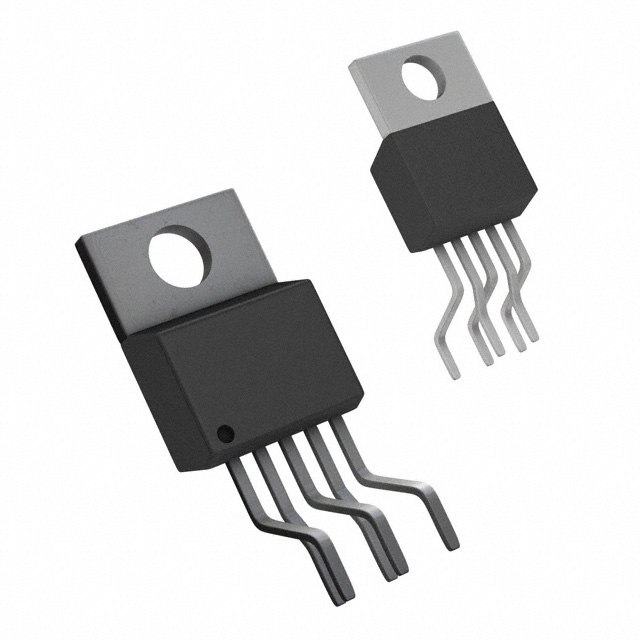
Key Specs
| Spec | Value | Condition | Source |
|---|---|---|---|
| Function | Step-Up, Step-Up/Step-Down | Digi-Key | |
| Output Configuration | Positive | Digi-Key | |
| Topology | Boost, Flyback, Forward Converter | Digi-Key | |
| Output Type | Adjustable | Digi-Key | |
| Number Of Outputs | 1 | Digi-Key | |
| Input Voltage (Min) | 3.5V | Digi-Key | |
| Input Voltage (Max) | 40V | Digi-Key | |
| Output Voltage (Min) | 1.23V | Digi-Key | |
| Output Voltage (Max) | 60V (Switch) | Digi-Key | |
| Output Current (Max) | 3A (Switch) | Digi-Key | |
| Switching Frequency (Typ) | 52kHz | Digi-Key | |
| Synchronous Rectifier | No | Digi-Key | |
| Operating Temperature Range | -40°C ~ 125°C (TJ) | Digi-Key | |
| Mounting Type | Through Hole | Digi-Key | |
| Package Case | TO-220-5 Formed Leads | Digi-Key | |
| Supplier Device Package | TO-220-5 | Digi-Key |
When To Use
-
3.5V to 40V input → 12V @ 3A boost converter: The wide input voltage range up to 40V and integrated 3A switch current rating make this part ideal for automotive or industrial supplies with fluctuating rails. Using a synchronous buck controller here would fail due to the lower input voltage limit and inability to boost above VIN, causing output dropouts.
-
Flyback converter for isolated 15V output at 2A: The internal current limit (up to 6A abs max) and integrated switch simplify flyback designs with moderate power levels, avoiding the need for discrete switching MOSFETs. A linear regulator in this scenario would dissipate excessive heat and enter thermal shutdown due to high input-to-output voltage differential.
-
Adjustable output from 1.23V to 60V at up to 3A: The adjustable output voltage capability up to 60V switch rating supports flexible designs such as industrial instrumentation supplies. Using an LDO regulator here would be impractical because it cannot handle input voltages 20% higher than output with acceptable power dissipation, risking thermal runaway.
When Not To Use
-
>3A load at 12V output: The maximum 3A switch current rating disqualifies this part for higher current requirements. Use a high-current synchronous buck with external FETs instead to handle higher load currents with better efficiency and thermal management.
-
Battery-powered sensor requiring ultra-low quiescent current: The typical input supply current of 7.5mA is too high for battery-operated devices needing μA standby currents. Use a low-IQ PFM buck controller designed for minimal quiescent current and extended battery life.
-
High-frequency switching above 500kHz for small inductor size: The fixed oscillator frequency of 52kHz limits switching speed, making this part unsuitable for designs requiring compact inductors and capacitors. Use a high-frequency buck controller to achieve higher switching frequencies and smaller magnetics.
Application Notes
-
The switching node (SW) pin carries high dV/dt and transient currents; keep SW node and associated loop inductance minimal to reduce EMI and ringing. Use a low-inductance PCB layout around SW.
-
Feedback pin (pin 4) is noise-sensitive; route feedback traces away from SW node and noisy switching currents to maintain stable regulation and minimize output voltage ripple.
-
The internal 3A NPN switch requires proper heat sinking. Ensure the TO-220-5 package mounting pad has low thermal resistance and is electrically isolated if necessary.
-
Soft-start is integrated; however, if the output capacitor has very low ESR, startup oscillations may occur. Consider adding a small series resistor or selecting capacitors with moderate ESR.
-
Undervoltage lockout set between 2.65V and 3.15V prevents operation below this input; ensure input supply ramps above this threshold to avoid startup failures or erratic switching.
Pin numbers are package-specific. Verify against the datasheet pinout diagram before routing.
Design Equations
Output voltage: Vout = 1.23V × (1 + R2/R1)
R1 is typically 1.21kΩ–10kΩ (1% tolerance). Solve for R2: R2 = R1 × (Vout/1.23 - 1). Example: for 5V with R1=1.21kΩ → R2 ≈ 3.74kΩ (use 3.74kΩ 1%).
Gotchas
-
[Soft-start interaction with low ESR output capacitors]: Designers often assume all ceramic capacitors improve performance; here, very low ESR ceramics can cause loop instability or output voltage ringing during soft-start. Symptom: Output voltage overshoot and oscillatory startup waveform visible on scope. Fix: Add a small ESR or a series resistor on output capacitor or use a tantalum/polymer capacitor mix.
-
[Feedback loop noise pickup from switching node]: Routing feedback traces too close to SW node or high-current loops causes erratic output voltage regulation and jitter. Symptom: Output voltage noise spikes and intermittent regulation failure. Fix: Use a separate ground reference for feedback, keep feedback loop area minimal, and shield feedback traces from SW node.
-
[Undervoltage lockout causing startup hang]: If input voltage rises slowly and never exceeds 3.15V UVLO max, the device won’t start switching, leading to a “dead” output without apparent fault. Symptom: Output remains at zero volts despite input presence. Fix: Verify input voltage ramp rate and ensure minimum 3.5V operating voltage is reached before enabling load.
-
[Switch current limit margin overlooked in high ripple current designs]: Assuming the 3A switch current rating covers all load conditions without accounting for inductor ripple current causes occasional switch current limit triggering and cycle skipping. Symptom: Output voltage dips under load transients with irregular switching frequency. Fix: Design inductor ripple current to stay within 20–30% of load current and confirm peak switch current stays below 3A absolute max.