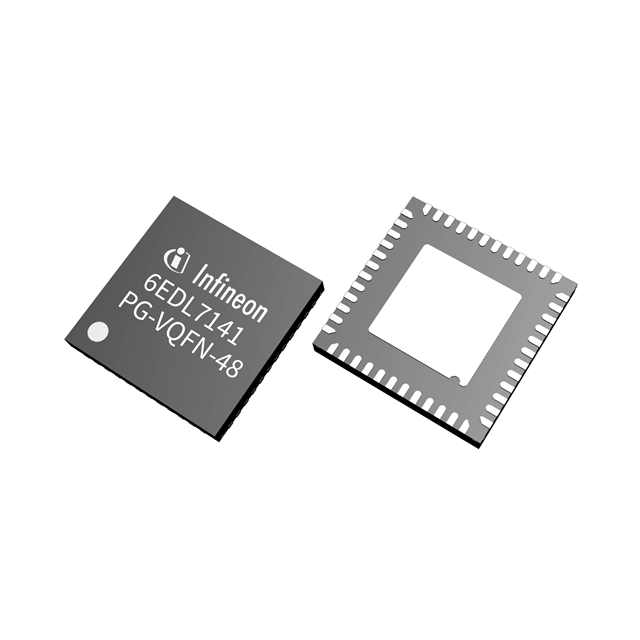
Comparison: Infineon 6EDL7141XUMA1 vs 2EDF9275FXUMA1 Half-Bridge Gate Drivers
1. Quick verdict
For three-phase motor drive applications requiring integrated multi-channel gate drivers with moderate peak current and wide supply voltage range, the 6EDL7141XUMA1 is the better choice due to its 3-phase integration and 5.5–60 V supply range. For high-speed, high-current driving of discrete IGBTs or SiC MOSFETs in isolated or dual-channel configurations, the 2EDF9275FXUMA1 excels with peak currents up to 8 A, faster switching times, and robust isolation ratings.
2. Spec comparison table
| Spec | 6EDL7141XUMA1 | 2EDF9275FXUMA1 | Notes |
|---|---|---|---|
| Channel Type | 3-Phase | Independent | 6EDL7141 integrates 3 half-bridges, saving board space for 3-phase drives; 2EDF9275 is 2-ch independent. |
| Number of Drivers | 3 | 2 | More channels on 6EDL7141 simplify 3-phase designs; 2EDF9275 suits 2-channel or custom configs. |
| Peak Output Current Source | 1.5 A | 4 A | 2EDF9275 provides higher drive current, better for large gate charges or fast switching. |
| Peak Output Current Sink | 1.5 A | 8 A | 2EDF9275’s much higher sink current improves turn-off speed and reduces switching losses. |
| Driven Configuration | Half-Bridge | Half-Bridge | Both support half-bridge topology. |
| Gate Type Supported | MOSFET (N-Channel) | IGBT, SiC MOSFET | 2EDF9275 explicitly supports IGBTs and SiC MOSFETs, indicating ruggedness for wide device types. |
| Input Type | Non-Inverting | Non-Inverting | Same input logic type. |
| Logic Voltage Thresholds (V_IL, V_IH) | 0.8 V (low), 2 V (high) | - (low), 1.65 V (high) | 6EDL7141 has higher VIH threshold; 2EDF9275 supports lower VIH, beneficial for 3.3 V logic. |
| Supply Voltage Range (V) | 5.5 – 60 | 6 – 16 (typ 12 V) | 6EDL7141 supports much wider supply voltage, useful for high-voltage motor drives. |
| High-Side Voltage Max Bootstrap (V) | Not specified | 650 V | 2EDF9275 supports high-side bootstrap up to 650 V, suitable for high-voltage half-bridge stages. |
| Rise Time Typical (ns) | Not specified | 6.5 ns | 2EDF9275’s fast rise time reduces switching losses, better for high-frequency applications. |
| Fall Time Typical (ns) | Not specified | 4.5 ns | 2EDF9275’s fast fall time similarly improves switching efficiency. |
| Operating Temperature Range (°C) | -40 to 125 (Junction) | -40 to 125 (Ambient) | Comparable range; note 6EDL7141 spec is TJ, 2EDF9275 is TA; actual thermal limits may differ. |
| Package Type | 48-VFQFN Exposed Pad | 16-SOIC (PG-DSO-16-11) | 6EDL7141’s larger VFQFN allows better thermal dissipation; 2EDF9275’s SOIC is smaller. |
| Mounting Type | Surface Mount | Surface Mount | Both are SMT devices. |
| Input Voltage Min (V) | Not specified | 8.5 V (min), typ 12 V, max 14 V (input supply) | 2EDF9275 requires controlled input supply voltage; 6EDL7141 more flexible. |
| Input Voltage Max (V) | Not specified | 5.5 V (logic input max) | 2EDF9275 logic input max is limited; 6EDL7141 can tolerate wider input levels. |
| Switching Frequency Typical | Not specified | 2 MHz | 2EDF9275 supports very high switching frequency, suitable for fast PWM or resonant topologies. |
| Input Current Max (mA) | Not specified | 50 mA | 2EDF9275 input current is relatively high, must consider in controller power budget. |
| Common Mode Transient Immunity (V/ns) | Not specified | 150 V/ns (max), 400 V/ns (typ) | 2EDF9275 clearly specifies CMTI, important for noisy power stages. |
| Isolation Voltage (V) | Not specified | >1500 V (functional), 460 V RMS | 2EDF9275 offers reinforced isolation, critical for certain industrial or automotive apps. |
| Propagation Delay Typical (ns) | Not specified | 29–44 ns | 2EDF9275 provides detailed timing; lower delay aids tight timing control in fast switching. |
| Quiescent Current Typical (mA) | Not specified | ~1.4 mA (Vdda), 1.6 mA (Vddi) | 2EDF9275 quiescent current given, important for low-power designs. |
| Thermal Resistance Junction-to-case (°C/W) | Not specified | 50 °C/W | 2EDF9275’s thermal resistance is moderate; 6EDL7141’s exposed pad VFQFN likely better thermal. |
| Package Dimensions (mm) | PG-VQFN-48-78 (not specified) | 6 × 3.2 (max) SOIC | 2EDF9275 is physically smaller, better for compact layouts but less thermal mass. |
| ESD Capability (HBM) (kV) | Not specified | 2 kV | 2EDF9275’s ESD rating is standard; 6EDL7141 not specified. |
| Input Side UVLO Typical (V) | Not specified | 3.5 V | 2EDF9275 has defined undervoltage lockout, improves robustness. |
| Output Side UVLO Min/Max (V) | Not specified | 3.2 V (min), 3.5 V (max) | 2EDF9275 output UVLO protects MOSFET driving voltage rails. |
3. Design trade-offs
The 6EDL7141XUMA1 is designed for integrated three-phase motor drives, consolidating three half-bridge drivers into a single IC with a wide supply voltage range from 5.5 V up to 60 V. This makes it well-suited for driving standard N-channel MOSFETs in industrial or automotive 3-phase inverter applications. The 48-pin exposed pad VFQFN package facilitates efficient thermal management, critical for continuous motor operation where heat dissipation can be a limiting factor. However, the peak source/sink current capability (1.5 A) is modest, meaning switching speed and gate charge drive capability are limited compared to high-current drivers.
In contrast, the 2EDF9275FXUMA1 targets high-performance, isolated half-bridge applications using IGBTs or SiC MOSFETs, with peak output currents up to 4 A source and 8 A sink. This asymmetric current capability favors fast turn-off switching, which is critical for minimizing tail currents in IGBTs and reducing switching losses in SiC devices. Its typical switching frequency up to 2 MHz and fast rise/fall times (6.5 ns / 4.5 ns) support high-frequency operation, advantageous for advanced power conversion topologies. The device also incorporates reinforced isolation and detailed undervoltage lockout thresholds, making it suitable for industrial and automotive isolated gate drive modules.
From a layout perspective, the 6EDL7141’s multi-channel integration reduces component count and board complexity in 3-phase systems but requires careful thermal management and consideration of the larger VFQFN footprint. The 2EDF9275’s smaller SOIC package eases tight PCB layouts but may require external isolation components if used in isolated systems, though it does have built-in isolation ratings. Firmware design for 2EDF9275 benefits from precise timing and UVLO feedback, but the higher input current and narrower supply voltage range (6–16 V) demand stable power rails and possibly additional regulators.
Cost-wise, the 6EDL7141’s integration and larger package might command a higher unit price but reduce system-level cost by replacing multiple discrete drivers. The 2EDF9275, as a dual-channel, high-current driver, may be less expensive per channel but could necessitate more external components and board space for a 3-phase design.
4. Use-case fit
Choose 6EDL7141XUMA1 when…
- Designing a three-phase inverter for AC motors (e.g., BLDC or PMSM) where integrated 3-channel drivers simplify layout and BOM.
- Operating from wide DC bus voltages up to 60 V, common in automotive 12 V/48