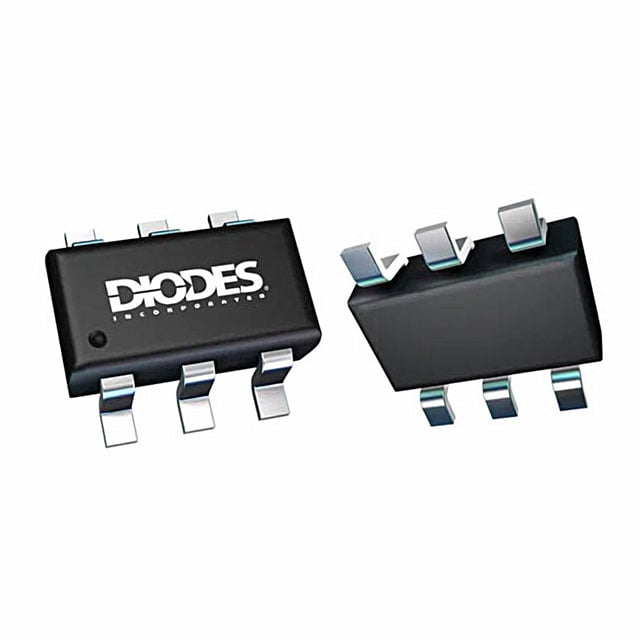
Key Specs
| Spec | Value | Condition | Source |
|---|---|---|---|
| Channel Type | Single | Digi-Key | |
| Current Peak Output Source Sink | 10A, 10A | Digi-Key | |
| Digikey Programmable | Not Verified | Digi-Key | |
| Driven Configuration | Low-Side | Digi-Key | |
| Gate Type | IGBT, SiC MOSFET | Digi-Key | |
| Grade | - | Digi-Key | |
| Input Type | Non-Inverting | Digi-Key | |
| Logic Voltage Vil Vih | - | Digi-Key | |
| Mounting Type | Surface Mount | Digi-Key | |
| Number Of Drivers | 1 | Digi-Key | |
| Operating Temperature Range | -55°C ~ 150°C (TJ) | Digi-Key | |
| Package Case | SOT-23-6 | Digi-Key | |
| Qualification | - | Digi-Key | |
| Rise Fall Time (Typ) | 48ns, 35ns | Digi-Key | |
| Supplier Device Package | SOT-26 | Digi-Key | |
| Voltage Supply | 40V (Max) | Digi-Key |
When To Use
Use the ZXGD3006E6TA when driving IGBT or SiC MOSFET devices in automotive or industrial applications requiring a peak source/sink current of up to 10A and operating over a wide temperature range from -55°C to +150°C. Its low-side driven configuration and qualified AEC-Q101 automotive compliance make it ideal for high reliability power switching in harsh environments.
Do not use this driver in high-side or floating gate drive applications or where symmetrical source and sink currents exceeding 10A peak are required. For those cases, consider dedicated high-side drivers or full gate driver ICs designed for isolated or bootstrap operation.
When Not To Use
-
>10A continuous high-current buck converter: The maximum peak source/sink current of 10A and typical output current of 4A limit sustained conduction capability. Use a high-current synchronous buck with external FETs for current beyond this rating and better thermal management.
-
Battery-powered sensor node requiring ultra-low quiescent current: The quiescent supply current specification is near-zero but not in the sub-μA range needed for coin-cell or long-life standby. Use a low-IQ PFM buck for minimizing battery drain in low-duty-cycle or sleep-mode operations.
-
High-frequency switching > 500kHz for compact magnetics: The rise/fall times and propagation delay times (typical 48ns/35ns and <10ns delay) limit switching frequency practical use to below 500kHz. Use a high-frequency buck controller when switching frequency above 500kHz is required to reduce inductor size and electromagnetic interference.
Application Notes
The gate drive output pin switches the gate of the IGBT or SiC MOSFET and should be routed with the smallest possible loop area to minimize parasitic inductance and reduce switching noise. The input pin is noise-sensitive; therefore, it requires careful routing and filtering to prevent false triggering or erratic operation.
At typical operating conditions with output currents up to 4A and peak pulses up to 10A, a heatsink is generally not required due to the low power dissipation of 1.1W max. However, thermal resistance junction-to-ambient is 113°C/W max, so PCB copper area and layout should be optimized for heat dissipation to maintain junction temperature below +150°C.
Gotchas
-
Mistake: Connecting the driver in a high-side configuration or to a floating gate without proper isolation.
Failure: The device will not function correctly, potentially causing gate drive voltage errors or device damage.
Fix: Use the ZXGD3006E6TA only in low-side configurations as specified, or select a driver designed for high-side or isolated operation. -
Mistake: Exceeding the maximum input voltage rating of 40V or applying input signals outside the specified input current range (minimum 1mA).
Failure: The driver may experience input stage damage or improper switching behavior.
Fix: Ensure input signals remain within 0 to 40V and provide at least 1mA input current from the controller to guarantee proper operation. -
Mistake: Ignoring the maximum power dissipation of 1.1W and operating continuously at high output current without adequate thermal management.
Failure: Device junction temperature may exceed +150°C, causing premature failure or degraded reliability.
Fix: Implement proper PCB thermal design and consider heat spreading to maintain junction temperature within the specified range.