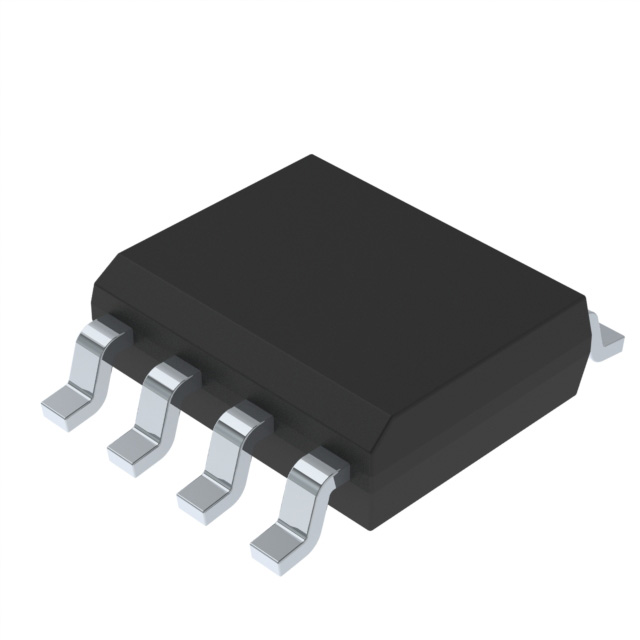
Key Specs
| Spec | Value | Condition | Source |
|---|---|---|---|
| 3db Bandwidth | 560 kHz | Digi-Key | |
| Amplifier Type | Current Sense | Digi-Key | |
| Current Input Bias | 210 µA | Digi-Key | |
| Current Output Channel | 26 mA | Digi-Key | |
| Grade | - | Digi-Key | |
| Mounting Type | Surface Mount | Digi-Key | |
| Number Of Circuits | 1 | Digi-Key | |
| Operating Temperature Range | -40°C ~ 125°C (TA) | Digi-Key | |
| Output Type | Single-Ended | Digi-Key | |
| Package Case | 8-SOIC (0.154”, 3.90mm Width) | Digi-Key | |
| Qualification | - | Digi-Key | |
| Quiescent Current (Typ) | 1.9mA | Digi-Key | |
| Slew Rate | 2V/µs | Digi-Key | |
| Supplier Device Package | 8-SO | Digi-Key | |
| Voltage Input Offset | 12 µV | Digi-Key | |
| Voltage Supply Span (Max) | 5.5 V | Digi-Key | |
| Voltage Supply Span (Min) | 2.7 V | Digi-Key |
When To Use
Use the TSC240A1IDT in current sensing applications where a bandwidth of up to 560 kHz is required, such as in power supply current monitoring or motor control feedback loops. Its low input bias current of 210 µA and single-ended output make it suitable for precision current measurement in surface mount designs with limited space, especially when operating within a supply voltage range of 2.7 V to 5.5 V and ambient temperatures from -40°C to 125°C.
When Not To Use
Do not use the TSC240A1IDT in high-frequency applications requiring bandwidths significantly above 560 kHz, such as RF signal processing, where a higher bandwidth amplifier is needed. Also avoid using it in applications demanding differential output signals or input offset voltages lower than 12 µV; in these cases, consider specialized instrumentation amplifiers or higher bandwidth current sense amplifiers designed for those specific requirements.
Application Notes
The input node of the TSC240A1IDT, which senses the current, should have the smallest possible loop area to minimize noise pickup and ensure accurate current measurement. The output pin is noise-sensitive and should be routed away from high-frequency switching nodes to avoid interference. Given the typical quiescent current of 1.9 mA and a maximum supply voltage of 5.5 V, the device does not require a heatsink under normal operating conditions up to 125°C ambient temperature.
Gotchas
-
[Offset drift with temperature overlooked]: Engineers may assume the 12 µV input offset voltage is constant, but it can drift significantly across the full -40°C to 125°C range, causing measurement errors in temperature extremes. This manifests as a slowly varying DC offset on the output during thermal cycling. Fix: characterize offset drift in your application environment and compensate in firmware or add calibration at operating temperature.
-
[Output loading exceeding 26 mA causes output saturation]: The datasheet’s maximum output current rating is often missed, leading to output stage clipping under heavy load, showing as a rail-limited output voltage and distorted sensed current waveforms. Fix: ensure external load or measurement circuitry input impedance does not draw more than 26 mA continuous.
-
[Noise coupling through input bias current]: The 210 µA input bias current flowing through high-value sense resistors creates additional voltage errors and noise susceptibility, especially if the PCB layout allows leakage currents or parasitic capacitances. This causes jitter and unstable readings at the output. Fix: minimize input resistor values consistent with power loss budgets and use guard traces connected to low impedance ground.
-
[Startup sequencing triggers output glitches]: Applying supply voltage before the input bias current path stabilizes can cause output transients or oscillations during power-up. This is especially problematic if the device is powered from supplies with slow ramp rates. Fix: sequence supply rails ensuring stable input current paths before enabling measurement, or add soft-start circuitry on the supply line.