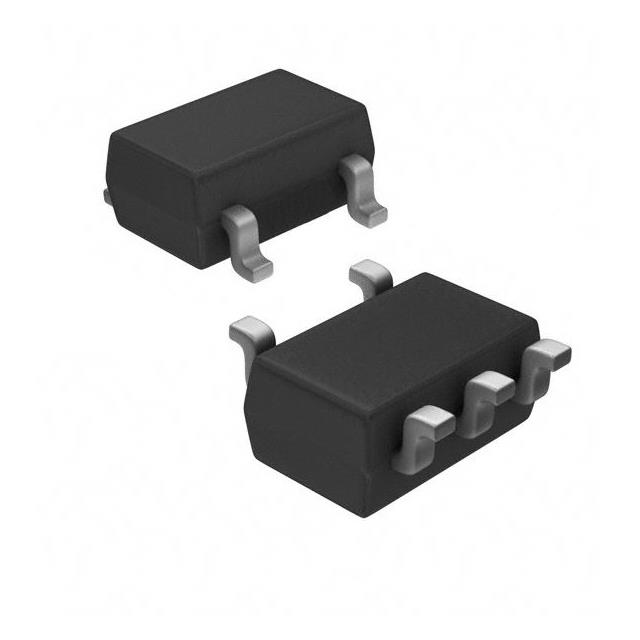
Comparison: TAR5SB33(TE85L,F) vs TCR2EF33,LM(CT) Linear Regulators
Quick verdict
For designs requiring a wider input voltage range up to 15 V and moderate quiescent current budget, the TAR5SB33(TE85L,F) is preferable due to its higher input voltage rating and integrated thermal protection. For low-power, battery-operated applications with stringent quiescent current constraints and input voltage limited to 5.5 V, the TCR2EF33,LM(CT) is the better option thanks to its extremely low 60 µA quiescent current and slightly better PSRR.
Spec comparison table
| Spec | TAR5SB33(TE85L,F) | TCR2EF33,LM(CT) | Notes |
|---|---|---|---|
| Control features | Enable | Enable | Equal — both offer enable pin for power gating. |
| Quiescent current (Iq) | 850 µA | 60 µA | TCR2EF33 has ~14x lower quiescent current, critical for battery-powered designs. |
| Maximum input voltage | 15 V | 5.5 V | TAR5SB33 supports nearly 3x higher input voltage, enabling use with less pre-regulation. |
| Mounting type | Surface Mount | Surface Mount | Equivalent in mounting; both suitable for compact PCB assembly. |
| Number of regulators | 1 | 1 | Equivalent single-output design. |
| Operating temperature range | -40°C to 85°C | -40°C to 85°C | Equivalent industrial temperature range. |
| Output configuration | Positive | Positive | Equivalent fixed positive output. |
| Output current max | 200 mA | 200 mA | Both rated for same maximum load current. |
| Output voltage min | 3.3 V | 3.3 V | Both fixed 3.3 V output variants. |
| Package / Case | SC-74A (SOT-753) | SC-74A (SOT-753) | Pin-compatible small-outline package, convenient for space-constrained layouts. |
| Protection features | Over Current, Over Temp | Over Current | TAR5SB33 adds thermal shutdown, increasing reliability under fault conditions. |
| PSRR (1 kHz) | 70 dB | 73 dB | TCR2EF33 offers marginally better noise rejection, beneficial in sensitive analog circuits. |
| Voltage dropout max | 0.2 V @ 50 mA | 0.2 V @ 150 mA | TCR2EF33 maintains dropout voltage at 0.2 V up to 3x higher current, better efficiency at load. |
| Supplier device package | SMV | SC-74A (SOT-753) | Both in small surface-mount packages (SMV and SC-74A are roughly equivalent). |
Design trade-offs
The key functional difference between the TAR5SB33(TE85L,F) and the TCR2EF33,LM(CT) lies in their input voltage range and quiescent current. The TAR5SB33’s 15 V max input voltage provides flexibility in systems where the regulator is fed from higher voltage rails or where input voltage spikes occur, reducing the need for additional pre-regulation or protection components. This can simplify power tree design at the cost of a notably higher quiescent current of 850 µA, which may be prohibitive in battery-powered or low-power standby applications.
In contrast, the TCR2EF33,LM(CT) is optimized for low quiescent current (60 µA), which significantly reduces no-load or light-load power dissipation. This makes it a better candidate when the regulator is powered from limited sources such as coin cells or primary batteries. However, its 5.5 V max input voltage limits its use to regulated or low-voltage rails only. Attempting to feed it from higher voltages risks device damage or requires additional components, increasing BOM and board complexity.
Thermally, the TAR5SB33’s integrated over-temperature protection adds a safety net in high ambient or fault conditions, preventing catastrophic failure. The TCR2EF33 lacks this feature, so external thermal management or conservative design margins are necessary. Both devices support 200 mA maximum output current, but the TCR2EF33 maintains dropout voltage at 0.2 V up to 150 mA, indicating better efficiency at moderate loads. The TAR5SB33 specifies dropout at 50 mA, so expect higher dropout voltage or losses at upper current range.
From a layout perspective, both devices come in SC-74A (SOT-753) packages, facilitating compact PCB real estate. The enable pin on both devices allows firmware or hardware power gating, but the higher quiescent current of the TAR5SB33 means gating gains are less pronounced. The PSRR difference (70 dB vs 73 dB at 1 kHz) is marginal but could matter in sensitive analog front-ends or RF systems.
Cost-wise, the TAR5SB33’s higher voltage rating and thermal protection typically translate into a higher unit cost, though volume pricing should be verified. The TCR2EF33, with its lower power dissipation and simpler protection, may be more cost-effective in high-volume, low-voltage applications.
Use-case fit
Choose TAR5SB33(TE85L,F) when…
- Input voltage rails up to 15 V are present, eliminating the need for additional pre-regulation.
- Thermal protection is required to prevent damage from overload or ambient temperature spikes.
- The design can tolerate 850 µA quiescent current, such as in mains-powered or always-on systems.
- Load currents are modest (<200 mA) but may experience voltage spikes or transients on input.
- PCB space is limited, and a single-chip solution with integrated protections reduces component count.
Choose TCR2EF33,LM(CT) when…
- The system voltage is limited to 5.5 V or less, such as USB-powered or regulated battery systems.
- Low quiescent current (<100 µA) is critical, e.g., in battery-operated or energy-harvesting devices.
- Dropout voltage performance at moderate loads (up to 150 mA) impacts efficiency and battery life.
- Slightly better PSRR (~3 dB improvement at 1 kHz) improves noise-sensitive analog or RF front ends.
- Thermal shutdown is not mandatory; the design implements external thermal management or conservative margins.
Drop-in compatibility
Both devices share the SC-74A (SOT-753) package and provide a single fixed 3.3 V output with an enable pin, suggesting similar pinouts. However, without explicit datasheet confirmation of pin-to-pin compatibility, one should not assume direct drop-in interchangeability. The different maximum input voltage ratings and protection features mean that upstream design considerations (input voltage source, thermal environment) must be reassessed before substitution.
If substituting TCR2EF33 for TAR5SB33, ensure the input voltage never exceeds 5.5 V to avoid device failure. Conversely, replacing TCR2EF33 with TAR5SB33 may increase quiescent current and require verifying thermal management due to higher power dissipation. Confirm pin assignments and functionality from both datasheets before swapping to avoid layout or functional errors.
Alternatives to consider
- MIC5205-3.3YM5-TR (Microchip): Low dropout regulator with 150 mA max current, ultra-low quiescent current (~70 µA), suitable for battery-powered designs with moderate current needs.
- TLV70033 (Texas Instruments): 3.3 V fixed output, 150 mA LDO with low quiescent current and robust thermal protection, good for portable device regulation.
- NCP1117ST33T3G (ON Semiconductor): 3.3 V fixed output LDO supporting up to 1 A, suitable for higher current applications but with higher dropout voltage and quiescent current.
This comparison should help engineers select the regulator best suited to their power budget, voltage environment, and thermal constraints.