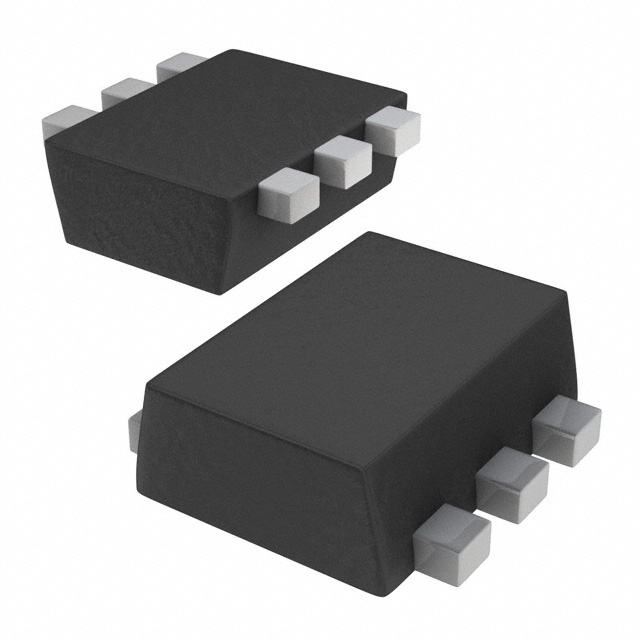
SSM6N815R,LF vs SSM6N58NU,LF MOSFET Arrays: A Technical Comparison
Quick verdict
For low-voltage, higher-current switching applications where gate drive voltage is limited and footprint constraints are tight, the SSM6N58NU,LF is the better choice due to its 1.8V logic-level drive and lower Rds(on). For designs requiring 100V blocking capability with moderate current (2A) and power dissipation, the SSM6N815R,LF is preferable thanks to its higher voltage rating and higher power dissipation, despite a higher gate charge and Rds(on).
Spec comparison table
| Spec | SSM6N815R,LF | SSM6N58NU,LF | Notes |
|---|---|---|---|
| Configuration | 2 N-Channel (Dual) | 2 N-Channel (Dual) | Equivalent |
| Continuous Drain Current (Id @ 25°C) | 2A (Ta) | 4A | SSM6N58NU supports double the current; better for higher current applications |
| Drain-Source Voltage (Vds max) | 100V | 30V | SSM6N815R supports higher voltage; essential for applications >30V |
| Max Power Dissipation (Ta) | 1.8W | 1W | SSM6N815R can dissipate nearly twice the power; better thermal margin |
| Rds(on) max @ Id, Vgs | 103mΩ @ 2A, 10V | 84mΩ @ 2A, 4.5V | SSM6N58NU has lower Rds(on) at lower gate drive voltage; better conduction efficiency |
| Gate Threshold Voltage (Vgs_th max) | 2.5V @ 100µA | 1V @ 1mA | SSM6N58NU turns on at lower gate voltage, suitable for 1.8V logic |
| Gate Charge (Qg max @ 4.5V) | 3.1nC | 1.8nC | SSM6N58NU requires less gate charge, reducing switching losses and gate driver load |
| Input Capacitance (Ciss max @ 15V) | 290pF | 129pF | SSM6N58NU has significantly lower input capacitance, improving switching speed |
| Operating Temperature Range | - to 150°C (Ta) | - to 150°C (TJ) | Both rated to 150°C; SSM6N58NU rating is junction temperature, may allow better thermal design |
| Package Type | 6-TSOP-F (Surface Mount) | 6-UDFN (2x2) (Surface Mount) | SSM6N58NU is smaller and has exposed pad for better thermal performance |
| Mounting Type | Surface Mount | Surface Mount | Equivalent |
| Technology | MOSFET (Metal Oxide) | MOSFET (Metal Oxide) | Equivalent |
Design trade-offs
The SSM6N815R,LF is designed for applications requiring up to 100V blocking voltage and 2A continuous current, with a power dissipation capacity of 1.8W at ambient temperature. This makes it suitable for low-to-mid current loads operating at higher voltages, such as industrial control signals, automotive subsystems, or power rails above 30V. However, its higher Rds(on) of 103mΩ at 10V gate drive and larger gate charge (3.1nC) mean switching losses and conduction losses are higher, impacting efficiency and thermal management.
In contrast, the SSM6N58NU,LF targets low-voltage (30V max), higher-current (4A) applications where low gate drive voltage (1.8V logic level) and minimal switching losses are critical. Its significantly lower Rds(on) of 84mΩ at 4.5V and lower gate charge (1.8nC) reduce conduction and switching losses, improving efficiency especially in battery-powered or low-voltage DC-DC converter circuits. The smaller 6-UDFN package with exposed pad helps with heat dissipation but requires careful PCB layout to leverage thermal vias and exposed pad soldering for optimal thermal performance.
Gate drive requirements differ notably: the SSM6N815R needs at least 4V logic-level drive to fully turn on, with threshold at 2.5V, limiting its use in low-voltage logic environments. The SSM6N58NU has a gate threshold of 1V and is optimized for 1.8V drive, making it more suitable for modern low-voltage microcontrollers or SoCs. The lower input capacitance and gate charge also reduce gate driver power dissipation and EMI concerns.
Thermal considerations favor the SSM6N815R for higher voltage and power dissipation, but its larger gate charge implies larger gate driver currents and potentially slower switching if gate drive strength is limited. The SSM6N58NU trades off voltage rating for better switching performance and higher current capacity, but its 1W power dissipation rating limits use in high-power environments. Cost at volume will depend on package and die size; the smaller 6-UDFN package of the SSM6N58NU may reduce PCB area and BOM cost, but exact price differences require vendor quotes.
Use-case fit
Choose SSM6N815R,LF when…
- You need to switch or control loads operating at voltages up to 100V, e.g., industrial sensor interface, relay drivers, or automotive 12/24V systems with voltage spikes.
- The continuous current requirement does not exceed 2A, and power dissipation up to 1.8W can be managed through PCB thermal design.
- Your gate drive voltage is at least 4V, typically 5V logic or higher, and you can afford the somewhat higher gate charge and switching losses.
- You require a dual MOSFET array in a 6-TSOP-F package for a mid-sized footprint and moderate thermal dissipation.
- Your application can tolerate a higher Rds(on) (103mΩ at 10V gate drive) in exchange for higher voltage blocking capability.
Choose SSM6N58NU,LF when…
- Your application voltage is 30V or below, such as USB power switches, battery-powered devices, or low-voltage DC-DC converters.
- You need to handle continuous currents up to 4A with limited thermal dissipation (1W max), requiring a low Rds(on) (84mΩ at 4.5V) for efficiency.
- Gate drive voltage is limited to 1.8–4.5V, e.g., directly driven by low-voltage microcontrollers or SoCs without level shifting.
- You want a compact 6-UDFN package with exposed pad for tight layout and improved thermal performance.
- Minimizing gate charge (1.8nC) and input capacitance (129pF) is critical to reduce switching losses and improve dynamic performance.
Drop-in compatibility
The two parts are not pin-compatible or footprint-compatible. The SSM6N815R,LF comes in a 6-TSOP-F package with flat leads, while the SSM6N58NU,LF is in a smaller 6-UDFN (2x2mm) package with an exposed pad. Their pinouts and thermal pad requirements differ, meaning a PCB designed for one cannot accept the other without layout changes. Gate drive voltage differences and electrical characteristics also preclude direct substitution without reviewing gate drive circuitry and thermal design.
Alternatives to consider
- Si2302DS (Vishay): A low-voltage logic-level MOSFET with low Rds(on) and small package, suitable for 30V, low-current applications.
- BSS138 (ON Semiconductor): A popular small-signal MOSFET with good gate drive characteristics for low current switching below 50V.
- IRLML6344 (Infineon): Logic-level MOSFET optimized for 20V–30V applications with very low gate charge and Rds(on), suitable for high-efficiency switching.
Each alternative offers varying trade-offs in voltage, current, and gate drive voltage that may better fit your specific application constraints.