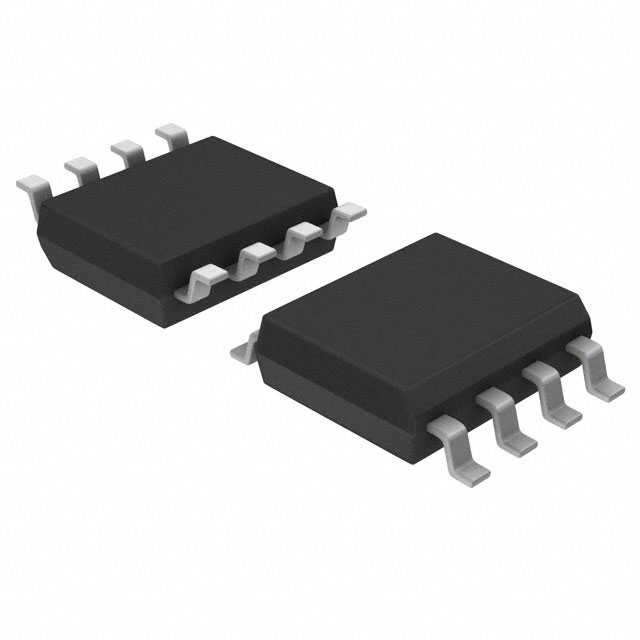
Key Specs
| Spec | Value | Condition | Source |
|---|---|---|---|
| Control Features | Enable | Digi-Key | |
| Current Quiescent IQ | 8 µA | Digi-Key | |
| Current Supply (Max) | 30 mA | Digi-Key | |
| Input Voltage (Max) | 16V | Digi-Key | |
| Mounting Type | Surface Mount | Digi-Key | |
| Number Of Regulators | 1 | Digi-Key | |
| Operating Temperature Range | -40°C ~ 125°C | Digi-Key | |
| Output Configuration | Positive | Digi-Key | |
| Output Current (Max) | 500mA | Digi-Key | |
| Output Type | Fixed | Digi-Key | |
| Output Voltage (Max) | - | Digi-Key | |
| Output Voltage (Min) | 3.3V | Digi-Key | |
| Package Case | 8-SOIC (0.154”, 3.90mm Width) | Digi-Key | |
| Protection Features | Over Current, Over Temperature, Reverse Polarity | Digi-Key | |
| Psrr | - | Digi-Key | |
| Supplier Device Package | 8-SOIC | Digi-Key | |
| Voltage Dropout (Max) | 0.7V @ 500mA | Digi-Key |
When To Use
-
12V automotive input → 3.3V @ 400mA: The 16V max input rating covers 12V automotive rails with margin for load-dump transients. The internal over-temperature and reverse polarity protection prevent destructive failure modes common in automotive environments, where simpler LDOs risk thermal runaway or latch-up.
-
Battery-powered industrial sensor → 3.3V @ 100mA: The ultra-low quiescent current of 8 µA minimizes battery drain during standby, extending runtime. A switching regulator would introduce switching noise and complexity, and a standard LDO without reverse polarity protection risks permanent damage if the battery is inserted backward.
-
3.3V fixed rail post-switching converter → 3.3V @ 500mA: The fixed 3.3V output and 0.7V dropout voltage at full load make this part ideal as a post-regulator to clean up noisy switching supplies. Using a buck converter here risks output voltage ripple and requires complex filtering, while a linear regulator with higher dropout would drop out under load.
When Not To Use
-
3.3V rail needing > 500mA load: Output current max of 500mA is insufficient for higher load applications. Use a high-current synchronous buck with external FETs to handle the current and maintain efficiency.
-
Battery-powered sensor with sleep currents < 1 µA: Quiescent current of 8 µA is too high for ultra-low power designs where sleep current dominates. Use a low-IQ PFM buck for better battery life in µA-range loads.
-
Input voltage near output voltage with noise-sensitive analog blocks: The dropout voltage of 0.7V at full load is too high when input/output differential is <1V and noise is critical. Use an LDO regulator with low dropout and better noise performance instead.
Application Notes
-
The Enable pin (active high) must be driven cleanly; slow or noisy enable signals can cause erratic startup or oscillation. Avoid floating this pin.
-
The package is 8-SOIC; thermal relief on the exposed pad is minimal, so use a solid copper area connected to the GND pin to help dissipate heat.
-
Reverse polarity protection is internal; however, verify that the input capacitor is rated for the maximum input voltage and polarity to avoid damage.
-
The output capacitor must have low ESR and sufficient capacitance to ensure stability and transient response; ceramic capacitors near the device pins are recommended.
-
No switching node (SW) pin is present as this is a linear regulator; routing should minimize noise pick-up on the feedback and enable pins.
Gotchas
-
[Ignoring input voltage transient spikes]: The absolute max input voltage is 16V, but transient spikes above this during load dump or switching events can cause device latch-up or permanent damage. Scope the input rail during worst-case conditions and include sufficient input transient suppression (e.g., TVS diode or bulk capacitor).
-
[Output capacitor ESR too high]: Using electrolytic capacitors with high ESR at the output causes instability and oscillations, leading to output voltage ripple and possible thermal stress. Use low-ESR ceramic capacitors as close as possible to the output pin.
-
[Floating Enable pin at startup]: If the enable pin is left floating, the device may randomly enable or disable during power-up, causing intermittent output voltage and system resets. Tie enable explicitly to logic or GND with a pull resistor.
-
[Assuming dropout voltage is constant]: The 0.7V dropout voltage is specified at 500mA load; at lower currents, dropout voltage decreases but may still be significant. Designing with input voltage near output + dropout can cause the regulator to drop out under load, leading to undervoltage on the output. Measure dropout under expected load conditions rather than relying on typical values.