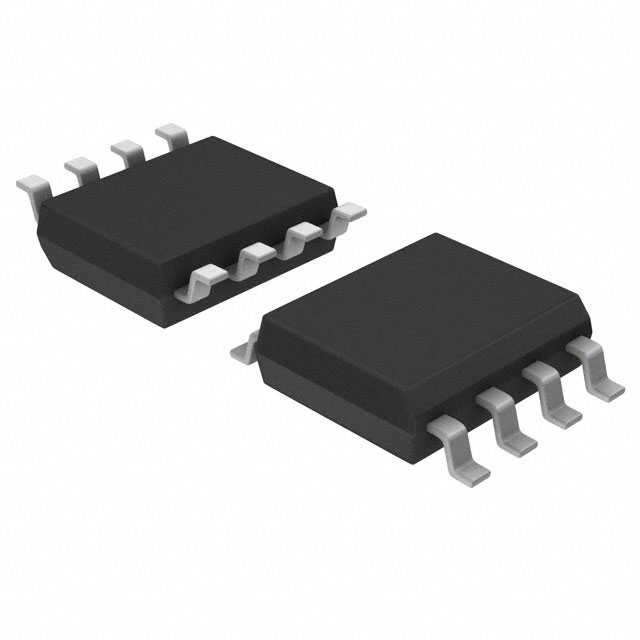
Key Specs
| Spec | Value | Condition | Source |
|---|---|---|---|
| Control Features | Enable | Digi-Key | |
| Current Quiescent IQ | 8 µA | Digi-Key | |
| Current Supply (Max) | 30 mA | Digi-Key | |
| Input Voltage (Max) | 16V | Digi-Key | |
| Mounting Type | Surface Mount | Digi-Key | |
| Number Of Regulators | 1 | Digi-Key | |
| Operating Temperature Range | -40°C ~ 125°C | Digi-Key | |
| Output Configuration | Positive | Digi-Key | |
| Output Current (Max) | 500mA | Digi-Key | |
| Output Type | Fixed | Digi-Key | |
| Output Voltage (Max) | - | Digi-Key | |
| Output Voltage (Min) | 2.5V | Digi-Key | |
| Package Case | 8-SOIC (0.154”, 3.90mm Width) | Digi-Key | |
| Protection Features | Over Current, Over Temperature, Reverse Polarity | Digi-Key | |
| Psrr | - | Digi-Key | |
| Supplier Device Package | 8-SOIC | Digi-Key | |
| Voltage Dropout (Max) | 0.7V @ 500mA | Digi-Key |
When To Use
Use the SPX3819S-L-2-5/TR in applications requiring a low dropout, fixed positive voltage regulator with an output current up to 500mA and low quiescent current (typical 90µA). It is ideal for battery-powered devices or portable electronics where low quiescent current and precise output voltage tolerance (+1% typical) are critical. The device’s overcurrent and overtemperature protection features make it suitable for robust embedded systems.
Do not use this regulator in applications requiring output currents exceeding 500mA or input voltages above 16V. For higher current loads, consider a regulator with a higher output current rating. For applications needing adjustable output voltage or lower dropout voltage at higher currents, select a different regulator optimized for those parameters.
When Not To Use
-
Load current above 500mA continuous: The max output current is 500mA, so designs needing >500mA should use a high-current synchronous buck with external FETs to handle higher current and maintain efficiency.
-
Battery-powered sensor needing ultra-low quiescent current in sleep: The typical quiescent current is 90µA (max 900µA), which is too high for μA-range sleep power budgets. Use a low-IQ PFM buck regulator optimized for minimal sleep-mode current.
-
Applications requiring switching frequency > 500kHz: This linear regulator cannot switch and thus cannot meet high-frequency switching demands for small inductors or fast transient response. Use a high-frequency buck controller for switching frequencies above 500kHz.
Application Notes
The input pin switches and should have the smallest possible loop area with the input bypass capacitor (minimum 10nF) placed as close as possible to minimize noise and voltage spikes. The bypass pin is noise-sensitive; therefore, the 10nF bypass capacitor must be connected directly to this pin to reduce output noise and improve transient response.
Although the SPX3819S-L-2-5/TR features internal thermal protection and power dissipation is internally limited, a heatsink or adequate PCB copper area is recommended when operating near the maximum junction temperature of +125°C and with high ambient temperature (up to 85°C) to ensure reliable operation and prevent thermal shutdown. Use the power dissipation formula (TJ(max) - TA)/θJA to estimate maximum power dissipation capability based on the chosen package and PCB thermal design.
Gotchas
-
[Insufficient output capacitance for stability]: Designers may assume any 1µF ceramic cap is sufficient, ignoring ESR and capacitance derating at temperature. Result: regulator oscillations seen as output voltage ripple or ringing on scope, which can cause intermittent reset or noise coupling. Fix: bench test with the recommended 1µF tantalum or a high-quality electrolytic with appropriate ESR; verify stable startup under worst-case load.
-
[Enable pin floating or slow transitions]: Leaving the enable pin unconnected or driven by a slow-rising signal near the 0.4V–2.0V threshold causes partial conduction and elevated quiescent current, leading to higher power dissipation and unstable startup. Fix: tie enable to a defined logic rail or use a dedicated buffer to guarantee clean transitions beyond thresholds.
-
[Output noise impact when BYP capacitor omitted]: Omitting the 10nF BYP capacitor reduces start-up delay but significantly increases output noise, which may degrade ADC or RF front-end performance. This noise is not reflected in static specs and can appear only under dynamic load. Fix: always fit the BYP capacitor for sensitive analog loads; measure output noise with a spectrum analyzer.
-
[Thermal derating at high ambient ignored]: Designers sometimes assume max load current at 85°C ambient without recalculating junction temperature. With θJA at 128.4°C/W (8-SOIC), power dissipation causes TJ to approach 125°C limit, triggering thermal shutdown or premature aging. Fix: verify power dissipation and junction temperature for worst-case ambient and cooling; reduce load or add heatsinking as needed.